

There’s a growing wave of concern around toxic materials in everyday cookware and drinkware. People are searching for “lead-free glass” more than ever — worried about chemical leaching from heated containers and the long-term effects of heavy metal contamination.
Does borosilicate glass contain lead? It’s a fair and important question. Borosilicate glass is widely used in kitchenware, baby bottles, laboratory equipment, coffee makers, and food storage containers, so getting the answer right matters.
The short version: authentic, high-quality borosilicate glass is generally lead-free. But product quality, manufacturing standards, and counterfeit products all play a role. This article breaks down exactly what you need to know before buying.
Written by Sarah Emirone | Reviewed by James Daniels, B.Sc, Inorganic Chemist & Materials Researcher | Updated September 2026 | See How We Test | Filed under: Material Safety & Lead Testing
What Is Borosilicate Glass?
Borosilicate glass is a specialty glass engineered for superior thermal and chemical performance. Unlike standard soda-lime glass, it’s formulated with a higher concentration of boron trioxide, which fundamentally changes how it responds to heat and chemical exposure.
It’s the go-to material wherever precision and stability matter, from hospital labs to high-end kitchenware.
What Is Borosilicate Glass Made Of?
The glass composition of borosilicate is primarily silica (silicon dioxide) — usually around 80% — combined with approximately 13% boron trioxide, plus small amounts of mineral additives like sodium oxide and aluminum oxide.
That boron trioxide is the defining ingredient. It lowers the thermal expansion coefficient of the glass, which is what gives borosilicate its signature heat resistance and low thermal expansion properties.
Why Borosilicate Glass Is Different From Regular Glass
Compared to standard soda-lime glass, borosilicate performs in a different league. It handles sudden temperature changes without cracking, which is thermal shock resistance.
It’s more chemically resistant, meaning acids and household substances are far less likely to degrade it. It’s also more durable over time.
Soda-lime glass is fine for wine glasses and windows, but for anything involving heat, borosilicate is the more reliable choice.
Common Products Made With Borosilicate Glass
You’ll find borosilicate glass in oven-safe glass bakeware, glass food storage containers, tea kettles, coffee carafes, French presses, double-wall drinkware, and lab beakers.
Pyrex is the most recognized brand built on borosilicate chemistry. Its combination of heat resistance, optical clarity, and chemical stability makes it the standard material in both kitchen and scientific settings.
Does Borosilicate Glass Actually Contain Lead?
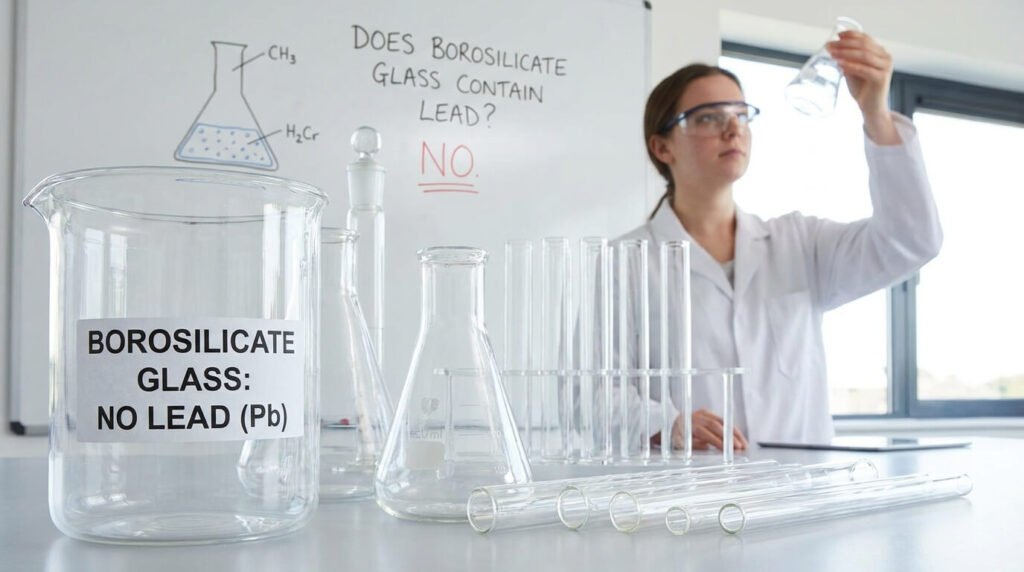
Most genuine borosilicate glass does NOT intentionally contain lead. Lead oxide is not part of the standard borosilicate glass composition.
The material is formulated around silica and boron trioxide: there’s simply no manufacturing reason to add lead compounds to a glass that already achieves its performance goals without them. For food contact safety and consumer safety, this matters enormously.
Why Lead Is Usually Not Used in Borosilicate Glass
Lead oxide was historically added to crystal glass to increase its refractive index, making it sparkle more brilliantly. Borosilicate glass doesn’t need that. Its heat resistance, durability, and structural properties come entirely from the silica-boron trioxide chemistry.
There’s no functional reason to introduce lead into the manufacturing process, which is why reputable manufacturers simply don’t.
Can Some Borosilicate Glass Products Still Test Positive for Lead?
Yes, and this is where consumer awareness becomes critical. Decorative paints or external coatings on glassware sometimes contain lead compounds. Cheap imports and counterfeit labeling are also real concerns.
A product marketed as “borosilicate” may not meet genuine glass purity standards if it’s produced in a facility with poor quality assurance. Low-quality manufacturing can introduce contaminants that aren’t part of the legitimate borosilicate glass composition.
Difference Between Lead-Free Glass and Lead Crystal
This is a common source of confusion. Here’s a clear comparison:
| Glass Type | Contains Lead? | Best Use |
| Borosilicate Glass | No (when authentic) | Cookware, lab equipment, drinkware |
| Soda-Lime Glass | Generally No | Everyday glassware, windows |
| Lead Crystal | Yes — intentionally | Decorative tableware, luxury stemware |
Why Are People Concerned About Lead in Glass?
What Is Lead and Why Is It Dangerous?
Lead is a heavy metal with no safe level of exposure in humans. Its toxicity is well-documented; even low-level exposure causes neurotoxicity, particularly in children, where it impairs brain function and development.
Long-term exposure is linked to organ damage, cardiovascular issues, and reproductive harm.
Lead poisoning doesn’t announce itself immediately, which is exactly what makes it dangerous in everyday household products.
How Lead Can Enter Food or Drinks
The main concern is leaching lead migrating from the glass surface into whatever food or liquid it contacts.
Heat accelerates this process, and acidic beverages like coffee, juice, and wine are particularly effective at drawing out heavy metals.
This is why food contact safety regulations focus heavily on what materials are allowed to touch heated or acidic food and drink.
Which Types of Glass Commonly Contain Lead?
Lead crystal glassware is the most well-known example; it’s intentionally formulated with lead oxide for brilliance. Decorative vintage glass and antique cookware are also common culprits, as older manufacturing standards were far more permissive.
If you’re using inherited glassware or picking up vintage pieces, it’s worth testing them. Modern borosilicate glass from reputable manufacturers is a very different situation.
Is Borosilicate Glass Safe for Food and Drink Use?
Is Borosilicate Glass Non-Toxic?
Yes — authentic borosilicate glass is considered a non-toxic cookware material. Its chemical stability means it doesn’t react with food or beverages under normal use conditions.
The silica-boron structure is inert: it doesn’t break down, doesn’t release compounds into food, and doesn’t absorb flavors or odors. That’s a meaningful advantage over some plastics and lower-grade materials.
Does Borosilicate Glass Leach Chemicals?
Under normal use conditions, borosilicate glass does not leach chemicals. Its heat stability and resistance to chemical reactions are among its defining properties.
The material maintains integrity across a wide temperature range without releasing compounds. This is precisely why it’s the standard choice for laboratory glassware where chemical contamination of samples would be catastrophic.
Is Borosilicate Glass Safe for Hot Liquids?
Absolutely. Borosilicate glass is designed for exactly this. Hot tea, coffee, and oven use are all well within its capabilities. The low thermal expansion means it handles the heat without structural stress.
Just stay within the manufacturer’s rated temperature range and avoid extreme transitions like moving a dish directly from a freezer to a hot oven, and it’s a highly reliable material for hot liquid applications.
Is It Safe for Babies and Children?
This is a common and completely legitimate concern. High-quality borosilicate glass baby bottles are considered safe; they’re lead-free, BPA-free, and don’t leach chemicals.
For food storage containers used with children’s food, borosilicate glass is generally one of the safer choices available. Always verify FDA compliance and food-grade labeling before buying baby-specific products.
How to Tell if Glassware Is Truly Lead-Free
Check Manufacturer Certifications
Look for FDA compliance, EU food safety standards, and food-grade material labeling. Reputable manufacturers will make this information accessible — on the packaging, on their website, or both.
Lead-free certification from a recognized safety testing lab is the strongest signal that a product has actually been tested, not just labeled optimistically.
Look for Borosilicate Glass Labels
Terms like “high borosilicate” and “lab-grade borosilicate” indicate a higher standard of glass purity.
These labels suggest the product meets the composition standards expected of genuine borosilicate glass — not a cheap substitute. Brand reputation matters here, too.
Established names like Pyrex have decades of product testing behind them.
Avoid Suspiciously Cheap Products
If a borosilicate glass set is priced dramatically lower than comparable products, that’s a signal worth taking seriously. Manufacturing shortcuts, fake labeling, and counterfeit products are real problems in the glassware market.
Authentic borosilicate production requires higher furnace temperatures and more precise quality control — that has a cost, and products priced well below market rate may not be meeting those standards.
Can You Test Glass for Lead at Home?
Yes, lead testing kits are available and relatively affordable. They use a chemical swab that changes color in the presence of lead compounds.
However, DIY testing has limitations; it detects surface lead but may not identify lead within the glass structure itself.
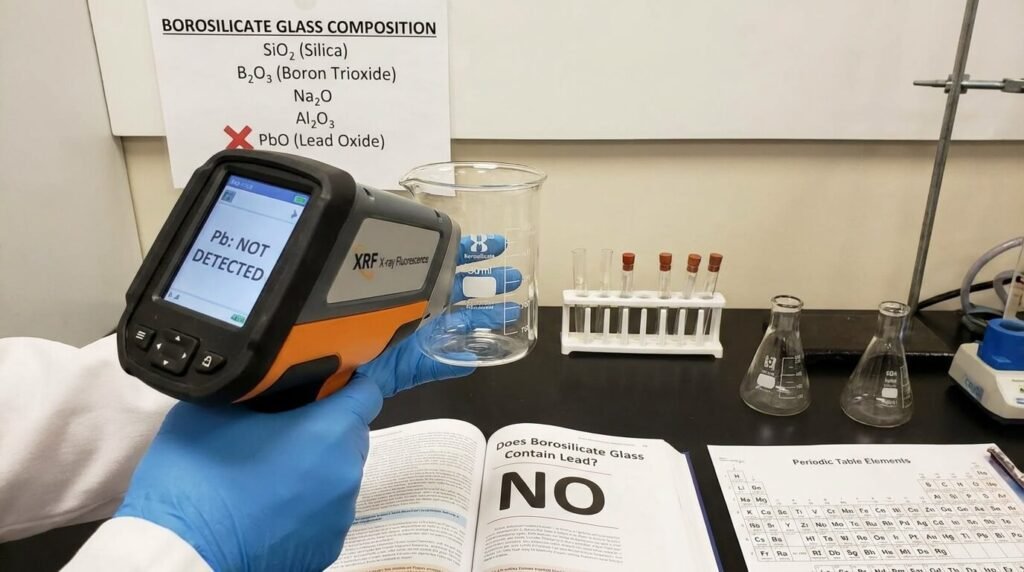
For definitive results, laboratory analysis using spectroscopy or XRF analysis is the gold standard. Heavy metal testing through a certified lab gives you the most reliable answer.
Borosilicate Glass vs Other Types of Glass
Borosilicate Glass vs Soda-Lime Glass
Soda-lime glass is the most common glass in everyday products. It’s cheaper to manufacture and generally lead-free, but it has significantly lower heat resistance and thermal shock resistance compared to borosilicate.
It’s fine for cold storage and room-temperature use, but it’s not a safe choice for oven or stovetop applications where borosilicate glass genuinely excels.
Borosilicate Glass vs Tempered Glass
Tempered glass is processed for impact resistance — it’s the safety glass used in car windows and shower screens. It handles physical impact better than borosilicate in everyday drop scenarios, and it breaks into blunt pebbles rather than sharp shards.
But it has lower thermal shock resistance. For cookware and lab use, borosilicate wins; for impact-prone environments, tempered glass has an edge.
Borosilicate Glass vs Lead Crystal
Lead crystal intentionally contains lead oxide, which is what creates its distinctive brilliance and heavy feel. It’s purely decorative and absolutely should not be used for food or beverage storage, especially with acidic drinks or heat.
Borosilicate glass is the opposite: engineered for safety and performance, not aesthetics. These two materials are not interchangeable, and the safety profiles couldn’t be more different.
Which Type of Glass Is Safest for Everyday Use?
For everyday cooking, food storage, and drinking, high-quality borosilicate glass is the safest glass option. It’s lead-free, chemically inert, heat-resistant, and dishwasher safe.
Soda-lime glass is acceptable for cold and room-temperature use. Lead crystal should be reserved for display only. If you want healthy kitchenware that performs safely across a range of temperatures, borosilicate is the clear answer.
For a full breakdown, see the cons of borosilicate glass to understand any trade-offs before buying.
What Safety Standards Regulate Lead in Glassware?
FDA Regulations on Lead in Glass
The FDA sets action levels for lead in food-contact materials. Glassware sold in the US must comply with these standards to be legally marketed as food-safe.
The Consumer Product Safety Commission also monitors hazardous products. Manufacturers producing cookware and drinkware for the US market are required to demonstrate that their products meet these thresholds through product testing.
European Union Lead Safety Standards
The EU applies some of the world’s strictest regulations on heavy metals in consumer products. EU Directive 84/500/EEC sets specific migration limits for lead and cadmium in ceramic and glass food-contact materials.
Products imported into the EU for food use must meet these standards — which is why EU-compliant labeling is a reliable quality signal even for consumers outside Europe.
California Prop 65 and Glass Products
California’s Proposition 65 requires businesses to warn consumers about significant exposures to chemicals that cause cancer, birth defects, or reproductive harm — including lead.
Products sold in California that contain lead above defined thresholds must carry a warning label. Absence of a Prop 65 warning on glassware sold in California is a meaningful indicator that lead levels are within safe limits.
How Manufacturers Test for Lead Content
Reputable manufacturers use laboratory analysis to verify glass purity. XRF analysis (X-ray fluorescence) is a standard non-destructive technique that identifies elemental composition, including lead content.
Spectroscopy methods provide similarly detailed breakdowns. ISO certification and third-party quality assurance testing are the benchmarks that distinguish genuinely safe products from unverified ones.
Benefits of Borosilicate Glass Beyond Being Lead-Free
Thermal Shock Resistance
Borosilicate glass handles rapid temperature changes that would crack ordinary glass. Moving from refrigerator to oven (with a brief room-temperature stop) is well within its capability.
That thermal shock resistance comes directly from its low thermal expansion — the glass simply doesn’t stress the way regular glass does when temperatures shift.
Durability and Longevity
Well-made borosilicate glass is durable glassware that lasts for years with proper care. It resists the gradual surface degradation that affects cheaper glass over time.
While it’s not indestructible — it will break on impact like any glass — its product durability under thermal and chemical stress is significantly better than standard alternatives.
Chemical Resistance
Its chemical resistance is why borosilicate glass is the standard in laboratory glassware worldwide. Acids, alkalis, and most household substances don’t degrade it.
That same property makes it ideal for storing acidic foods and beverages — lemon juice, tomato sauce, coffee — without any risk of the glass reacting with the contents.
Eco-Friendly and Reusable Properties
Borosilicate glass is a sustainable material. It’s reusable, long-lasting, and doesn’t leach microplastics or chemicals into the environment.
Unlike single-use plastic containers, a quality borosilicate food storage container can last for years, reducing waste. It’s also a recyclable material, though specialty glass recycling requires separate processing from standard glass.
For eco-friendly cookware, it’s one of the better options available.
Common Myths About Borosilicate Glass and Lead
“All Glass Contains Lead”
This is false. Lead crystal intentionally contains lead. Standard borosilicate glass, soda-lime glass, and tempered glass do not. The confusion comes from lumping all glass together but glass composition varies widely.
Authentic borosilicate glass is lead-free by design, and that’s been validated through decades of laboratory analysis and regulatory compliance.
“Heat Releases Lead From Any Glass”
Heat can accelerate leaching from glass that contains lead, but you can’t leach what isn’t there. If a borosilicate product is genuinely lead-free, heating it won’t release lead.
The concern about heat and leaching applies specifically to lead crystal and low-quality decorative glassware where lead compounds are present in the material or its coatings.
“Imported Glass Is Always Unsafe”
Origin alone doesn’t determine safety. Many high-quality borosilicate products are manufactured outside the US and Europe and meet rigorous international standards.
What matters is whether the manufacturer adheres to FDA compliance, EU standards, or ISO certification — not where the factory is located. That said, very cheap imports with no certifications are a legitimate risk.
“Borosilicate Glass Is Unbreakable”
It isn’t. Borosilicate glass is more thermally robust than regular glass, but it breaks on impact just like any other glass. The dangers of borosilicate glass in breakage situations are real, as it fractures into sharp shards rather than the blunt fragments of tempered glass.
Handle it with care, store it properly, and don’t confuse thermal durability with physical indestructibility.
Frequently Asked Questions (FAQ)
Is Pyrex Borosilicate Glass Lead-Free?
Authentic Pyrex borosilicate glass is lead-free. Pyrex has a long history of food-safe manufacturing and FDA compliance. Note that some Pyrex products sold in North America shifted to tempered soda-lime glass in the 1990s — if you’re using vintage Pyrex, check whether it’s the original borosilicate formulation.
Can Borosilicate Glass Go in the Microwave?
Yes. Most borosilicate glass is microwave safe. It handles the heat generated during microwave cooking without structural issues.
Avoid overheating food or liquid to the point where uneven heating creates hot spots, which create localized thermal stress that can weaken the glass over time.
Is Borosilicate Better Than Plastic?
For food storage and cooking, yes. Borosilicate glass doesn’t leach BPA or microplastics, doesn’t absorb odors, and is chemically inert. Plastic containers, especially when heated, can release chemicals into food.
For anyone concerned about safe cookware selection and chemical exposure, borosilicate glass is the more reliable choice. The borosilicate glass guide covers what to look for when switching from plastic.
Can Borosilicate Glass Break From Heat?
It can crack if subjected to temperature transitions that exceed its limits, particularly going from extreme cold directly to high heat without a room-temperature pause. Within normal use parameters, though, it handles heat reliably.
Always follow manufacturer guidelines on temperature limits.
Is Borosilicate Glass Safe for Daily Use?
Yes. High-quality borosilicate glass is safe for daily food preparation, cooking, and storage. Its non-porous surface is hygienic, it doesn’t leach chemicals, and it’s dishwasher safe. It’s a practical, long-lasting material for everyday kitchen use.
Does Colored Borosilicate Glass Contain Lead?
The base borosilicate glass itself doesn’t, but external decorative coatings or paints used to create colors sometimes do.
If you’re buying colored borosilicate drinkware or cookware, check that the manufacturer explicitly confirms the decorative finish is also lead-free and cadmium-free. Interior surfaces that contact food should always be uncoated glass.
Conclusion
Final Answer to the Main Question
Authentic borosilicate glass is lead-free. Its composition — silica, boron trioxide, and small mineral additives — simply doesn’t include lead compounds.
High-quality borosilicate products are considered safe for food and beverage use, backed by FDA compliance, EU standards, and decades of laboratory testing.
Key Safety Takeaways
Buy from trusted manufacturers with verifiable certifications. Verify food-grade labeling and lead-free status. Avoid decorative lead-painted glass or suspiciously cheap imports without any quality assurance backing.
Final Consumer Recommendation
Choose reputable borosilicate cookware and drinkware from manufacturers who prioritize tested, food-safe materials. When in doubt, verify certifications, check for Prop 65 compliance if buying in the US, and stick to established brands.
Understanding the full picture, including the dangers of borosilicate glass and its genuine strengths, helps you make a genuinely informed choice for your kitchen and your health.
About the Author & Reviewer
Sarah Emirone, Author
Sarah researches and writes SafeKitchn’s dinnerware and kitchenware guides, with a focus on material safety, lead content, and manufacturer specifications. She cross-references product data sheets, safety certifications, and regulatory filings (including FDA and Prop 65 records) before publishing, and updates articles when new information becomes available.
James Daniels, Reviewer
James reviews SafeKitchn’s material safety content for scientific accuracy. He holds a B.Sc in inorganic chemistry and works as a materials researcher, with particular focus on the composition and safety behavior of glass, ceramic, and metal used in kitchenware.