

Borosilicate glass shows up everywhere in your kitchen, your lab, and your morning coffee setup. It’s built from silica and boron trioxide, which gives it that impressive ability to handle heat without cracking.
And yes, that’s genuinely useful. But here’s the thing: the disadvantages of borosilicate glass don’t get nearly enough attention.
Most people buy it expecting something close to indestructible, and that’s where the trouble starts.
Drop it on a hard floor, scratch it with the wrong sponge, or move it straight from the freezer to the oven, and you’ll quickly discover its limits.
This guide breaks down what borosilicate glass actually struggles with so you can decide if it’s the right material for your needs.
Written by Sarah Emirone | Reviewed by James Daniels, B.Sc, Inorganic Chemist & Materials Researcher | Updated September 2026 | See How We Test | Filed under: Buying, Care & Product Guides
What Is Borosilicate Glass?
Composition of Borosilicate Glass
Borosilicate glass is made by combining silica (silicon dioxide) with boron trioxide — usually around 15% boron oxide by weight. That boron trioxide is the key ingredient.
It lowers the glass’s thermal expansion coefficient, which means the material doesn’t expand or contract much when temperatures shift.
Pyrex is probably the most well-known brand built on this chemistry. The result is a glass structure that’s more thermally stable than standard soda-lime glass, but it’s still glass — rigid, non-flexible, and prone to fracture under the right (or wrong) conditions.
Why Borosilicate Glass Is Popular
The main selling point is thermal shock resistance. Regular glass cracks when you pour boiling water into a cold container. Borosilicate glass handles transition much better because it expands less under heat stress.
It’s also chemically resistant to acids, and most household substances won’t degrade it easily. That combination of heat resistance and chemical stability is why you’ll find it in laboratories, high-end kitchenware, and specialty drinkware.
It feels premium, and for many applications, it earns that reputation.
Common Uses of Borosilicate Glass
You’ll find borosilicate glass in oven-safe bakeware, food storage containers, French presses, coffee carafes, glass teapots, and double-wall drinkware.
In scientific settings, it’s standard for beakers, test tubes, and other laboratory glassware where chemical resistance and thermal stability matter.
It’s also used in optical applications because of its clarity and consistent refractive index. Basically, anywhere precision and heat tolerance are priorities, borosilicate glass tends to show up.
Main Disadvantages of Borosilicate Glass
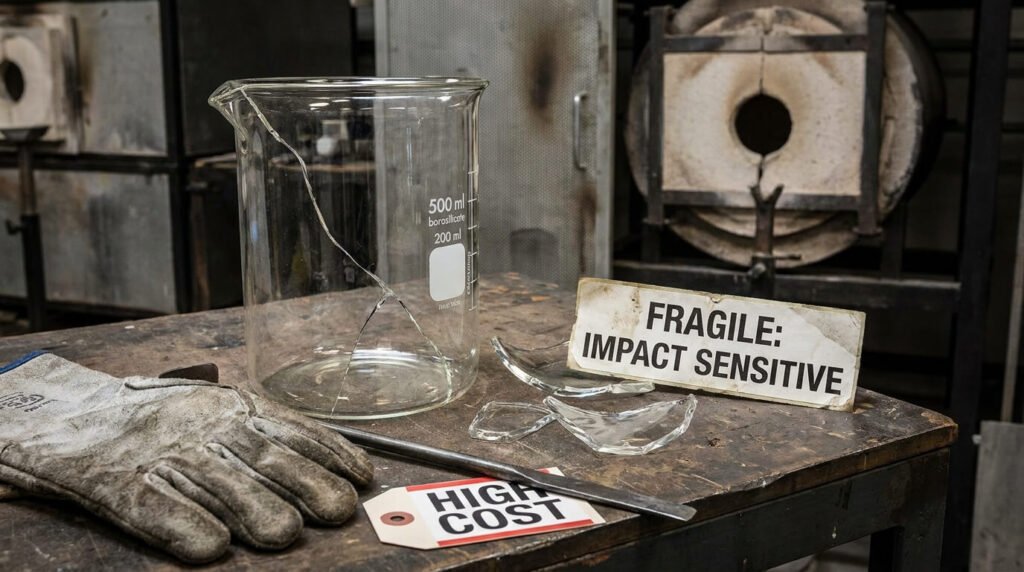
Here’s a straightforward look at all the known disadvantages of borosilicate glass. Some of these are deal-breakers depending on your situation; others are manageable if you’re careful.
Vulnerability to Impact Damage
For all its thermal strengths, borosilicate glass has limited impact resistance. It doesn’t flex, it breaks. If a glass dish slides off the counter and hits a hard floor, there’s a very real chance it shatters.
The material’s brittleness means it has almost no ability to absorb physical force. This is a serious consideration for households with kids or anyone who handles cookware frequently without a lot of caution.
Higher Cost Compared to Regular Glass
The manufacturing complexity behind borosilicate glass drives up the price significantly.
The glass furnace needs to reach higher temperatures, boron trioxide is an expensive raw material, and the annealing process requires more precision than standard glass production.
You’re paying for that engineering. A borosilicate baking dish can cost two to four times more than a comparable soda-lime glass product. And when it breaks, which it will, eventually, that replacement cost adds up.
Limited Flexibility
Glass doesn’t bend. That’s obvious, but it’s worth spelling out because it matters when you’re comparing materials. Stainless steel flexes slightly under impact. Silicone bends dramatically.
Borosilicate glass has essentially zero give. Any mechanical stress being squeezed, dropped, or knocked sideways goes straight to the structure, and if it exceeds the glass’s fracture toughness, it breaks.
That limited flexibility is a real disadvantage in high-traffic kitchens and on-the-go scenarios.
Breakage and Shattering Risks
Sudden Impact Failure
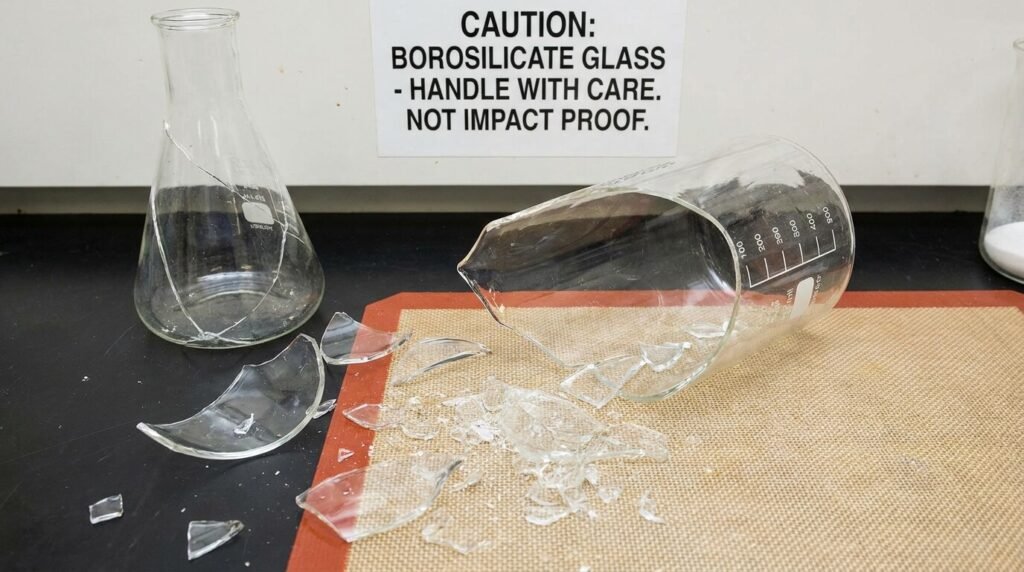
Borosilicate glass is far from shatterproof. When a glass container hits a hard surface — tile, stone, concrete — the energy from that collision has nowhere to go except through the glass structure itself.
The result is often sudden, complete breakage. The harder the surface and the higher the drop, the more catastrophic the failure. This is one area where tempered glass actually performs better in some real-world drop scenarios, despite having lower thermal resistance.
Stress Fractures Over Time
This one’s sneaky. Microfractures can develop in borosilicate glass over time through repeated heating and cooling cycles, drops that don’t quite break it, and general mechanical stress.
These tiny cracks spread gradually, weakening the glass’s structural integrity without being obviously visible. Glass fatigue is real; a dish that’s handled roughly for two years is more likely to fail than a new one, even if it looks fine.
That’s why manufacturer guidelines usually recommend replacing glassware after visible chips or impacts.
Sharp Fragmentation Risks
When borosilicate glass breaks, it doesn’t crumble into pebbles the way tempered glass does. It fractures into sharp glass shards, jagged pieces that cause serious laceration injuries.
Eye injuries from airborne glass particles are also a concern. If you’re handling broken borosilicate glassware, protective gloves and safety goggles are the right call.
Keep in mind the dangers of borosilicate glass in breakage situations: the fragments can travel further than you expect, especially on hard flooring.
Thermal Shock Limitations
Heat Resistance Does Not Mean Indestructibility
This is probably the most common misunderstanding. Borosilicate glass handles thermal shock better than regular glass — but it still has limits.
Expose it to temperatures beyond its rated threshold, or subject it to a temperature change that’s simply too extreme, and it will crack or shatter. The boron trioxide lowers thermal expansion, but it doesn’t eliminate it.
Heat stress accumulates, and eventually the glass structure gives way.
Extreme Temperature Transitions
A freezer-to-oven transition is exactly the kind of scenario that tests borosilicate glass’s limits. Moving a container from -18°C straight into a 220°C oven is a sudden temperature change that creates intense thermal stress.
Many manufacturers explicitly warn against this. Even with borosilicate’s improved tolerance, that kind of transition increases fracture risk significantly.
Let the dish come to room temperature first. It takes a few minutes and dramatically reduces the chance of cracking.
Uneven Heating Problems
Hot spot formation is another real concern, particularly in microwave ovens. If food or liquid heats unevenly — which happens frequently — certain areas of the glass experience significantly more heat stress than others.
That differential expansion across the glass surface creates internal tension.
Over time, or in one bad heating cycle, it can produce a stress fracture. Stirring food during microwave heating and avoiding overheating helps reduce this risk.
Weight and Handling Concerns
Heavier Than Some Plastic Alternatives
Glass cookware and glass containers are noticeably heavier than their plastic equivalents. A borosilicate glass baking dish loaded with food can be genuinely awkward to handle, especially for older users or anyone with limited grip strength.
For portable use — water bottles, travel containers, lunch boxes — that extra weight is a meaningful disadvantage compared to lightweight stainless steel or BPA-free plastic options.
Fragility During Transportation
Traveling with borosilicate glass products requires real care. Whether it’s packing a French press for a camping trip or shipping glass food storage containers, the breakage risk during transport is substantial.
The glass needs padding, careful positioning, and ideally a dedicated protective case. That level of preparation isn’t always practical, and for many people, it’s enough of a hassle to push them toward more durable alternatives.
Careful Handling Requirements
Borosilicate glass is simply less forgiving than metal containers. Set a stainless steel bottle down hard on a concrete floor, and it might dent.
Do the same with borosilicate glass, and it’s likely game over. That constant need for care, mindful placement, gentle handling, and deliberate storage is a real lifestyle adjustment that not everyone wants to make, especially in busy households.
Surface Scratches and Wear
Scratches From Utensils or Abrasives
Borosilicate glass isn’t scratch-proof. Using metal utensils, steel wool, or abrasive cleaners damages the surface over time. Those scratches aren’t just cosmetic; they create microscopic weak points in the glass structure.
Abrasive cleaner damage is cumulative: what starts as surface wear eventually contributes to the glass’s overall brittleness and increases the likelihood of breakage.
Stick to soft sponges and non-abrasive cleaners to protect the surface.
Cloudiness and Cosmetic Damage
Repeated dishwasher cycles can cause a cloudy, hazy appearance on borosilicate glass over time. Dishwasher wear results from the combination of hot water, harsh detergents, and mechanical agitation.
The glass technically remains functional, but the optical clarity that makes borosilicate attractive gradually diminishes. For people who care about the appearance of their drinkware or food storage containers, this is a real frustration.
Structural Weakness From Chips
Edge chipping is common with borosilicate glass, especially on dishes, plates, and containers with thin rim profiles. Each chip weakens the glass at that point, making future breakage more likely to start there.
A chipped glass isn’t just cosmetic damage; it’s a structural vulnerability. Most safety guidelines recommend discarding chipped borosilicate glass cookware rather than continuing to use it.
Cost Disadvantages
Higher Manufacturing Costs
Producing borosilicate glass is genuinely expensive. The manufacturing process requires higher furnace temperatures than standard glass production, more precise quality control, and a more complex annealing process to relieve internal stress.
That manufacturing complexity translates directly into higher prices on store shelves.
For manufacturers, it also means higher energy consumption — borosilicate glass production is energy-intensive by nature.
More Expensive Than Soda-Lime Glass
Standard soda-lime glass — the kind used in most everyday glassware — is significantly cheaper to produce and purchase.
For consumers on a budget, the price gap between a basic glass dish and a borosilicate equivalent can be hard to justify, especially if they’re not taking advantage of the thermal properties that justify the premium.
If you’re storing cold food and not doing any oven baking, you might not need borosilicate at all.
Replacement Costs After Breakage
Here’s where the cost issue compounds. Because borosilicate glass does eventually break and often breaks completely rather than chipping slightly, replacement costs hit harder than with cheaper materials.
Buying a stainless steel container once and using it for a decade looks increasingly appealing when you’ve replaced a borosilicate set twice in the same period. Long-term ownership expense is a real consideration.
Usage Limitations in Cookware
Not Always Suitable for Direct Flame
Most borosilicate glass cookware is not designed for direct flame exposure. Using a glass baking dish on a gas stove burner is a recipe for failure.
The uneven, concentrated heat from a direct flame creates localized thermal stress that the glass can’t distribute effectively.
Glass fractures quickly under that kind of direct heat. Always check the manufacturer’s guidance before using any borosilicate product on a stovetop.
Broiler and Extreme Heat Concerns
Even oven-safe borosilicate glass has temperature limits. Most products are rated up to around 230–250°C (450–480°F). A broiler can exceed 290°C (550°F), which pushes beyond what the glass can safely handle.
Overheating weakens the glass structure and dramatically increases fracture risk. If a recipe calls for broiling, move the food to a metal pan rather than relying on glass bakeware.
Compatibility Restrictions Across Appliances
Not all borosilicate glass products are rated for every appliance. Some are oven-safe but not microwave-safe; others handle microwaves fine but shouldn’t go near a stovetop.
Manufacturer usage guidelines exist for good reason; they define the tested safety limits of that specific product. Ignoring them doesn’t just risk the glass; it risks injury. Always read the product specification before using borosilicate glass in a new context.
Cleaning and Maintenance Challenges
Risk of Damage During Cleaning
Cleaning glass cookware sounds simple, but it’s one of the most common moments when damage happens. A dish that slips in a wet sink and hits the faucet hard can chip or crack.
Stacking glass items while washing increases collision risk. The maintenance requirements for borosilicate glass go beyond just cleaning — they include being deliberate about how and where you clean, dry, and set down the pieces.
Avoiding Abrasive Cleaning Tools
Steel wool, rough scrubbing pads, and harsh powdered cleansers all scratch borosilicate glass surfaces. Cleaning precautions are straightforward: use a soft sponge or cloth, mild dish soap, and warm water.
For stubborn residue, soaking works better than scrubbing aggressively. It’s not complicated, but it does require a little more intention than cleaning a stainless steel pan, which can take almost any amount of scrubbing without visible damage.
Proper Storage Requirements
Stacking borosilicate glass items — plates, bowls, containers — increases the risk of chips and cracks at the edges.
Storage precautions include using felt or silicone dividers between stacked pieces, avoiding overcrowded cabinet shelves, and keeping glass items away from edges where they can be knocked off.
The stackability risk is real: a heavy glass container tipping onto another one in a cabinet can cause both to chip even without falling.
Advantages of Borosilicate Glass
It’s only fair to balance the picture. Despite its disadvantages, borosilicate glass has genuine strengths that explain why it’s so widely used.
Best Ways to Reduce the Disadvantages
Avoid Sudden Temperature Changes
Let the borosilicate glass come to room temperature before moving it between extreme heat and cold environments.
Don’t pull a dish straight from the freezer and slide it into a hot oven. Don’t pour boiling liquid into a cold glass container. These simple habits dramatically reduce thermal stress and extend the product lifespan of your glassware.
Handle With Care
Safe handling sounds obvious, but it’s worth being specific. Use both hands on larger dishes. Dry your hands before picking up glass containers.
Place glass items on soft surfaces rather than slamming them onto hard countertops. Keep glass away from the edges of tables and counters. These aren’t complicated changes, but they make a real difference in how long borosilicate glass lasts.
Store Properly
Use silicone or felt dividers between stacked glass items. Don’t overload cabinet shelves where glass could topple. Store lids separately when possible to reduce pressure on container rims.
Storage precautions like these prevent the edge chipping and accidental collisions that are among the most common causes of borosilicate glass damage in everyday use.
Follow Manufacturer Guidelines
Safe heating and cleaning practices are spelled out in product documentation for a reason. They reflect tested limits, not conservative guesses. If the manufacturer says don’t use it under a broiler, don’t use it under a broiler.
If the label says top-rack dishwasher only, respect that.
Following manufacturer guidelines is the single most reliable way to get the maximum lifespan from borosilicate glass products while staying safe.
When Borosilicate Glass Is Still a Good Choice
Oven Baking and Heat Applications
For oven baking within the manufacturer’s rated temperature range, borosilicate glass is genuinely excellent. Its low thermal expansion means it handles the heat cycle of baking without the stress that would crack standard glass.
Casserole dishes, pie plates, and baking pans made from borosilicate glass are reliable workhorses in the kitchen when used correctly.
Chemical and Food Safety Needs
The non-porous, non-reactive surface of borosilicate glass makes it a top choice anywhere chemical and food safety matter. It doesn’t leach chemicals into food or beverages — no BPA concerns, no metallic taste, no absorption of previous contents.
For food storage containers, laboratory glassware, and high-purity applications, the chemical resistance and hygienic material quality are hard to beat.
Hot and Cold Beverage Use
Double-wall borosilicate glass drinkware handles both hot and cold beverages beautifully. It keeps hot drinks hot without burning your hand, and cold drinks cold without sweating on the outside.
The optical clarity also makes it visually appealing for serving. If you’re careful with it and don’t need portability, it’s an excellent choice.
For a deeper look at safe practices and product selection, the borosilicate glass guide covers what to look for when buying.
Common Misunderstandings About Borosilicate Glass
“Borosilicate Glass Is Unbreakable”
This is the most persistent and most dangerous misconception.
Borosilicate glass is not unbreakable — not even close. It’s more thermally resistant than standard glass, but it shatters under sufficient impact damage, breaks from thermal shock at extreme temperature differentials, and fails from accumulated stress fractures over time.
Treating it as indestructible leads directly to the kind of improper usage that causes it to fail. Understanding its actual durability limitations is the first step toward using it safely.
“Heat-Resistant Means Shockproof”
Thermal resistance and shock resistance are completely different properties. Borosilicate glass’s ability to withstand heat has nothing to do with its ability to handle physical impact.
A piece of borosilicate drinkware that handles a hot espresso without issue will still shatter if knocked off a countertop.
These are independent characteristics, and conflating them creates a false sense of security that increases kitchen accident risk.
Heat-resistant means it handles temperature changes well, nothing more.
“All Glass Cookware Is Borosilicate”
Not all glass cookware is made from borosilicate glass. Some products, particularly lower-cost options, use soda-lime glass instead, which has significantly worse thermal durability.
Interestingly, this has also affected some well-known brands: certain Pyrex products sold in North America shifted from borosilicate to tempered soda-lime glass years ago, which has confused consumers who assumed all Pyrex products were the same material.
Always check product specifications rather than assuming glass cookware material based on brand name alone.
Warning Signs That Borosilicate Glass Is Unsafe to Use
Visible Cracks and Chips
Any visible crack, no matter how small, is a signal to stop using that piece immediately.
A crack that seems minor is already a structural weakness indicator; it will propagate further under heat or stress, and the timing of that failure is unpredictable.
Edge chipping on bowls, plates, or bakeware creates the same concern. Once the glass surface has been compromised at the rim or edge, the resistance to further fracture at that point drops significantly.
There is no safe way to continue using cracked or chipped borosilicate glassware.
Cloudiness or Surface Damage
Cloudiness or surface haziness in borosilicate glass is a sign of material wear — often from repeated dishwasher damage or cleaning with abrasive cleaners that have scratched the glass surface over time.
While cloudiness itself isn’t an immediate fracture risk, it’s an indicator that the surface has been worn down and that the glass has undergone more stress than is visually obvious.
Deeply scratched or pitted glass is more vulnerable to crack initiation under thermal or mechanical stress than a smooth, undamaged surface.
Loose Handles or Structural Instability
For glass cookware with attached handles, casserole dishes, saucepots, or similar items, any looseness, wobble, or instability in the handle joint is a serious cookware safety issue.
A handle that isn’t fully secure creates mechanical stress at the joint every time the piece is lifted or moved, and if that joint fails while the dish is hot and full, the consequences can be severe.
If a handle shows any sign of coming loose, treat the item as unsafe to use with heat.
Who Should Avoid Borosilicate Glass?
Homes With Frequent Heavy Handling
If your household involves frequent dropping, rough handling, or an environment where glass cookware is regularly knocked around, borosilicate glass may not be the right material for you.
High-impact usage concerns are real; the material offers no meaningful protection against physical force, and repeated minor impacts accumulate as glass fatigue over time.
Households with young children, high-traffic kitchens, or anyone who regularly handles cookware quickly and without particular care may find that the glass breakage risk is simply too high for practical everyday use.
Users Expecting Unbreakable Cookware
If you’re buying borosilicate glass cookware or drinkware under the assumption that it won’t break, you’re going to be disappointed — and potentially injured.
Understanding material limitations before purchase is the responsible approach.
Borosilicate glass is not engineered for impact resistance, and if what you need is cookware that can survive being dropped or knocked over regularly, this isn’t the right material for your needs.
Stainless steel containers or silicone cookware would serve that use case far better.
Commercial High-Impact Environments
In commercial kitchens, catering operations, or other high-volume food service settings where durability demands are intense and the pace of use is fast, borosilicate glass is generally not the appropriate material for high-wear applications.
Restaurant tableware takes constant impacts, stacking, and rapid temperature cycles that accelerate glass fatigue and increase product failure risk significantly.
For commercial high-impact environments, restaurant-grade stainless steel, ceramic, or purpose-built commercial tableware materials offer far better durability under those conditions.
Conclusion
Borosilicate glass earns its popularity due to its thermal shock resistance, chemical stability, and food safety credentials, which are all genuinely strong. But the disadvantages are real and shouldn’t be glossed over.
It breaks on impact, costs more than alternatives, demands careful handling, and isn’t right for every user or environment. Understanding those limitations doesn’t mean avoiding borosilicate glass; it means using it where it actually excels.
If you’re an avid baker who handles cookware carefully, it’s probably a great fit.
If you’re buying water bottles for an active family or outfitting a high-volume kitchen, other materials may serve you better. Weigh the trade-offs honestly, and you’ll make a choice you won’t regret.
About the Author & Reviewer
Sarah Emirone, Author
Sarah researches and writes SafeKitchn’s dinnerware and kitchenware guides, with a focus on material safety, lead content, and manufacturer specifications. She cross-references product data sheets, safety certifications, and regulatory filings (including FDA and Prop 65 records) before publishing, and updates articles when new information becomes available.
James Daniels, Reviewer
James reviews SafeKitchn’s material safety content for scientific accuracy. He holds a B.Sc in inorganic chemistry and works as a materials researcher, with particular focus on the composition and safety behavior of glass, ceramic, and metal used in kitchenware.