

Choosing the right dinnerware often comes down to what your table actually needs day to day. When people compare Corelle versus Lenox, they’re really weighing two very different dining philosophies.
Corelle is the go-to for lightweight, durable everyday dinnerware built on Vitrelle glass technology. Lenox, on the other hand, is a premium brand known for elegant bone china and fine china that elevates formal dining and special occasions.
Both have strong reputations, but they serve different households in different ways. This guide breaks down what separates them so you can make a confident, informed choice.
Written by Sarah Emirone | Reviewed by James Daniels, B.Sc, Inorganic Chemist & Materials Researcher | Updated September 2026 | See How We Test | Filed under: Brand & Product Comparisons
Overview of Corelle Dinnerware
What Corelle Is Made Of
Corelle dinnerware is built from Vitrelle glass, a proprietary triple-layer tempered glass technology that bonds three thin layers of glass under heat and pressure.
This manufacturing process is what gives Corelle dishes their unusual combination of being thin, light, and far more durable than you’d expect from a glass-based product.
The non-porous glass surface is also BPA-free, lead-free, and cadmium-free, making it a solid food-safe material choice for everyday household use.
Corelle’s Lightweight Design
One of the most immediately noticeable things about Corelle is how light the dishes feel.
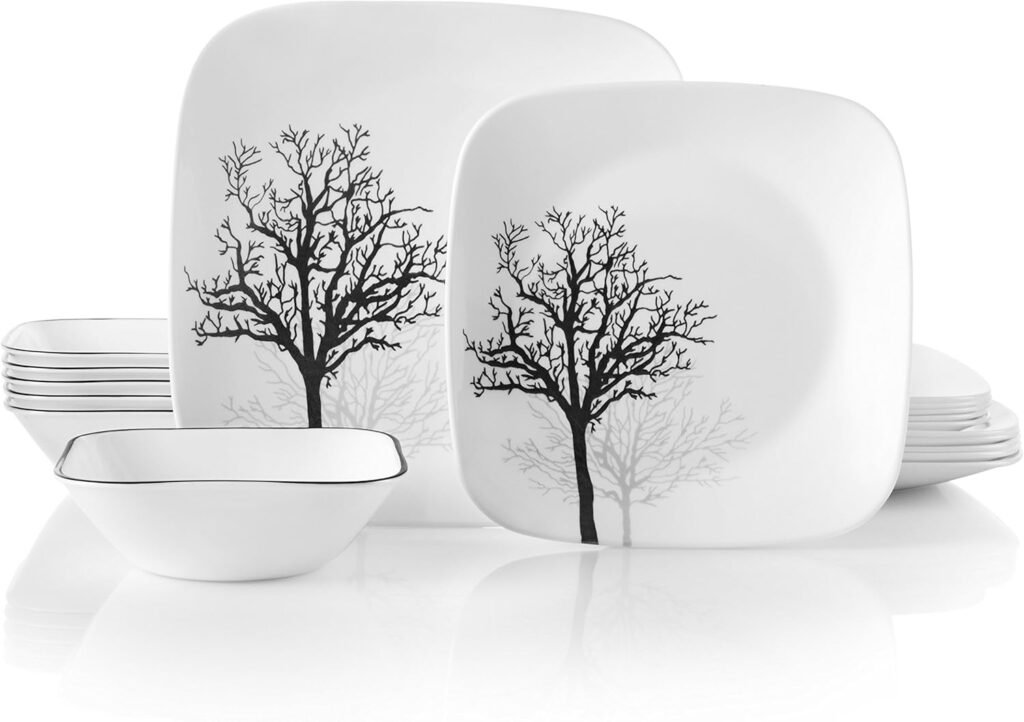
A standard Corelle dinner plate weighs significantly less than a comparable ceramic or porcelain plate, which makes a real difference during daily family kitchen use, loading the dishwasher, setting the table, or handing a bowl to a child.
The thin-profile stackable design also means a full set of plates and bowls takes up a fraction of the cabinet space compared to heavier alternatives.
Corelle’s Everyday Dining Appeal
Corelle was designed around family dining — the kind of meals that happen every day, multiple times a day, with little ceremony.
Its chip resistance, dishwasher-safe construction, and microwave-safe convenience make it a genuinely practical choice for busy households.
For a deeper look at the full range of Corelle products and collections, the complete Corelle guide is a useful resource.
Overview of Lenox Dinnerware
What Lenox Dinnerware Is Made Of
Lenox produces dinnerware in several premium materials, with bone china being the brand’s most recognized offering.
Bone china is a refined porcelain material made with bone ash mixed into the clay body, which gives it a distinctive translucent quality and a naturally white, smooth finish.
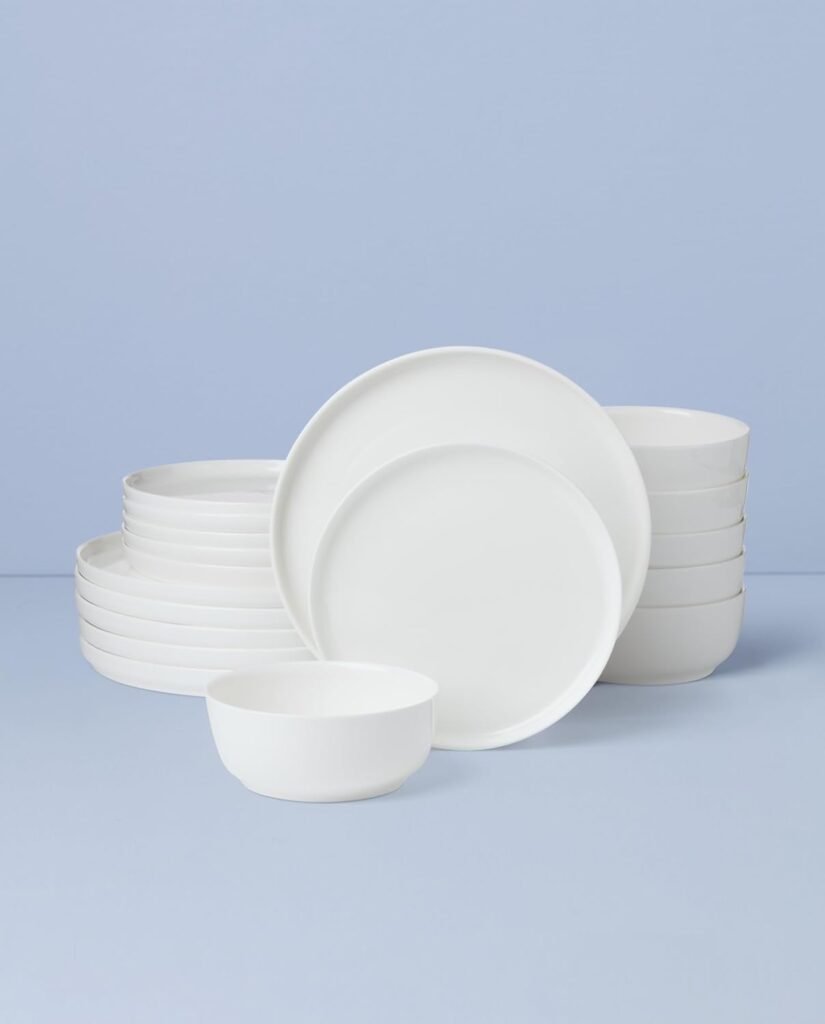
Lenox also produces fine china and porcelain dinnerware across different collections, ranging from classic formal patterns to more contemporary designs.
Lenox’s Reputation for Elegant Dining
Lenox has built its brand reputation around luxury dinnerware and elegant table settings. The brand is closely associated with gold trim and platinum trim detailing, embossed patterns, and floral pattern designs that carry a formal, refined aesthetic.
This decorative quality is a big part of what attracts buyers to Lenox, the dishes genuinely look the part when you’re setting a beautiful table for guests or a holiday meal.
Lenox in Formal and Luxury Dining
Where Corelle handles everyday routines, Lenox is built for entertaining guests and special occasions. A full Lenox place setting dinner plate, salad plate, bread plate, soup bowl, and tea cup, creates a table setting that reads as polished and deliberate.
Many Lenox collections sit at the premium dinnerware end of the market, which is also why they frequently appear on wedding registry lists and as upscale housewarming gifts.
Material Comparison of Corelle versus Lenox Dinnerware
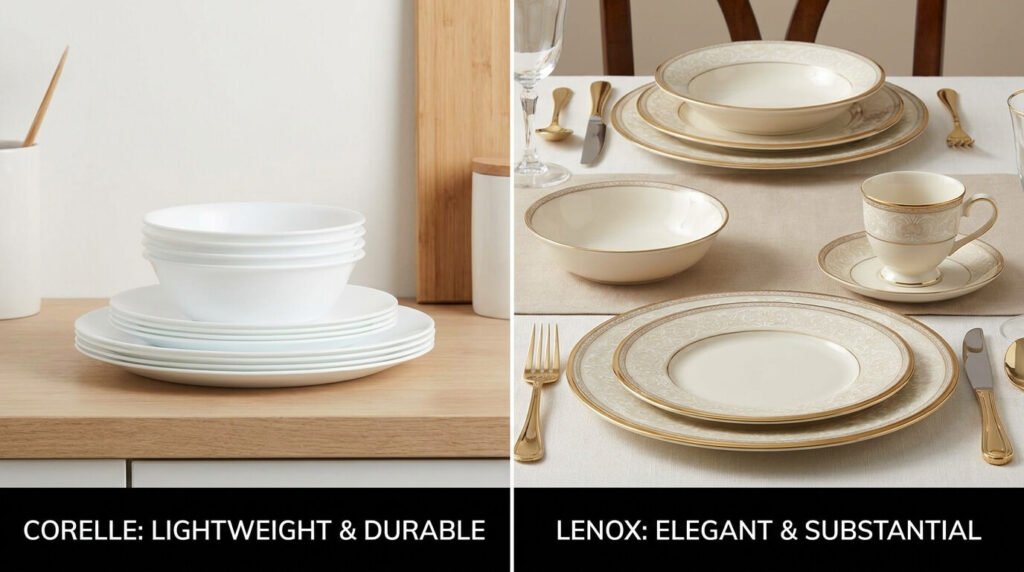
Tempered Glass vs Bone China
Vitrelle tempered glass and bone china are fundamentally different materials with different strengths. Tempered glass is engineered to resist impact and breakage through its laminated triple-layer structure.
Bone china gets its elegance from a refined ceramic firing process that produces a dense, white, slightly translucent body.
Corelle’s tempered glass resists breakage under everyday use better than most ceramic options, while Lenox’s bone china delivers a level of visual refinement that glass simply doesn’t replicate.
Thickness and Weight Differences
Corelle’s Vitrelle glass is noticeably thin — thinner than most ceramic dishes — which contributes directly to it being lightweight dinnerware.
Lenox bone china and porcelain dinnerware tend to have more physical presence; they feel like premium, substantial pieces in a way that Corelle’s lightweight tableware doesn’t aim for.
Neither is better in absolute terms, it depends entirely on whether you want ease of handling or an elegant dining feel at the table.
Heat Resistance and Material Performance
Corelle’s tempered glass handles thermal shock resistance reasonably well and are microwave safe, making them practical for everyday food reheating.
Lenox’s bone china and porcelain collections vary in microwave and oven compatibility depending on whether they feature metallic trim — gold trim and platinum trim pieces should generally be kept out of the microwave.
Corelle’s everyday appliance compatibility is more straightforward for household routines.
Durability Comparison
Chip Resistance of Corelle
Chip resistance is one of Corelle’s most talked-about advantages. The Vitrelle glass technology means the edges of Corelle dishes hold up well against the knocks and bumps of daily use in a way that ceramic edges typically don’t.
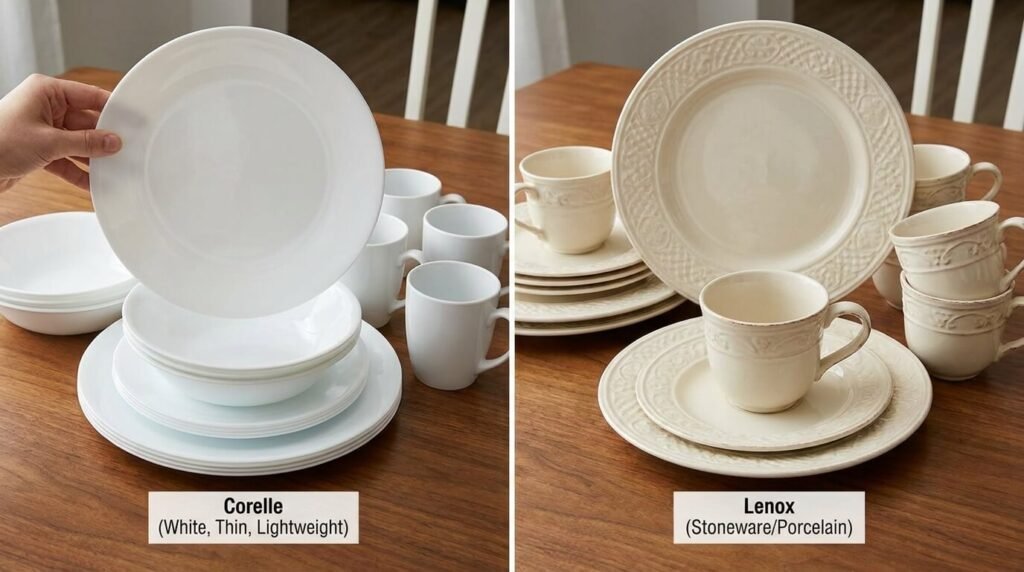
Most Corelle users report that their dishes stay chip-free for years of regular use, which is a meaningful durability advantage when you’re running dishes through the dishwasher and stacking them in cabinets every single day.
Fragility of Fine China and Porcelain
Lenox fine china and porcelain dinnerware require more careful handling. The thin, refined construction of bone china makes it susceptible to chipping at the rim if knocked against a hard surface, and the decorative finishes, particularly embossed patterns and metallic trim — add to the delicate edge handling considerations.
This doesn’t mean Lenox dishes are poor quality; they’re engineered for careful, deliberate use rather than the rough-and-tumble of everyday family dining.
Long-Term Wear and Surface Scratches
Both brands experience surface wear over time. Corelle’s glass surface can develop light utensil marks from repeated metal cutlery contact, though these often clean off with a gentle cleaner.
Lenox dishes are susceptible to color fading on decorative patterns and gold trim wear with heavy dishwasher use over the years. Proper care instructions including avoiding abrasive cleaning and following manufacturer guidance extend the lifespan of both considerably.
Weight and Handling Comparison
Lightweight Convenience of Corelle
The lightweight convenience of Corelle is one of its most practical day-to-day advantages.
Carrying a stack of plates from the cabinet to the table, filling bowls with soup, or handing dishes to children all become noticeably easier when the dishes themselves weigh so little.
This also extends to kitchen cabinet storage — lighter dishes are simply easier to manage when you’re reaching overhead or loading lower shelves.
Elegant Weight of Lenox Dinnerware
Lenox dishes carry a physical weight that contributes to the premium dining experience they’re meant to deliver. When you pick up a Lenox dinner plate, it feels like a quality piece of tableware — substantial, refined, deliberate.
That heavier feel is part of what signals “this is a special meal” at a formal table setting. It’s a feature for the audiences Lenox is designed for, even if it makes everyday handling less convenient.
Best for Elderly Users or Families
For households with elderly members dealing with reduced grip strength, or families with young children learning to carry their own dishes, Corelle’s lightweight design is a significant practical advantage.
Lighter dishes mean fewer drops, easier handling, and less fatigue over time. Lenox’s heavier construction isn’t built with those ease-of-use considerations in mind — it’s oriented toward deliberate formal dining rather than accessibility.
Design and Style Comparison
Corelle’s Minimalist and Functional Aesthetic
Corelle’s design language is clean, modern, and understated. The minimalist design approach — plain white dinnerware or subtle geometric patterns — fits easily into contemporary kitchens without demanding attention.
The focus is on functionality and practicality rather than visual statement. Corelle dishes complement a modern kitchen aesthetic without looking out of place, which makes them a versatile everyday option across different home styles.
Lenox’s Elegant and Decorative Designs
Lenox approaches design very differently. Its collections are built around fine dining presentation and visual impact — embossed patterns, decorative rims, metallic edging, and carefully developed color coordination across each collection.
The dining table decor effect of a full Lenox table setting is intentional and considerable. For buyers who care deeply about meal presentation and want their dishes to visually contribute to the occasion, Lenox delivers what Corelle simply doesn’t attempt to.
Casual vs Formal Dining Appeal
Corelle belongs in casual dining environments — family kitchens, everyday meals, informal gatherings. Lenox belongs at formal dinner parties, holiday tables, and special occasion hosting.
The two brands aren’t really competing for the same use case once you understand that distinction. Some households maintain both: Corelle for daily use and a Lenox set tucked away for entertaining guests on occasions that warrant it.
Everyday Use Comparison
Best for Daily Family Meals
For daily family meals, Corelle wins on practically every practical measure. It’s dishwasher safe, microwave safe, chip-resistant, lightweight, and designed to handle the repetitive demands of being used and washed every single day.
The non-porous surface resists staining from tomato-based sauces, coffee, and other everyday foods, which keeps the dishes looking cleaner for longer without special effort.
Best for Formal Entertaining
When the goal is a polished formal table setting for a dinner party, holiday gathering, or celebratory meal, Lenox sets the standard for elegant table presentation.
A fully set Lenox table — with matching serveware and flatware — creates a cohesive, impressive dining experience that casual dinnerware simply can’t replicate.
The visual weight and decorative quality of Lenox bone china or fine china read as intentional and luxurious to guests.
Best for Apartments and Small Kitchens
For apartment living where kitchen cabinet storage is limited, Corelle’s compact stackability is a genuine practical benefit. A complete Corelle set stacks into a surprisingly small footprint, leaving room for other kitchen essentials.
Lenox’s thicker construction takes up considerably more cabinet space for an equivalent number of pieces, which matters in smaller living spaces where storage efficiency is a real constraint.
Storage and Space Efficiency
Compact Stackability of Corelle
Corelle’s thin-profile design allows plates, bowls, and salad plates to stack evenly and compactly. A set of eight Corelle dinner plates stacks to roughly the same height as four or five heavier ceramic plates.
This stackability advantage is one of the reasons Corelle is popular in smaller homes, apartments, and RV setups where space saving is a practical necessity rather than a preference.
Larger Storage Footprint of Lenox
Lenox dishes, by virtue of their thicker, premium construction, naturally require more storage space.
A full Lenox place setting for eight people takes up a meaningful amount of kitchen cabinet storage and many Lenox collections include pieces like serving bowls, tea cups, and bread plates that add further to the footprint.
This isn’t a flaw; it’s a reflection of the dishes being built for occasional formal use rather than compact daily storage.
Best for Limited Cabinet Space
If you’re working with limited cabinet space, Corelle is the more practical choice by a significant margin. The space-saving profile means you can maintain a complete set of dinnerware without sacrificing cabinet real estate needed for other kitchen items.
Lenox makes more sense when you have dedicated storage — a china cabinet, a sideboard, or ample shelving — where the dishes can be displayed or stored properly between uses.
Microwave and Dishwasher Safety
Microwave Compatibility
Corelle is fully microwave safe across its standard collections, making food reheating on the plate a completely routine option. Lenox’s microwave compatibility depends heavily on the specific collection.
Plain bone china or porcelain pieces are often microwave safe, but collections with gold trim or platinum trim metallic detailing are not — the metal interacts with microwave energy and can damage both the dishes and the appliance.
Always verify the specific Lenox collection before microwaving.
Dishwasher Cleaning Convenience
Corelle handles regular dishwasher cycles without issue — the Vitrelle glass surface and colorfast printed patterns are built to tolerate repeated machine washing.
Lenox recommends hand washing for many of its decorated collections, particularly those with metallic trim or delicate embossed finishes. For households that rely on dishwasher convenience as a daily routine, this care instructions difference is a meaningful practical gap between the two brands.
Resistance to Staining and Odors
Corelle’s non-porous glass surface gives it a natural advantage in stain resistance and odor resistance. Food doesn’t absorb into the material, so even strongly pigmented foods leave no lasting marks with regular washing.
Lenox’s ceramic glaze also resists staining well on intact surfaces, but if the glaze chips or develops micro-cracks over time, those areas can absorb odors and pigments more readily than Corelle’s uniformly non-porous Vitrelle glass.
Safety and Food Contact Considerations
Non-Porous Surface Benefits
The non-porous surface of Vitrelle glass is a genuine hygiene advantage in daily kitchen use. A surface that doesn’t absorb liquids also doesn’t harbor bacteria in the way that micro-porous or crazed ceramic surfaces can over time.
This makes Corelle dinnerware inherently hygienic in a way that requires no special maintenance — standard washing is sufficient to maintain a clean, safe food contact surface.
Decorative Finish and Glaze Considerations
Lenox’s ceramic glaze and decorative finishes are manufactured to modern food safety standards, and contemporary Lenox collections are generally lead-free and cadmium-free in compliance with FDA requirements.
However, vintage Lenox pieces — particularly older collections with decorative rim detailing or metallic glazes — may not meet current modern manufacturing standards and are better used as display pieces rather than active dinnerware.
Modern Manufacturing Standards
Both Corelle and Lenox produce dinnerware that meets current consumer product safety standards.
Corelle’s Vitrelle glass is BPA-free, lead-free, and FDA-compliant as a food-safe material. Lenox’s contemporary collections similarly comply with modern food contact safety requirements.
As with any dinnerware purchase, checking product specifications for the specific collection you’re buying — rather than relying on general brand reputation alone — is always the more reliable approach.
Cost and Value Comparison
Price Differences Between Brands
The price point difference between Corelle and Lenox is significant. Corelle is positioned as budget dinnerware in the best sense — affordable, practical, and built for everyday use without asking for a premium.
A complete Corelle set for four to eight people is accessible to most household budgets.
Lenox sits firmly in the premium dinnerware category, with individual place settings often costing multiples of what a full Corelle set would run. Both reflect their target markets accurately.
Long-Term Replacement Costs
Corelle’s chip resistance and durability mean individual pieces rarely need replacing under normal use — a full set can realistically last a decade or more with standard care.
Lenox’s fine china requires more careful handling, and when a piece chips or breaks, replacement costs are higher given the premium price point.
From a long-term replacement cost perspective, Corelle’s combination of durability and affordability gives it a clear practical advantage for everyday households.
Value for Different Dining Needs
Value looks different depending on what you need. For a household that uses dishes three times a day and wants durability, convenience, and low maintenance, Corelle delivers exceptional value for money.
For someone who hosts formal dinners, cares deeply about table aesthetics, or wants dinnerware that doubles as a collectible or display piece, Lenox’s premium pricing reflects a different kind of value one built around elegance and the dining experience rather than daily practicality.
Best Choice Based on Lifestyle
Best for Busy Families
For busy families with children, high daily dish turnover, and limited time for careful maintenance, Corelle is the clear practical choice.
The lightweight, durable construction, full dishwasher compatibility, microwave convenience, and chip resistance all align with how family kitchens actually operate.
Corelle doesn’t ask anything extra of you — it just works, day after day, without special handling or concern.
Best for Formal Dining Enthusiasts
If setting a beautiful formal table is genuinely important to you for dinner parties, holiday gatherings, or simply because you enjoy the ritual of elegant dining — Lenox is worth the investment.
The elegant table presentation that Lenox bone china and fine china deliver is a real and tangible thing; no amount of practical advantage from Corelle changes the fact that Lenox simply looks more impressive in a formal dining context.
Best for Minimalist Kitchens
For a clean, uncluttered kitchen aesthetic, Corelle’s plain white or subtly patterned collections are a natural fit. The minimalist design profile, compact stackability, and simple maintenance routine align well with a minimalist kitchen philosophy.
You’re not storing a china cabinet’s worth of formal pieces — just a practical, clean set of everyday dishes that tuck away neatly.
Best for Special Occasions and Hosting
Lenox earns its place in households that host regularly or put a premium on the dining experience during special occasions.
A well-chosen Lenox collection becomes part of the hosting identity the dishes you bring out when the occasion calls for something more than the everyday.
The decorative dining appeal, meal presentation quality, and brand reputation all contribute to making Lenox a meaningful choice for dedicated entertainers.
Common Complaints About Each Brand
Corelle Breakage Characteristics
The most consistent complaint about Corelle is how the dishes behave when they do break. Under severe impact — a hard drop onto tile or stone flooring — Vitrelle glass can shatter into many small fragments rather than breaking into a few large pieces like ceramic.
This shattering characteristic surprises users who expect glass behavior similar to ceramic.
It’s worth knowing before you buy, especially in households with young children or frequent kitchen accidents.
Lenox Chipping Concerns
Lenox users frequently mention fragile edges and decorative finishes as a long-term concern.
The delicate rims of bone china and fine china pieces are vulnerable to chipping when knocked against hard surfaces, and the gold trim and platinum trim detailing can wear or scratch with heavy use over time.
Careful handling and proper storage ideally with felt separators between stacked pieces significantly extend the lifespan of Lenox collections.
Surface Wear Over Time
Both brands experience surface wear with extended use. Corelle can accumulate utensil marks on the glass surface over years of regular use, and while these often respond to non-abrasive cleaning, they can become part of the dish’s appearance permanently over time.
Lenox’s decorative patterns and color fading on printed rim details are more visible complaints on older pieces, particularly those subjected to frequent dishwasher cycles against manufacturer care recommendations.
Common Buying Mistakes to Avoid
Choosing Based Only on Appearance
It’s easy to choose dinnerware based purely on how it looks in a photo or on a shelf. But functionality matters too — and the appearance of a Lenox collection in a showroom tells you nothing about how practical it will be in your kitchen, day to day.
Think about microwave use, dishwasher habits, storage space, and how often you’ll actually be using the dishes formally versus casually before committing to a premium set that requires careful handling.
Ignoring Storage Space Needs
Many buyers overlook cabinet and stacking considerations when choosing dinnerware. A full Lenox set for eight takes up considerably more room than a comparable Corelle set.
If your kitchen storage is already at capacity, adding a thick formal set without thinking through where it will live creates a real logistical problem. Measure your available cabinet space and think honestly about storage before buying either brand in large quantities.
Buying Without Considering Daily Usage
The biggest mistake is buying without lifestyle compatibility in mind. If you eat three casual family meals a day and rarely entertain formally, a Lenox set may spend most of its life in a cabinet unused, while you reach for something more practical.
Conversely, if you care deeply about your table settings and host regularly, Corelle’s casual aesthetic may leave you underwhelmed. Match the dinnerware to how you actually live, not how you imagine you might live.
Which Dinnerware Brand Is Better?
When Corelle Is the Better Choice
Corelle is the better choice when lightweight everyday dining and practicality are the priority. If your household uses dishes constantly, has children or elderly members at the table, relies on the dishwasher and microwave daily, and values compact storage, Corelle delivers all of that reliably.
For context on how Corelle compares within its own competitive space, see Noritake vs Corelle and Corelle vs Fiestaware for additional comparison perspectives.
When Lenox Is the Better Choice
Lenox is the better choice when elegant entertaining and premium aesthetics are the priority.
If you host formal dinners, value the visual quality of your table settings, and are prepared to give your dishes the care they require, Lenox delivers a dining experience that Corelle simply isn’t designed to replicate.
The brand reputation, design quality, and material refinement justify the price for buyers who know what they’re looking for.
Choosing Based on Household Needs
The honest answer is that the better brand depends entirely on your household’s needs. Functionality, dining style, and habits all matter.
A practical family kitchen and a formal entertaining household are genuinely different environments, and the best dinnerware for each reflects that difference.
Buy the brand that matches how your household actually eats — not the brand that sounds more impressive on paper.
Conclusion
Corelle and Lenox serve genuinely different dining lifestyles, and that’s the core takeaway from this comparison.
Corelle excels at lightweight durability, everyday convenience, and practical family-kitchen performance it’s built for real daily use. Lenox stands out for luxury aesthetics, formal dining elegance, and the kind of table presentation that makes special occasions feel special.
Neither is universally better. Your best choice comes down to daily usage habits, dining style, the storage space you’re working with, and what you actually want your dishes to do for you.
About the Author & Reviewer
Sarah Emirone, Author
Sarah researches and writes SafeKitchn’s dinnerware and kitchenware guides, with a focus on material safety, lead content, and manufacturer specifications. She cross-references product data sheets, safety certifications, and regulatory filings (including FDA and Prop 65 records) before publishing, and updates articles when new information becomes available.
James Daniels, Reviewer
James reviews SafeKitchn’s material safety content for scientific accuracy. He holds a B.Sc in inorganic chemistry and works as a materials researcher, with particular focus on the composition and safety behavior of glass, ceramic, and metal used in kitchenware.