

Most people asking how much is my Fiesta dinnerware worth make the same mistake: they go straight to a price list before confirming what they actually have.
A dinner plate in Medium Green sells for $150–$300. The same plate in Yellow sells for $40. Same shape, same era, completely different number.
Color and age, specifically whether your pieces are vintage (1936–1972) or modern (1986–present), are the two variables that drive almost every Fiestaware valuation.
Get those wrong, and any price guide is useless. This article works through identification first, then value by color, then value by piece, then condition, then selling. In that order, because that’s the order that actually works.
Written by Sarah Emirone | Reviewed by James Daniels, B.Sc, Inorganic Chemist & Materials Researcher | Updated September 2026 | See How We Test | Filed under: Buying, Care & Product Guides
How to Tell If Your Fiestaware Is Vintage or Modern (This Determines Everything)
Vintage Fiestaware (1936–1972) and modern Fiestaware (1986–present) can look similar at a glance. But their values are not in the same conversation.
A vintage cobalt blue disc pitcher in mint condition sells for $300–$500. A modern cobalt dinner plate in perfect condition sells for $15–$25 used.
The identification step isn’t a formality; it’s the difference between pricing something accurately and leaving real money on the table. Before looking up any price, run your piece through our complete Fiestaware vintage identification guide first.
Reading the Backstamp: The Fastest Way to Date Any Fiestaware Piece
The mark on the bottom of your piece is the starting point, but one rule that gets repeated everywhere is wrong. Every simplified guide says “lowercase ‘fiesta’ means vintage.”
That’s true for ink backstamps. It’s false for in-mold impressions. Homer Laughlin reused original molds when the line relaunched in 1986, which means some post-1986 modern pieces carry a lowercase “fiesta” in-mold mark, the same mark that “proves” vintage on an ink stamp.
The ® symbol and the raised “H” are the two things that override the lowercase inference entirely.
| Mark Description | Mark Type | Era It Confirms | Exception / Override |
|---|---|---|---|
| Lowercase “fiesta” ink stamp | Ink backstamp | Definitive vintage (1936–1972) | No exceptions |
| Lowercase “fiesta” in-mold impression | In-mold | Ambiguous — could be vintage or modern | Check for ® or raised H; check color and form |
| ® symbol present | Either | Post-1986 modern — no exceptions | Overrides lowercase inference entirely |
| Raised “H” in in-mold mark | In-mold | Post-1986 modern | Overrides lowercase inference entirely |
| Uppercase “FIESTA” | In-mold | Post-1986 modern | No exceptions |
| 3-letter date code | In-mold | Post-1992 modern | Format: letter + number + letter |
| No mark at all | — | Ambiguous | Small vintage pieces are often unmarked; some early modern ones, too |
The only mark that confirms vintage with no exceptions is a lowercase ink backstamp — not an in-mold impression. For every mark type with reference images, see our Fiestaware backstamp and marking identification guide ( link above).
The Wet Foot Test, Glaze Opacity, and Other Physical Clues


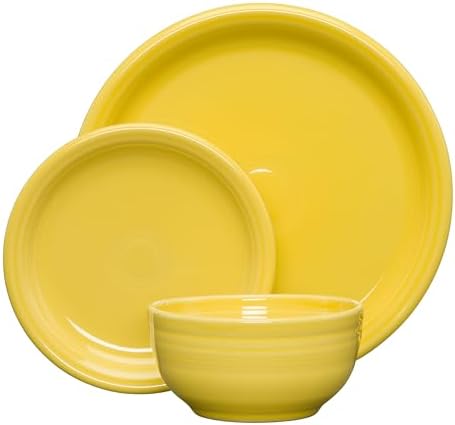
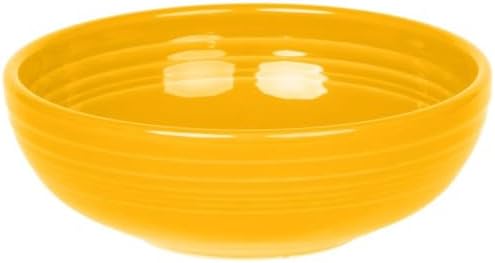
When the backstamp is ambiguous or absent, the piece itself tells you what the stamp won’t.
- Check the base (the “foot”) — vintage Fiestaware has a fully glazed base with three small pin marks from kiln stilts (called a “wet foot”); modern pieces have an unglazed ring on the base (a “dry foot ring”) that leaves raw clay exposed.
- Look at glaze density — vintage glaze is thicker and more opaque; on modern pieces, the glaze thins visibly over the raised concentric rings, giving the ridges a slightly lighter appearance.
- Check wall thickness — vintage pieces are generally thinner and lighter than modern equivalents of the same form; pick up both, and the difference is noticeable.
- Count the concentric rings — genuine Fiestaware (vintage or modern) has rings wrapping the entire piece; Harlequin look-alikes (a related Homer Laughlin line often confused with Fiesta) have rings only at the edges, not across the full body.
Related: How to Identify Fiestaware authentic colors, old vs new
What Fiestaware Colors Are Worth the Most Money?
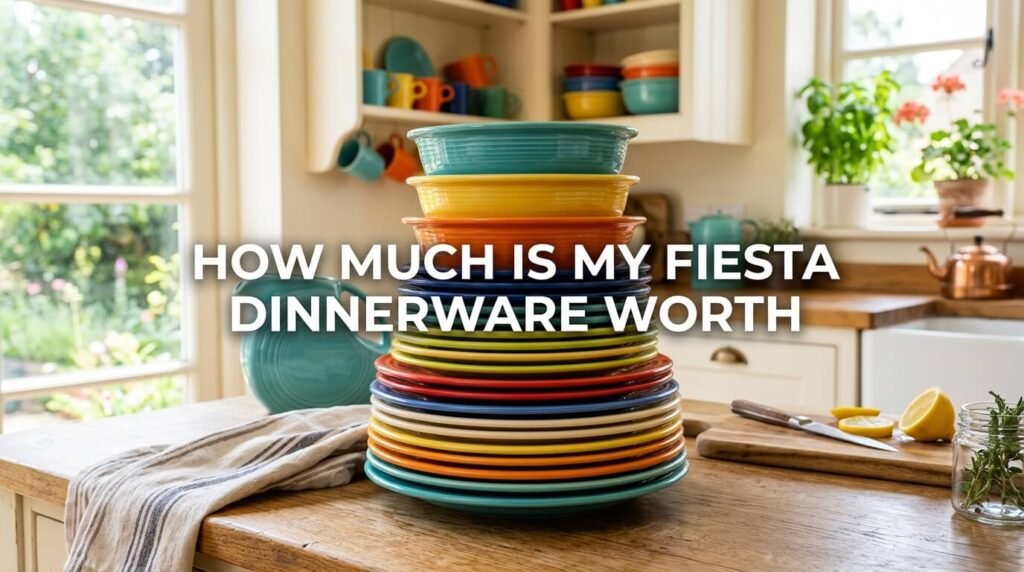
Color is the single biggest value driver in Fiestaware. More than the piece type, more than the condition (within reason), more than whether you have a complete set.
Medium Green leads all vintage colors by a wide margin — produced for only ten years (1959–1969) in a reduced range of pieces during a period when the line was declining.
Original Red from 1936–1943, which used uranium oxide in the glaze, is the second most collected vintage color.
Vintage Color Value Ranking: From Medium Green Down to Yellow
| Color | Production Period | Value Tier | Notes |
|---|---|---|---|
| Medium Green | 1959–1969 | ★★★★★ Highest | Shortest run; limited pieces made; dinner plate $150–$300; disc pitcher $500–$900 |
| Original Red (uranium) | 1936–1943 | ★★★★★ Highest | Pre-WWII uranium glaze; more orange than modern Scarlet; rarer forms (syrup pitcher, individual salad bowl) reach $400–$800+ |
| Cobalt Blue (vintage) | 1936–1951 | ★★★★ High | Deep navy; disc pitcher $300–$500; consistently strong collector demand |
| Turquoise (vintage) | 1937–1969 | ★★★ Strong | Long run but beloved; demand-driven reintroduction in 1988 proves sustained interest |
| Light Green (Original) | 1936–1951 | ★★★ Strong | Often confused with Medium Green; confirmed by backstamp + production era |
| Ivory | 1936–1951 | ★★ Moderate | Warm cream tone; solid demand but more available than cobalt or green |
| Yellow | 1936–1969 | ★★ Moderate | Long run, high supply keeps prices lower than rarer colors |
| 1950s pastels (Rose, Chartreuse, Gray, Forest Green) | 1951–1959 | ★★★ Strong | Short 8-year window; especially Chartreuse and Gray command collector premiums |
Cross-reference your color with every Fiestaware color ever made, with production dates to confirm its production window. For the full breakdown of Medium Green authentication and current sold prices, see our Fiestaware Medium Green value and authentication guide.
Retired Modern Colors Worth Collecting: Lilac, Sapphire, and Chartreuse
Modern colors (post-1986) are generally worth $5–25 per piece used. But three retired modern colors break well above that floor.
- Lilac (1993–1995) was produced for only two years with limited distribution, which makes it the most sought-after retired modern color; individual pieces sell for $40–$120, with serving pieces at the top of that range.
- Sapphire (1996–1997) was a Bloomingdale’s exclusive and never entered general retail; that retailer exclusivity creates genuine scarcity; pieces sell for $50–$150 depending on form.
- Chartreuse (modern, 1997–1999) had a short two-year run and a yellow-green tone with no current equivalent in the lineup; per-piece resale runs $25–$80.
For context on which colors have been most beloved across the brand’s history, see our guide to the most popular Fiestaware colors by production longevity.
Fiestaware Price Guide by Piece: What Each Item Is Actually Worth
After color, piece type is the second biggest value driver. Covered pieces, anything with a lid, command premiums because lids get lost, broken, or separated, making complete covered pieces rarer than open ones.
Early-discontinued forms like the cake plate and onion soup bowl reach prices that surprise most inheritors. A standard dinner plate in a common color is a $40–50 item.
The same plate in Medium Green is $150–300. The onion soup bowl in Medium Green is $1,200–$8,000, depending on condition.
Complete Price Reference: Common Pieces to Rare Finds
| Piece | Common Color Range | Rare Color Premium | Notes |
|---|---|---|---|
| Dinner plate (10″) | $40–$50 | $150–$300 (Medium Green) | Most common piece; high supply in common colors |
| Disc pitcher | $80–$120 | $500–$900 (Medium Green) | Most popular single Fiestaware piece among collectors |
| Cake plate | $1,600–$2,500+ | Higher in rare colors | Flat, footed server; discontinued early; genuinely scarce |
| Covered onion soup bowl | $1,200–$8,000 | Top end in Medium Green or original Red | Lid survival critical to value; lidless drops 60–70% |
| Mixing bowl set (7-piece) | $350–$600 | $1,700–$3,000 (vintage complete set) | Complete sets are rare; interior rings on the earliest bowls add 25% |
| Relish tray (5-part) | $50–$90 | $150–$300 with inserts | All five color inserts must be present |
| Fruit bowl (4¾”) | $40–$60 | $200–$425 (Medium Green) | Small size; condition matters more at smaller scale |
| Gravy boat | $85–$95 | $200–$350 (cobalt or Medium Green) | Solid collector demand across colors |
| Nesting bowl set | $200–$400 | $700–$1,200+ | See early variation note below |
| Syrup pitcher (with lid) | $200–$350 | $400–$800 (original Red) | Lid survival is everything; check hinge mechanism |
Early Variations That Add 20–25% to Any Piece’s Value
Not all vintage Fiestaware from the same era is equal. The earliest production (1936–1937) has specific physical characteristics that add a measurable premium.
- Interior rings on nesting bowls were present only on the earliest production run (1936–1937); later nesting bowls have smooth interiors — a bowl with interior rings adds roughly 25% over a comparable smooth-interior example.
- Flat-bottom onion soup bowls predate the footed version and command a 20% premium over the more common footed style.
- Outside bottom rings on early unmarked pieces indicate pre-stamp production from 1936; the combination of no mark plus outside bottom rings plus known vintage color is worth a 20% premium over marked equivalents.
- The 12″ divided plate was discontinued early in the production run and rarely surfaces; in any color, it commands a significant premium over standard plates.
How Condition Affects Fiestaware Value: The Real Numbers
A chip or crack drops Fiestaware value by 50–90%. That’s not a rough estimate — it’s what WorthPoint’s completed transaction data consistently shows across piece types and colors.
Collectors who buy for display or use want mint pieces. A chipped Medium Green disc pitcher that would sell for $700 in mint condition might fetch $70–$150 chipped, if it sells at all.
Condition Grade Reference: What Each Flaw Costs You
| Condition Issue | Value Impact | Notes |
|---|---|---|
| Mint / near-mint | Full price | No chips, no cracks, no crazing, minimal use marks |
| Minor factory flaws (glaze skip, small bubble) | −20% to −40% | Factory-origin flaws; some collectors accept; document clearly when selling |
| Fork marks / light use scratches | −20% to −40% | Surface marks from normal use; more acceptable on common colors |
| Crazing (fine glaze crack network) | Significant drop + safety concern | See the section below |
| Chip (any size, any location) | −50% to −90% | Rim chips worst; base chips slightly more forgivable |
| Crack (hairline or full) | −50% to −90% | Hairline cracks often invisible until held to light — disclose always |
| Professional repair / restoration | Near-zero collector value | Repaired pieces sell only to decorative buyers, not collectors |
What “Crazing” Means and Why It Matters for Value and Safety
Crazing is a network of fine cracks in the glaze surface — visible as a spider-web pattern when you hold the piece at an angle to light.
It happens when the glaze and clay body expand and contract at different rates over time or through repeated thermal stress (dishwasher cycling, temperature changes).
For value, crazing drops a piece 30–60% below mint price, depending on severity and how prominently it shows.
For safety, it matters more on vintage pieces: crazed glaze on pre-1972 Fiestaware, particularly original Red with uranium oxide glaze, can harbor bacteria and may leach glaze materials into food, particularly with acidic foods.
A crazed vintage Red piece is best treated as a display item, not a food-contact surface.
For the full breakdown of which vintage Fiestaware pieces raise food safety concerns, see our Fiestaware lead glaze and food safety guide.
Is Modern Fiestaware (Post-1986) Worth Anything?
Yes, but the numbers are different. A standard modern dinner plate in a current color sells used for $8–$20. A complete 5-piece place setting in a common modern color sells for $30–$60.
Those are not collector prices — they’re replacement-market prices. But the modern line has its exceptions.
Retired Colors of the Year gain 30–60% above their original retail price within two to three years of discontinuation, based on secondary market tracking on eBay and Etsy.
Retailer-exclusive colors (Sapphire, Chocolate) trade at 2–4× standard modern prices because they never entered general retail.
Modern Retired Colors With the Most Secondary Market Demand
| Color | Retail Era | Retailer | Current Resale Range | Demand Level |
|---|---|---|---|---|
| Lilac | 1993–1995 | General retail | $40–$120/piece | High |
| Sapphire | 1996–1997 | Bloomingdale’s exclusive | $50–$150/piece | High |
| Chartreuse (modern) | 1997–1999 | General retail | $25–$80/piece | Moderate–High |
| Periwinkle | 1989–2006 | General retail | $10–$40/piece | Moderate |
| Sea Mist Green | 1991–2005 | General retail | $15–$50/piece | Moderate |
| Flamingo | 2010 (Color of the Year) | General retail | $25–$60/piece | Moderate |
| Poppy | 2011 (Color of Year) | General retail | $20–$55/piece | Moderate |
The Modern Pieces Most Likely to Gain Value Over Time
Not all modern FiestaWare is appreciated. These are the factors that separate pieces that gain value from those that don’t.
- Short production windows matter most — Colors of the Year produced for a single year have roughly half the supply of colors that ran for three or more years, and secondary market prices reflect that within 18–24 months of retirement.
- Retailer-exclusive pieces never entered the general market, so the supply ceiling was set at a single chain’s purchase order — Sapphire is the clearest example of this playing out in price.
- Covered pieces where the lid survived are worth significantly more than open pieces of the same color, because lids get separated and lost; a complete covered casserole in Lilac is worth 40–60% more than just the base.
- Commemorative and limited-edition pieces — the 1997 Raspberry Bowl released for Fiesta’s 60th anniversary is one example — have fixed supply from day one and collector demand that doesn’t depend on color retirement.
Where to Sell Fiestaware: What Each Channel Actually Pays
Selling to a dealer returns 30–50% of online collector prices. That’s the baseline reality, and it’s worth knowing before you call an antique shop.
eBay and Etsy return the highest net to sellers for rare individual pieces, but they require more time and effort. The right channel depends on how rare your pieces are and how much time you’re willing to spend.
Channel Comparison: eBay, Etsy, Dealers, Auction Houses, and Estate Sales
| Channel | Approx. % of Full Value Retained | Speed to Sale | Best For | Watch Out For |
|---|---|---|---|---|
| eBay (direct sale) | 85–87% (after ~12.9% selling fee) | Days to 2 weeks | Individual rare pieces: disc pitchers, cake plates, onion soup bowls | Must research sold listings accurately; shipping fragile items is a real cost |
| Etsy | 89–91% (after ~6.5% transaction + 3% payment + $0.20 listing) | 1–4 weeks | Curated lots; aesthetic presentation; Color of the Year sets | Smaller Fiestaware buyer pool than eBay |
| Antique dealer / reseller | 30–50% of collector value | Same day | Large lots; when speed matters more than price; estate clearance | You will leave significant money on the table on rare pieces |
| Auction house | 75–85% (after 10–15% seller commission) | 4–12 weeks | High-value single pieces ($500+); estates with multiple rare pieces | Minimum values may exclude common pieces; timeline is slow |
| Estate sale company | 35–50% of appraised value after commission | 1–2 weeks | Full household lots; no time to research individual pieces | Commission varies 25–35%; rare pieces may be underpriced |
eBay sold listings consistently return the highest net for rare individual pieces. Etsy works better for curated lots with aesthetic presentation. Dealers are the right call when speed matters more than price — just go in knowing the trade-off.
How to Price Your Fiestaware Before Listing: The eBay Sold Listings Method
Published price guides date quickly. Dealer appraisals are built for insurance, not selling. The only reliable real-time pricing data is eBay’s completed transaction history — specifically sold listings, not active listings. Here’s the exact process:
- Go to eBay.com and type your search: piece name + color + “Fiestaware” (example: “disc pitcher medium green Fiestaware”).
- On the left sidebar, find “Show Only” and check the box for “Sold Items” — this filters to completed transactions only.
- Ignore every active listing — asking prices are not market prices; a seller asking $1,200 for a common yellow plate doesn’t mean anyone is paying $1,200.
- Look at the 10–15 most recent sold results for comparable pieces in comparable condition; note the median, not the outliers at either end.
- Adjust for your condition using the condition table above — if your piece has fork marks, subtract 20–40% from the median; if it has a chip, subtract 50–90%.
A search for “disc pitcher medium green Fiestaware” with Sold Items filtered shows a median of $550–$700 in mid-2025, with mint examples reaching $800+. That’s your anchor. Adjust from there.
Not Sure What You Have? Start With Identification
An accurate valuation starts with knowing whether your pieces are vintage or modern and which color they actually are. If the backstamp is ambiguous or missing, the physical tests above will get you most of the way there.
Frequently Asked Questions
How much is Fiestaware worth at the low and high end?
Common modern pieces in everyday colors sell used for $8–$25 per plate. At the high end, a mint-condition Medium Green covered onion soup bowl can reach $8,000. The gap between those two numbers comes down to era, color, piece type, and condition — in that order.
What color Fiestaware is worth the most?
Medium Green (1959–1969) leads all colors by a clear margin, followed by original pre-1943 Red with uranium glaze. Both were produced for short windows during periods of declining output, which kept supply low against collector demand that has only grown.
How do I know if my Fiestaware is valuable vintage or common modern?
Start with the backstamp: a lowercase ink stamp with no ® symbol and no raised H is the strongest confirmation of vintage origin. Then check the base — a fully glazed bottom with three pin marks is vintage; an unglazed ring is modern.
If both checks are ambiguous, the color itself narrows the window, since colors like Medium Green and original Cobalt Blue only exist in the vintage era.
Does a chip make my Fiestaware worthless?
Not worthless, but significantly less valuable — chipped pieces typically sell for 50–90% less than mint examples of the same piece. A chipped Medium Green disc pitcher that would fetch $700 in mint condition might sell for $70–$150 chipped.
The exception is extremely rare forms, where even damaged examples are difficult to find.
What is the most valuable single piece of Fiestaware?
The covered onion soup bowl in Medium Green is the piece that reaches the highest individual prices — up to $8,000 for a mint example with its original lid. The cake plate runs a close second at $1,600–$2,500+ in common colors, higher in rare ones.
Is unmarked Fiestaware worth anything?
Yes. Small vintage pieces, fruit bowls, individual creamers, and some early cups were often produced without backstamps.
If the piece passes the wet-foot test, shows vintage glaze characteristics, and matches a known vintage color, the absence of a mark doesn’t eliminate its value. Document the physical evidence and price it accordingly.
Where should I sell my Fiestaware to get the best price?
For rare individual pieces (disc pitchers, cake plates, covered onion soup bowls), eBay sold listings set the market price, and direct eBay sales return the highest net after fees (~87%).
For large lots or when time is the constraint, an estate sale or dealer is faster but returns 30–50% of collector value.
Can modern post-1986 Fiestaware be worth collecting?
Yes, selectively. Retailer-exclusive colors like Sapphire (Bloomingdale’s, 1996–1997) and short-run Colors of the Year consistently trade above retail on the secondary market.
Standard modern pieces in current or recently retired colors are replacement-market items, not collector pieces, but the gap between the two categories is real and trackable on eBay.
About the Author & Reviewer
Sarah Emirone, Author
Sarah researches and writes SafeKitchn’s dinnerware and kitchenware guides, with a focus on material safety, lead content, and manufacturer specifications. She cross-references product data sheets, safety certifications, and regulatory filings (including FDA and Prop 65 records) before publishing, and updates articles when new information becomes available.
James Daniels, Reviewer
James reviews SafeKitchn’s material safety content for scientific accuracy. He holds a B.Sc in inorganic chemistry and works as a materials researcher, with particular focus on the composition and safety behavior of glass, ceramic, and metal used in kitchenware.