

Rubbermaid’s own FAQ page puts a number on it: about 80% of its products are made in the USA.
That sounds like a clear answer. It isn’t, not really, because “80%” blends garbage cans made in Virginia, food storage made in Ohio, and commercial steel hardware shipped in from overseas suppliers, all under one brand name.
So when someone asks, “Is Rubbermaid made in the USA?” the honest answer depends entirely on which product they’re holding.
This page breaks that 80% down by category, explains the legal reason Rubbermaid won’t print an unqualified “Made in USA” label, even on items built entirely in Ohio, and covers a February 2026 statement from Newell Brands that no one else has covered yet.
Written by Sarah Emirone | Reviewed by James Daniels, B.Sc, Inorganic Chemist & Materials Researcher | Updated September 2026 | See How We Test | Filed under: Origin & Manufacturing
Who Owns Rubbermaid, and Where Is It Headquartered?
Newell Brands owns Rubbermaid.
Newell acquired the company in 1999, folding it into a portfolio that now includes Sharpie, Graco, Coleman, Yankee Candle, Oster, and Rubbermaid Commercial Products, a separate division aimed at restaurants, hospitals, and offices rather than home kitchens.
Newell Brands is headquartered in Atlanta, Georgia, and that’s also where Rubbermaid’s corporate decisions get made today.
Newell Brands ownership and Rubbermaid’s place in the portfolio
Rubbermaid isn’t a standalone company anymore, and hasn’t been for over two decades. Inside Newell’s structure, it sits in the Home and Commercial Solutions segment alongside brands like FoodSaver and Calphalon.
That matters for the “Made in USA” question because Rubbermaid doesn’t set its own manufacturing policy in isolation — sourcing decisions, factory investments, and tariff strategy run through Newell at the corporate level.


A single Newell earnings call ends up telling you more about Rubbermaid’s factories than Rubbermaid’s own marketing copy does.
For a closer look at how the consumer line differs from the division that serves businesses, see Rubbermaid Commercial vs consumer product lines.
Rubbermaid’s founding in Wooster, Ohio, and how it shaped the manufacturing base
Rubbermaid started in Wooster, Ohio, in May 1920 — originally the Wooster Rubber Company, making rubber dustpans and toy balloons before switching to housewares.
The name changed to Rubbermaid in 1957. That Ohio root isn’t trivia. It’s the reason the state still hosts active Rubbermaid manufacturing more than a century later, and it’s the thread connecting the company’s history to its current production strategy.
Is Rubbermaid Made in the USA? What the Company Actually Says
Rubbermaid says yes, mostly. The company’s own FAQ page states that about 80% of Rubbermaid products are manufactured in the USA, a figure that’s been stable for years and shows up nearly word-for-word across multiple official sources.
That’s a real number, not marketing fluff — but it’s the start of the answer, not the end of it.
Rubbermaid’s own statement: “about 80% of products are manufactured in the USA”
The 80% figure comes directly from Rubbermaid Commercial Products’ FAQ page, which adds that production complies with clean air and water regulations.
No source breaks that number down by product line or explains what counts as “manufactured” versus “assembled” versus “finished” — three different things under federal labeling rules, and the difference matters more than the headline percentage.
Why does the packaging say “raw materials sourced globally” instead of a blanket claim
Rubbermaid’s LunchBlox containers, and several other lines, carry packaging language that reads “made in the USA of global components” rather than a flat “Made in USA.”
That phrasing isn’t an accident or a hedge. Plastic resin, the raw material in nearly every Rubbermaid product, is a petroleum derivative traded on global commodity markets, and Rubbermaid has stated directly that because raw materials are globally sourced, the company is required to note that on the label.
A product can be molded, assembled, and packaged entirely in Ohio and still need that disclosure, because the rule cares about the input material’s origin, not just where the factory sits.
Which Rubbermaid Product Categories Are Actually Made in the USA?
Garbage cans, mop products, and storage sheds: mostly domestic. Food storage and commercial hardware: it varies by the specific line, and the honest breakdown looks different by category rather than by brand as a whole.
Category-by-category breakdown: food storage, trash cans, totes, commercial lines
For background on what these plastics are actually made of and why that matters beyond country of origin, see BPA-free plastic safety explained before checking the table below.
| Product category | Manufacturing reality | Evidence |
|---|---|---|
| Garbage cans/trash cans | Predominantly US-made | Confirmed by Rubbermaid customer service; Newell names Brute trash cans as made in Virginia |
| Mop buckets, mop heads, mop handles | Predominantly US-made | Confirmed directly by Rubbermaid customer service |
| Storage sheds | Predominantly US-made | Confirmed directly by Rubbermaid customer service |
| Food storage containers | Mixed — varies by line and year | A 2025 customer service exchange said this category isn’t mostly domestic; a February 2026 Newell investor call named “Rubbermaid food storage in Ohio” specifically |
| Commercial-grade carts and hardware | Plastic body is often US-made, and hardware is often imported | Customer service noted utility cart hardware is sourced overseas; import records show stainless steel components from Asian suppliers |
| Wire shelving | Imported | Confirmed directly by Rubbermaid customer service |
That table is the real answer most articles skip. A single brand-wide percentage can’t tell you what’s true for the specific container in your cart.
What “Made in USA of globally sourced components” means for specific product lines
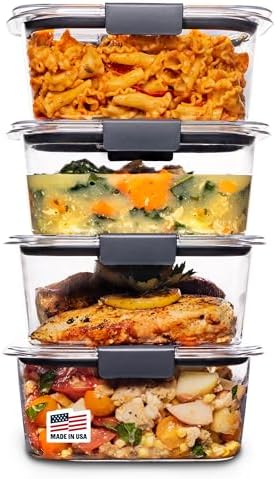
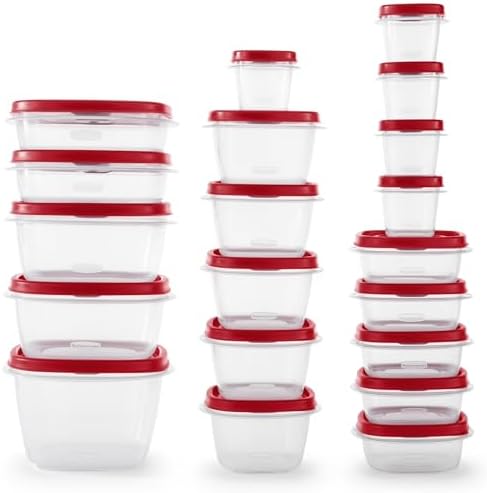
Brilliance containers, Rubbermaid’s most popular food storage line, sit right in the gray zone the table above describes.


Individual sellers and product Q&A threads claim specific Brilliance sets are manufactured in the USA, and at least one official response to a buyer’s question confirms a particular 10-piece clear set is US-made.
But that’s one SKU, on one date, from one response, not a category-wide guarantee. The lids, latches, and any glass components in the line can carry separate origins entirely. Don’t assume the whole Brilliance line shares one manufacturing answer just because one set does.
Why Doesn’t Rubbermaid Make a Blanket “Made in USA” Claim? The FTC Rule Explained
Because the law doesn’t let it, not without serious legal risk. The Federal Trade Commission’s Made in USA Labeling Rule requires a product to meet an “all or virtually all” standard before a company can print an unqualified Made in USA claim, and almost no plastic consumer product clears that bar cleanly.
The “all or virtually all” standard and why plastic resin complicates the claim
All or virtually all is the FTC’s own term, codified into a formal rule — 16 CFR Part 323 — in August 2021. To make an unqualified “Made in USA” claim, a product needs final assembly and all significant processing to happen in the US, and all or virtually all components and ingredients to be of US origin too.
There’s no specific percentage threshold in the federal rule itself, though many companies informally use California’s 5% foreign-content rule as a working benchmark.
Plastic resin breaks this for Rubbermaid almost by default: it’s a global commodity, refined from petroleum sourced wherever it’s cheapest that quarter, and the FTC counts that origin against an unqualified claim even when every other step happens on US soil.
Civil penalties for false Made in USA claims — why companies hedge their language
| Violation type | Consequence |
|---|---|
| Unqualified false claim on a label | Civil penalty up to $51,744 per violation |
| Repeat violation after a prior FTC order | Can reach into the millions — a 2025 case against a kitchen retailer resulted in a $3.175 million penalty |
| Implied claims (flags, imagery, branding without text) | Treated the same as a written claim under the 2021 rule |
| Failure to update claims after sourcing changes | A separate violation — companies must keep substantiation current |
A March 2026 executive order pushed enforcement further, directing agencies to treat Made in USA mislabeling as an ongoing compliance issue rather than a one-time check.
For a fuller breakdown of how the rule works and who it’s enforced against, see FTC Made in USA labeling rule penalties. Rubbermaid’s careful wording isn’t evasive. It’s the predictable response to a rule with real teeth and a regulator that’s actively using them.
Rubbermaid’s 2026 Shift Toward Domestic Manufacturing
Newell Brands is now treating domestic manufacturing as a selling point, not just a compliance detail.
At the company’s CAGNY 2026 investor presentation in February, leadership named Rubbermaid food storage manufacturing in Ohio specifically, as part of a broader domestic production base the company has been promoting to retailers since new tariffs took effect in 2025.
What Newell Brands told investors about Ohio production and tariff strategy
The CAGNY transcript lists several Newell brands by their US production state in the same breath: Ball jars in Indiana, NUK baby products in Wisconsin, Sharpie and Elmer’s in Tennessee, Coleman coolers in Kansas, Brute trash cans in Virginia, and Rubbermaid food storage in Ohio.
Leadership described “actively leveraging” that domestic footprint with key retailers since what they referred to as “Liberation Day” — the April 2025 tariff announcement that raised costs on imported goods broadly.
The logic is simple for the company, even applied to plastic containers: when imports get more expensive, a factory in Ohio stops being a cost line and starts being a pricing advantage.
Which Ohio facilities make Rubbermaid products today
- Mogadore, Ohio, near Akron, runs injection molding for Rubbermaid products. A prior expansion phase added $25 million in investment and nearly 140 jobs, and a 2026 case study from automation firm Bastian Solutions documents a 10-robot packing system currently operating at this facility.
- Wooster, Ohio, remains the company’s founding location from 1920 and still carries operational weight in how Rubbermaid frames its American manufacturing identity.
- Newell Brands hasn’t published a complete current list of every Rubbermaid-specific facility, so Mogadore is the most concretely documented active site rather than the only one. For the wider list of where Newell’s other brands manufacture domestically, see Newell Brands US factory locations.
Rubbermaid vs Other Storage Brands: Which Is More American-Made?
Sterilite manufactures the large majority of its products in US-based plants and has for decades, which puts it ahead of Rubbermaid on raw domestic manufacturing share — even though Rubbermaid’s individual Ohio facilities are better documented in public sources.
Comparing domestic manufacturing claims across major storage brands
For shoppers comparing options before buying, see how Rubbermaid Brilliance vs Oxo Pop, Sistema vs Rubbermaid, and Rubbermaid Brilliance vs Sterilite Ultra comparison stacks up specifically on food storage, since that’s the category where Rubbermaid’s domestic claim is weakest.
| Brand | Domestic manufacturing claim | Strongest category | Weakest category |
|---|---|---|---|
| Rubbermaid | ~80% overall (company’s own figure) | Garbage cans, mop products, and sheds | Food storage, wire shelving |
| Sterilite | Manufactures primarily in US-based facilities (Ohio, Massachusetts) | Storage totes and bins | Limited public transparency on component sourcing |
| OXO | Mixed — design is US-based, manufacturing largely overseas | None marketed as domestic | Nearly the entire product line |
Rubbermaid and Sterilite both lean on Ohio, but Sterilite’s claim is broader across its full catalog. OXO doesn’t compete on this axis at all — its products are designed in New York and manufactured mostly abroad, and the brand doesn’t market itself as domestically made.
How to verify the country of origin before buying
- Check the specific product page for a country-of-origin statement rather than relying on brand-level claims, since “Rubbermaid” as a name covers products made in at least three different countries.
- Look for qualified language like “Made in USA of US and imported parts” — that phrasing is more trustworthy than an unqualified claim because it’s legally required to be accurate.
- For commercial or bulk purchases, request a country-of-origin certificate directly from the supplier, especially for anything with metal hardware or electronic components.
- Treat customer service answers as a snapshot, not a permanent fact. Sourcing changes between production runs, sometimes within the same calendar year.
Looking for genuinely domestic kitchen storage? Rubbermaid’s Ohio-made lines and Sterilite’s US-based totes are both reasonable starting points, just check the specific SKU before buying, not the brand name alone.
About the Author & Reviewer
Sarah Emirone, Author
Sarah researches and writes SafeKitchn’s dinnerware and kitchenware guides, with a focus on material safety, lead content, and manufacturer specifications. She cross-references product data sheets, safety certifications, and regulatory filings (including FDA and Prop 65 records) before publishing, and updates articles when new information becomes available.
James Daniels, Reviewer
James reviews SafeKitchn’s material safety content for scientific accuracy. He holds a B.Sc in inorganic chemistry and works as a materials researcher, with particular focus on the composition and safety behavior of glass, ceramic, and metal used in kitchenware.