

Most people searching for discontinued Fiesta colors and rare shades are asking the wrong question. They want a list. What they actually need is a framework because discontinued does not mean rare, and rare does not mean valuable.
A dinner plate in Apricot, discontinued in 1998 after a 12-year run, might sell for $4 at a thrift store. A dinner plate in Medium Green, also discontinued, can sell for $300. The same word discontinued completely different reality.
This guide gives you the framework first, then the specific colors, production dates, prices, and authentication steps you need to make real decisions at estate sales and on the secondary market.
Written by Sarah Emirone | Reviewed by James Daniels, B.Sc, Inorganic Chemist & Materials Researcher | Updated September 2026 | See How We Test | Filed under: Buying, Care & Product Guides
Not All Discontinued Fiesta Colors Are Rare — Here’s How to Think About It
The quickest way to overpay for Fiestaware is to assume that “discontinued” signals scarcity. Homer Laughlin retired dozens of colors that were produced for 10 to 20 years, long enough that millions of pieces exist.
Rarity in Fiesta collecting comes from three things: a short production window, limited shape availability during that window, and collector demand that outpaces supply.
When all three align, prices climb sharply. When only one does, prices stay modest.
The Four Rarity Tiers: Ultra-Rare, Very Rare, Moderately Rare, and Uncommon
Use this table at estate sales. Find the color name, check the tier, and price accordingly.
| Tier | Colors | Primary Rarity Reason | Approx. Dinner Plate Price |
|---|---|---|---|
| Ultra-Rare | Medium Green, pre-1943 Red (uranium), Sapphire | Short run + very few shapes produced + intense collector demand | $150–$400+ |
| Very Rare | Lilac, Marigold (numbered), Heather, Pearl Gray, Juniper | 1–3 year production or deliberately limited quantity | $30–$120+ per piece |
| Moderately Rare | Post-86 Chartreuse, Peacock, Plum, Cinnabar, Flamingo | 3–10-year run; enough pieces to find, but demand keeps prices elevated | $15–$50 per piece |
| Uncommon | Apricot, Periwinkle, Sea Mist, Yellow (post-86), Rose (post-86) | 10+ year runs; common enough that condition matters more than scarcity | $3–$15 per piece |
Prices above are secondary market estimates based on eBay sold listings and HLCCA show reports. Condition, piece type, and seller platform all affect the final number.
What Actually Drives Value — Production Length, Shape Availability, and Demand
Three factors determine whether a discontinued Fiesta color is worth hunting:
- Production length is the starting point — colors fired for under three years had less time to accumulate in the market, so finding intact pieces in good condition is genuinely harder.
- Shape availability during production matters as much as color rarity — Medium Green was only available in a limited shape assortment, which means certain pieces (like the disk pitcher or the individual creamer) barely exist in that color and command prices that feel irrational until you understand the supply.
- Collector demand is the multiplier — Lilac and Sapphire are rare by production numbers, but they’re also wanted, which is why they consistently sell at the top of their tier; a color like Heather is similarly short-run but attracts a smaller collector pool, so prices are lower.
- Completeness premiums are real — a collector building a full place setting in Lilac will pay more per piece than someone buying a single mug, because completing a set in a rare color is a multi-year project.
For a broader look at how piece type affects price across the full line, see the full Fiesta dinnerware value guide with prices by piece type.
The Rarest Vintage Discontinued Colors (1936–1972)
The complete Fiesta color timeline from 1936 to today covers nearly 50 distinct colors across both eras. But within the vintage line — everything made before Homer Laughlin discontinued Fiesta in 1972–1973 — a handful of colors consistently outperform everything else at auction.
Medium Green — The Most Valuable Color in the Entire Line
Medium Green ran from 1959 to 1969. Ten years sounds like a long time, but production during that decade was significantly lower than earlier eras. Fiestaware was losing ground to earthenware trends, and Homer Laughlin was scaling back.
More importantly, Medium Green was introduced late in the original line’s life, when the full shape assortment had already been trimmed.
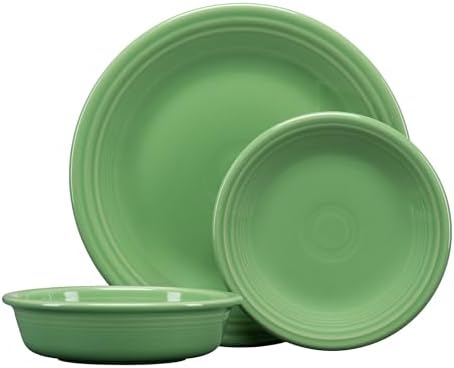
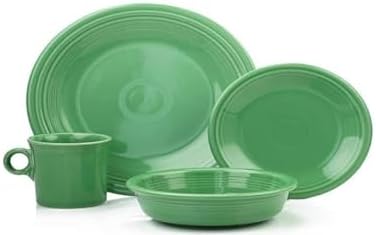
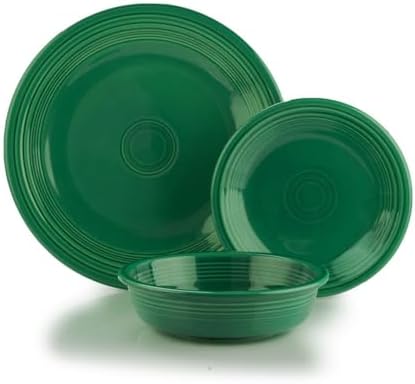

Certain pieces, the disk water pitcher, the individual sugar bowl, and the carafe, were either never made in Medium Green or produced in tiny quantities.
A Medium Green dinner plate in excellent condition sells in the $150–$250 range on eBay. A disk pitcher in Medium Green, if you find one, can exceed $400.
Finding a complete place setting for four in this color is a years-long project for most collectors, and that scarcity is entirely real.
Radioactive Red — The Pre-1943 Uranium Glaze Pieces
Original Red was part of Fiesta’s 1936 launch. The color came from uranium oxide in the glaze — a standard industrial practice before World War II.
In 1943, the U.S. government restricted uranium for military use, and Homer Laughlin pulled Red from production entirely. It returned in 1959, this time with depleted uranium, and stayed in production until 1972.
This distinction matters for collectors. Pre-1943 pieces have a warmer, more orange-red tone and carry the uranium history that some collectors specifically seek.
Post-1959 pieces are slightly cooler in hue. Both are valuable compared to common vintage colors, with pre-1943 plates typically selling in the $80–$200 range depending on condition.
The radiation from these pieces is real but extremely low — the Nuclear Regulatory Commission has consistently classified ordinary handling and display as below threshold for health concern.
For questions about using vintage pieces for food, see whether vintage Fiestaware is safe to use for food service.
The 1950s Color Group — Gray, Forest Green, Chartreuse, and Rose
Homer Laughlin introduced four new colors in 1951 and retired all of them in 1959. They’re softer and more muted than the original six, a deliberate design shift toward postwar suburban tastes. All four are genuinely scarce compared to original colors.
| Color | Production Years | Run Length | Rarity Notes | Approx. Plate Value |
|---|---|---|---|---|
| Gray | 1951–1959 | 8 years | Soft charcoal; often confused with later Slate (post-86) | $25–$60 |
| Forest Green | 1951–1959 | 8 years | Deep hunter green; not to be confused with post-86 Shamrock | $30–$70 |
| Chartreuse | 1951–1959 | 8 years | Yellow-green; visually close to post-86 Chartreuse (1997–1999) | $30–$65 |
| Rose | 1951–1959 | 8 years | Dusty pink; softer than post-86 Rose; popular with set builders | $25–$55 |
All four were followed by Medium Green in 1959, which replaced the entire group. If you find any of these at an estate sale with a pre-1973 impressed backstamp, they’re worth picking up.
Original Cobalt Blue and Old Ivory — Discontinued in 1951
Both Cobalt Blue and Old Ivory were part of Fiesta’s original 1936 lineup and were retired in 1951 when Homer Laughlin restructured the color range.

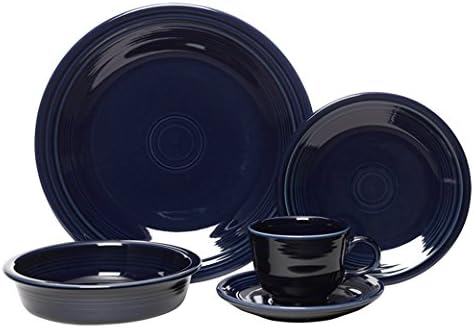


Original Cobalt is a true deep navy, distinctly different from both post-86 Cobalt Blue (reintroduced 1986, retired 2021) and Sapphire (a blue-purple post-86 exclusive from 1996–1997). Getting them confused costs money.
- Original Cobalt Blue (1936–1951) sells for $40–$90 per dinner plate in good condition; its glaze has a deeper, slightly greenish-blue cast compared to post-86 Cobalt.
- Old Ivory (1936–1943, then 1959–1972) is a warm cream tone; the pre-1943 pieces are slightly more sought-after, with plates in the $30–$60 range.
- Both carry lead-based glazes — a factor that affects food-use decisions but not display or collection value.
The Rarest Post-86 Discontinued Colors (1986–Present)
Post-86 Fiesta launched in 1986 with five colors: White, Black, Rose, Apricot, and Cobalt Blue. From that point, Homer Laughlin added and retired colors steadily, sometimes after a full decade, sometimes after less than two years.
The short-run post-86 colors are where active collectors spend the most time hunting.
Lilac (1993–1995) — The Most Wanted Post-86 Color
Lilac ran for just two years, from 1993 to 1995. It sold poorly at the time — the soft lavender tone didn’t fit the bold, primary-color aesthetic that made Fiesta popular in the 1980s revival.
Homer Laughlin pulled it quickly, and that slow initial sales performance is exactly why it’s so sought after now: there just aren’t many pieces out there.
A Lilac dinner plate in excellent condition sells in the $40–$80 range. Rarer pieces — the disk pitcher, the large bowl, the individual teapot — run significantly higher.
Complete Lilac place settings appear at HLCCA shows and specialist auctions more than on eBay, where listings are sporadic, and prices vary widely depending on seller knowledge.
Sapphire (1996–1997) — The Bloomingdale’s Exclusive With the Shortest Run
Sapphire had an even shorter window than Lilac. It was produced exclusively for Bloomingdale’s from 1996 to 1997 — roughly an 18-month retail window — and never sold through any other channel.
The color is a deep blue-purple that many collectors mistake for vintage Cobalt Blue or even post-86 Cobalt. It isn’t either.
The glaze has a distinct violet undertone visible in natural light, and the backstamp will read “LEAD FREE” with a Bloomingdale’s designation on authenticated pieces.
Sapphire dinner plates sell in the $80–$200 range, depending on condition and buyer urgency. Because it was a retailer exclusive, pieces surfaced less predictably than other short-run colors. Estate sales are often the best source.
The Short-Run Color Reference — Marigold, Heather, Pearl Gray, Juniper, and More
This table covers every significant short-run or limited-edition post-86 discontinued color, sourced from Fiesta Factory Direct’s official color history page (fiestafactorydirect.com/pages/color-history).
Dates for some colors vary slightly across retailer sources; the Factory Direct dates are considered the most reliable.
| Color | Production Years | Run Length | Run Type | Collector Notes | Value Tier |
|---|---|---|---|---|---|
| Lilac | 1993–1995 | 2 years | Limited run | Most wanted post-86 color: soft lavender | Very Rare |
| Sapphire | 1996–1997 | ~18 months | Bloomingdale’s exclusive | Blue-purple; confused with Cobalt | Ultra-Rare |
| Chartreuse (post-86) | 1997–1999 | 2 years | Standard retirement | Brighter than vintage Chartreuse | Very Rare |
| Pearl Gray | 1999–2001 | 2 years | Standard retirement | Subtle shimmer finish; distinctive texture | Very Rare |
| Juniper | 1999–2001 | 2 years | Standard retirement | Deep blue-green; Y2K-era collectible | Very Rare |
| Heather | 2006–2008 | 2 years | Standard retirement | Dusty lavender; confused with Lilac by new collectors | Very Rare |
| Marigold | 2008–2011 | ~75 weeks | 75th anniversary limited | ≤10,000 individually numbered pieces | Very Rare |
| Flamingo | 2012–2013 | ~1 year | Standard retirement | Bright coral-pink; short enough run to be scarce | Very Rare |
| Chocolate | 2008–2012 | 4 years | Macy’s exclusive | Rich brown; channel-limited like Sapphire | Moderately Rare |
| Peacock | 2005–2014 | 9 years | Standard retirement | Teal; long enough run that condition matters | Moderately Rare |
| Plum | 2001–2015 | 14 years | Standard retirement | Purple-brown; common enough to be affordable | Moderately Rare |
| Cinnabar | 2000–2010 | 10 years | Standard retirement | Deep burgundy-red; often overlooked | Moderately Rare |
| Paprika | 2010–2016 | 6 years | Standard retirement | Terra-cotta orange; popular with warm-tone collectors | Moderately Rare |
For context on how these discontinued colors interact with pieces still in production, see which current Fiesta colors have become modern collector favorites.
Retailer-Exclusive and Commemorative Colors
Homer Laughlin has used retailer exclusives and limited anniversary releases as a deliberate strategy since at least 1993.
These pieces are scarce by design, produced for a single retail channel or a fixed commemorative run, which makes them immediately collectible but also harder to authenticate.
How Retailer Exclusives Work and Which Ones Matter
A retailer exclusive means Homer Laughlin produced a color specifically for one store’s contract, sold only through that channel, and retired it when the contract ended.
Sapphire (Bloomingdale’s, 1996–1997) is the most famous example. Chocolate (Macy’s, 2008–2012) is the most recent significant one.
These exclusives matter to collectors because they’re channel-limited: even if a color ran for several years, it only reached customers who shopped at one specific retailer. Distribution was structurally narrow.
Finding retailer exclusives outside estate sales and specialist dealers is harder than finding standard retired colors. Bloomingdale ‘s-era Sapphire pieces sometimes surface at thrift stores in wealthy suburban areas, the original buyer demographic, but it’s never predictable.
Commemorative and Anniversary Releases — Marigold 75th and Raspberry
Marigold gets discussed most often in this category. Homer Laughlin produced it for 75 weeks to mark Fiesta’s 75th anniversary in 2011, and capped production at no more than 10,000 individually numbered pieces.
That number sounds large until you compare it to the millions of pieces produced in standard colors. Numbered Marigold pieces with the anniversary backstamp sell for $50–$120+, depending on the specific piece and condition.
The rare commemorative is the Raspberry presentation bowl from 1997. Homer Laughlin produced exactly 500 of them to mark the company’s 500 millionth piece, each numbered.
These rarely appear on the open market and, when they do, prices are negotiated rather than listed.
The Lookalike Problem — Colors That Collectors Regularly Confuse
Misidentification is the most expensive mistake in Fiesta collecting. Post-86 Persimmon is not vintage Red. Post-86 Sapphire is not vintage Cobalt Blue.
Post-86 Chartreuse is not vintage Chartreuse. The visual similarity is real enough that experienced collectors get fooled, but the price difference between the real thing and the lookalike can be $50 to $200 per piece.
The Six Most Dangerous Confusion Pairs in Fiesta Collecting
| Pair | Color 1 | Color 2 | Key Visual Difference | Key Backstamp Difference | Price Gap |
|---|---|---|---|---|---|
| Vintage Red vs. Post-86 Persimmon | Vintage Red (1936–1972): orange-red, uranium-based | Post-86 Persimmon (1995–2008): slightly cooler, more salmon-orange | Vintage Red is warmer and more intensely orange; Persimmon leans coral | Vintage: impressed mark, no “LEAD FREE.” Post-86: “LEAD FREE” ink stamp | $50–$150 vs. $5–$15 |
| Vintage Cobalt vs. Post-86 Cobalt vs. Sapphire | Vintage Cobalt (1936–1951): deep navy, slight green cast | Post-86 Cobalt (1986–2021): brighter, cleaner blue. Sapphire (1996–1997): blue-purple | Sapphire has visible violet undertone; vintage Cobalt is darker and duller | Vintage: impressed only. Post-86 Cobalt: “LEAD FREE.” Sapphire: “LEAD FREE” + Bloomingdale’s mark | $40–$90 vs. $10–$20 vs. $80–$200 |
| Vintage Chartreuse vs. Post-86 Chartreuse | Vintage (1951–1959): softer, more yellow-green | Post-86 (1997–1999): brighter, slightly more lime | Post-86 reads sharper and more saturated under natural light | Vintage: impressed mark. Post-86: “LEAD FREE” ink stamp | $30–$65 vs. $20–$50 |
| Vintage Light Green vs. Medium Green | Light Green (1936–1951): pale, minty | Medium Green (1959–1969): darker, more saturated | Medium Green is unmistakably deeper — not a subtle difference once you’ve seen both | Both have vintage impressed marks; check the production timeline against the color | $15–$30 vs. $150–$400 |
| Vintage Rose vs. Post-86 Rose | Vintage Rose (1951–1959): dusty, muted pink | Post-86 Rose (1986–2005): brighter, more saturated | Vintage Rose is noticeably cooler and softer | Vintage: impressed. Post-86: “LEAD FREE” ink stamp | $25–$55 vs. $5–$12 |
| Post-86 Lilac vs. Post-86 Heather | Lilac (1993–1995): true lavender, blue-purple cast | Heather (2006–2008): dusty lavender, slightly grayer | Heather is warmer and more muted; Lilac is cooler and more saturated | Both post-86; check date codes — Lilac pieces pre-date 1996 | $40–$80 vs. $20–$40 |
Why the 13-Year Gap Matters for Authentication
No genuine Fiesta was produced between 1973 and 1985. Homer Laughlin discontinued the line in 1972–1973 and didn’t relaunch until 1986.
Any piece described as “vintage Fiesta from the late 70s” or “early 80s Fiesta” is either misdated, misidentified, or not Fiesta at all.
This gap is one of the cleanest authentication tools available: if the seller’s story puts production in that 13-year window, something is wrong.
How to Authenticate a Rare Fiesta Piece Before You Buy
Authentication is worth doing before any purchase over $30. The steps below apply to both vintage and post-86 pieces, and they work in sequence, stopping at the step that gives you a definitive answer.
The Five-Step Authentication Method
- Check the backstamp first. Turn the piece over and look for a mark. Genuine vintage pieces (1936–1972) have an impressed mark reading “FIESTA” or “FIESTA H.L.C. U.S.A.” Post-86 pieces have an ink-stamped “FIESTA” with “LEAD FREE” clearly printed. If there’s no mark at all on a piece claimed to be vintage, that’s possible — some early pieces have faint or worn marks — but it warrants extra scrutiny on every other point.
- Check for concentric rings on the base. Authentic vintage Fiesta has a series of concentric rings on the underside. Post-86 pieces also have rings, but the ring count and depth differ between eras. Counterfeit pieces often omit the rings entirely or space them unevenly.
- Cross-reference the color against the production timeline. If someone is selling a piece as vintage Red but the color looks like post-86 Persimmon — or selling Sapphire as vintage Cobalt — the timeline tells you what’s possible. A color that wasn’t produced until 1993 cannot be a “1960s piece.”
- Check the weight and density. Vintage Fiestaware is noticeably heavier than post-86 pieces. The clay body and glaze thickness changed between eras. If a supposedly vintage piece feels light, that’s a flag.
- Examine the handle ring detail on cups and mugs. Vintage cups have a ring handle with a specific molding style; post-86 handles are slightly different in profile. This is a secondary check — useful when the backstamp is worn — but becomes more reliable once you’ve handled enough pieces to feel the difference.
What Backstamps Tell You — and What They Don’t
For a full visual reference across all eras, see the complete Fiesta backstamp identification guide. Here’s the quick reference:
| Backstamp Type | Era | What It Confirms | Authentication Confidence |
|---|---|---|---|
| Impressed “FIESTA” only | 1936–early 1940s | Vintage: earliest production | High — if mark depth and style match |
| Impressed “FIESTA H.L.C. U.S.A.” | 1940s–1972 | Vintage; mid-to-late original run | High |
| Ink-stamped “FIESTA” + “LEAD FREE” | 1986–present | Post-86; lead-free formulation | High |
| “LEAD FREE” + retailer name | 1986–late 1990s | Post-86 retailer exclusive | High — confirms exclusive channel |
| No mark | Any era | Inconclusive alone | Low — requires all other steps |
Where to Buy and Sell Rare Discontinued Fiesta Colors
If you’re buying or selling discontinued colors, see how to mix and match discontinued colors with current production pieces for context on which retired pieces still work well in an active collection.
For the transaction itself, platform choice matters; different venues serve different rarity tiers.
Secondary Markets Ranked by Best Use Case
| Platform | Best For | Strengths | Weaknesses | Best Color Tier |
|---|---|---|---|---|
| eBay (sold listings) | Buying and pricing research | Largest inventory; sold listings show real prices | Condition photos vary; seller’s knowledge is inconsistent | Uncommon to Moderately Rare |
| HLCCA Shows | Buying ultra-rare; getting appraisals | Expert sellers; authenticated pieces; fair prices | Annual events; geographically limited | Ultra-Rare and Very Rare |
| Replacements, Ltd. | Buying specific pieces to complete sets | Huge inventory; consistent grading | Higher prices than estate market | All tiers |
| Estate sales (local + online) | Finding underpriced pieces | Sellers often don’t know Fiesta values | Requires authentication skill on your part | All tiers — highest upside |
| Facebook Marketplace / Groups | Buying from collectors | Collector-to-collector pricing; negotiable | No buyer protection; authentication on you | Moderately Rare to Very Rare |
| Heritage Auctions | Selling ultra-rare pieces | Reaches serious buyers; documented provenance | Not worth the commission for lower-value pieces | Ultra-Rare only |
Pricing Strategy — What to Expect at Estate Sales vs. Specialist Auctions
Estate sales are where the underpriced Fiesta appears most often. Sellers at estate sales typically price by general “looks old and colorful” logic rather than by color identification.
A Medium Green creamer was tagged at $8 because the seller didn’t recognize it, which happens regularly at estate sales in areas where Fiesta was popular in the 1960s.
Specialist auctions are where you find authenticated ultra-rare pieces at fair-to-premium prices:
- eBay sold listings are the baseline — search the exact color name plus piece type, filter by “sold,” and you have the current market in 30 seconds.
- HLCCA sets the premium price — pieces there are usually well-attributed and priced accordingly; overpaying is rare, but bargains are too.
- Heritage Auctions is for Medium Green and Raspberry — the commission structure (typically 20–25% buyer’s premium) isn’t worth it unless the piece would sell for $200+.
- Local estate sales are where the money is made — the authentication skill gap between sellers and knowledgeable buyers creates real opportunities, especially for the 1950s color group and short-run post-86 colors like Lilac and Juniper.
Before you buy or sell a rare piece: Use the five-step authentication method above, cross-reference production dates against the rarity tier table, and check eBay sold listings for a real price baseline.
For Medium Green, pre-1943 Red, and Sapphire specifically, consider getting a second opinion from the Homer Laughlin China Collectors Association (HLCCA) — their annual show is the best place in the country to have an expert look at a piece you’re uncertain about.
Frequently Asked Questions About Discontinued and Rare Fiesta Colors
What is the rarest Fiesta dinnerware color overall?
Medium Green is the most consistently valuable color across the full Fiesta line, vintage or post-86. It was produced only from 1959 to 1969, during a period of declining production, and was available in a limited shape range.
Among post-86 colors, Sapphire holds that position by production volume.
How many Fiesta colors have been discontinued in total?
Counting both eras, Homer Laughlin has discontinued approximately 40 to 45 distinct colors, depending on how you classify the Ironstone era colors and retailer exclusives.
The Fiesta Factory Direct color history page is the most complete public list available.
Is it safe to use vintage Red Fiestaware for food?
Pre-1943 vintage Red was made with uranium oxide glaze, and the radiation from these pieces is measurable but classified as below the health concern threshold by the Nuclear Regulatory Commission for display and handling.
The lead content in the glaze is the more relevant food-safety issue. Vintage Red pieces should not be used daily for food service, especially with acidic foods.
How do I tell post-86 Cobalt from vintage Cobalt Blue?
Vintage Cobalt Blue (1936–1951) has an impressed backstamp with no “LEAD FREE” designation and a slightly greenish-blue cast. Post-86 Cobalt (1986–2021) has a “LEAD FREE” ink stamp and reads as a cleaner, brighter blue.
The price difference is significant: vintage Cobalt plates run $40–$90; post-86 Cobalt plates are $8–$20.
Why is Fiesta Lilac so sought after if it’s a post-86 color?
Lilac ran only from 1993 to 1995 and sold poorly at the time — its soft lavender tone didn’t match the bold color aesthetic that defined Fiesta’s 1986 relaunch.
Low original sales meant lower production, and that limited supply combined with strong collector demand now makes it the most wanted post-86 color by a clear margin.
Are Fiesta Ironstone pieces (Mango Red, Antique Gold, Turf Green) worth collecting?
The three Ironstone colors produced from 1969 to 1972 as a separate earthenware line are scarce but have a smaller collector pool than standard Fiesta colors.
Antique Gold and Turf Green are the easier finds; Mango Red (the Ironstone version of the classic red) is the most collectible of the three and sells at a modest premium.
Can a piece have no backstamp and still be genuine vintage Fiestaware?
Yes. Some very early pieces (mid-1930s to early 1940s) have faint, worn, or completely absent marks, particularly pieces that were heavily used.
A missing backstamp is not an automatic disqualification, but it means the other authentication steps (weight, ring detail, color timeline cross-reference) carry more weight individually.
What are the most common colors sold as rare that actually aren’t?
Apricot (1986–1998) and Periwinkle (1989–2006) appear regularly at estate sales, priced as rare because they look distinctive and unfamiliar.
Both ran for over a decade and exist in large quantities. Condition determines value more than scarcity. Apricot plates in excellent condition sell for $8–$15, not $40.
Where can I get a Fiesta piece professionally appraised?
The Homer Laughlin China Collectors Association (HLCCA) annual show is the most reliable venue for getting an expert opinion on a specific piece, particularly for Medium Green, pre-1943 Red, or any Bloomingdale’s exclusive.
Replacements, Ltd. also offers appraisal services, though their assessments reflect their own retail pricing rather than secondary market values.
About the Author & Reviewer
Sarah Emirone, Author
Sarah researches and writes SafeKitchn’s dinnerware and kitchenware guides, with a focus on material safety, lead content, and manufacturer specifications. She cross-references product data sheets, safety certifications, and regulatory filings (including FDA and Prop 65 records) before publishing, and updates articles when new information becomes available.
James Daniels, Reviewer
James reviews SafeKitchn’s material safety content for scientific accuracy. He holds a B.Sc in inorganic chemistry and works as a materials researcher, with particular focus on the composition and safety behavior of glass, ceramic, and metal used in kitchenware.