

Whether you are standing at an estate sale holding an unfamiliar piece or building a mixed table service from scratch, the Fiestaware color guide you need is one that answers two questions simultaneously: when was this color made, and how does it differ from a similar color produced in another era?
Most guides cover vintage colors and modern colors in separate sections and leave the cross-era confusion the colors that share names but differ in formula, tone, and value completely unresolved.
This guide is organized differently. It gives you every color, every production date, the definitive identification tests, the rarity hierarchy, and the retirement strategy that no body explains.
Written by Sarah Emirone | Reviewed by James Daniels, B.Sc, Inorganic Chemist & Materials Researcher | Updated September 2026 | See How We Test | Filed under: Buying, Care & Product Guides
The Original Fiestaware Colors (1936–1950)
Fiestaware launched with five colors in 1936 — not six. Turquoise was added in 1937, bringing the founding palette to six. Collectors note this distinction because pieces in the five original colors have a slightly longer production window than turquoise, and the 1936 launch documentation references five colors specifically.
The Six Original Colors — Names, Dates, and What Made Each Unique
| Color | Collector Name | Production Years | Key Note |
|---|---|---|---|
| Red | Radioactive Red / Original Red | 1936–1943 (paused); 1959–1972 | Uranium oxide glaze; wartime production halt |
| Blue | Cobalt Blue | 1936–1951 | Deep dark blue; retired 1951; revived post-1986 |
| Green | Light Green / Original Green | 1936–1951 | Soft minty green; retired 1951 |
| Yellow | Yellow | 1936–1972 | Only color to survive the full original run |
| Ivory | Old Ivory | 1936–1951 | Creamy warm tone; uranium content; UV reactive |
| Turquoise | Turquoise | 1937–1969 | Added one year after launch; revived post-1986 |
The Uranium Glaze Colors — Red, Ivory, and What a UV Light Reveals
Original red and old ivory are both uranium-bearing colors — but the way their uranium content manifests is completely different, and this difference is where most guides fail the reader.
Original red (1936–1943) contains uranium oxide, which creates its characteristic warm orange-red tone, but it does not glow under a UV blacklight.
Old ivory, by contrast, glows bright orange under UV — a reaction visible within seconds in a darkened room using any standard UV or blacklight flashlight.
This makes the UV test the fastest, cheapest, and most accessible authentication tool for distinguishing vintage old ivory from modern ivory (2008–present), which does not react at all.
The practical method: hold a UV flashlight close to the suspected old ivory piece in a low-light environment. Vintage old ivory fluoresces bright orange.
Related: Is FiestaWare Dinnerware Lead and Cadmium Free?

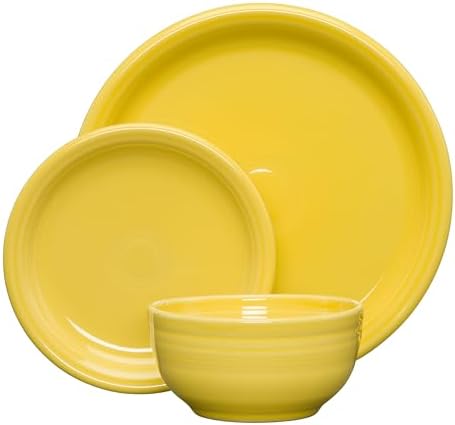

Modern ivory shows no reaction. Some vintage cobalt and turquoise pieces show faint green fluorescence under UV, but this response is inconsistent across pieces and should not be used as a definitive test.
For original red, a Geiger counter is the correct instrument — UV will not detect uranium in red glaze.
For full documentation of uranium oxide in original Fiestaware red and ivory, the chemistry differs between the two pieces and matters for both authentication and safety decisions.
The 1950s Fiestaware Colors — What Changed in 1951
In fall 1951, Homer Laughlin retired cobalt blue, light green, and old ivory and introduced four new colors as a group. These four shades — now called the 1950s color group by collectors — were produced for fewer than eight years before being retired in 1959.
That short window is why they consistently command higher prices than the original colors that ran for 15 or more years.
The Four 1950s Colors — Forest Green, Rose, Chartreuse, and Gray
| Color | Production Years | Tone Description | Collector Note |
|---|---|---|---|
| Forest Green | 1951–1959 | Deep, rich dark green | 8-year window; among the most valuable 1950s pieces |
| Rose | 1951–1959 | Dusty, muted pink | Less saturated than modern pink colors; distinctly sophisticated |
| Chartreuse | 1951–1959 | Yellow-green; mid-century modern | Modern chartreuse (1997–1999) looks visually similar; mark is the only sure test |
| Gray | 1951–1959 | Warm neutral gray | Distinguished from post-1986 Pearl Gray, which is cooler and has a slight shimmer |
Medium Green (1959–1969) — The Rarest and Most Valuable Vintage Color
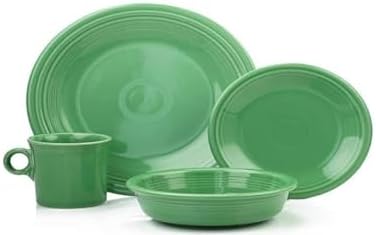
Medium green was introduced in 1959 as the eleventh vintage color and discontinued in 1969 — a 10-year production window, the shortest of any original Fiestaware color. It was never revived.

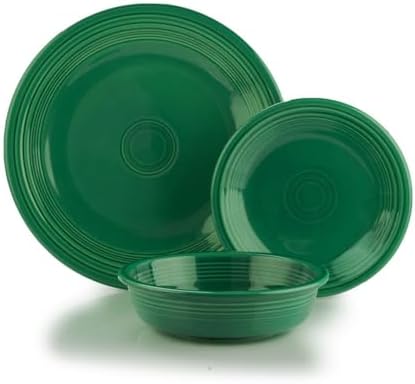

Collectors describe medium green as a true mid-tone green with a slightly yellow cast, distinctly different from light green (softer, mintier), forest green (darker), and any post-1986 green. It is sometimes called “John Deere green” or “Tic-Tac green” in collector communities.
The value figures reflect the scarcity: a medium green disk pitcher sells for $500–$800 at auction; a 5-piece place setting routinely exceeds $1,000. A confirmed medium green piece commands 2–5× the price of the same form in yellow or turquoise.
For a full breakdown of why medium green is the most valuable vintage Fiestaware color, the 10-year window combined with the lack of revival production drives sustained scarcity across all form types.
The End-of-Line Ironstone Colors (1969–1972)
In 1969, Homer Laughlin restyled the Fiestaware line for a final reduced production run known as the Ironstone era. The piece range was sharply cut and only four colors were produced during this terminal vintage period before the line was discontinued entirely in 1972.
The Four Ironstone-Era Colors
| Color | Production Years | Note |
|---|---|---|
| Antique Gold | 1969–1972 | Muted golden-yellow; strongly 1970s in aesthetic |
| Turf Green | 1969–1972 | Avocado-inspired green; quintessential late 1960s/1970s palette |
| Mango Red | 1969–1972 | Ironstone version of the original red line; coral-toned rather than orange-red |
| Amberstone Brown | 1969–1972 | Deep brown; limited collector appeal relative to other vintage colors |
Why Ironstone Colors Are Gaining Collector Interest
Ironstone was long dismissed by vintage collectors because the colors felt dated rather than classic. A retro resurgence across the last decade has pushed values upward as mid-century modern and 1970s aesthetics have re-entered mainstream interior design.
The limited piece range available in Ironstone colors — only disc pitcher, 7″ and 10″ plates, platter, shakers, sauce boat, and teapot were produced in these shades means fewer total pieces exist than in the main vintage run, creating genuine scarcity without the premium pricing of the classic colors.
For budget collectors entering the vintage market, Ironstone remains one of the most accessible entry points.
The Full Post-1986 Fiestaware Color Timeline
When Homer Laughlin revived Fiestaware in 1986 with lead-free, cadmium-free glazes, the relaunched line opened with six colors and has since expanded to more than 56 distinct shades across four decades of continuous production.
Only 13–16 colors are active at any given time — Fiesta Tableware Company’s policy requires a color to be retired before a new one can be introduced. This deliberate constraint is the structural engine behind collector value for discontinued modern pieces.
Modern Colors Released 1986–2010 With Production Dates
| Color | Years Active | Status | Note |
|---|---|---|---|
| White | 1986–present | Active | Permanent line staple |
| Black | 1986–present | Active | Permanent line staple |
| Cobalt Blue | 1986–2021 | Discontinued | Near-identical to vintage cobalt; see confusion table below |
| Rose | 1986–present | Active | More saturated than vintage rose |
| Apricot | 1986–1998 | Discontinued | Peachy tone; first modern color retirement |
| Yellow | 1986–present | Active | Brighter, more lemony than vintage yellow |
| Turquoise | 1988–present | Active | See confusion table — differs from vintage turquoise |
| Periwinkle Blue | 1989–2006 | Discontinued | Lavender-blue; 1990s bestseller |
| Sea Mist Green | 1991–2005 | Discontinued | Pale misty green |
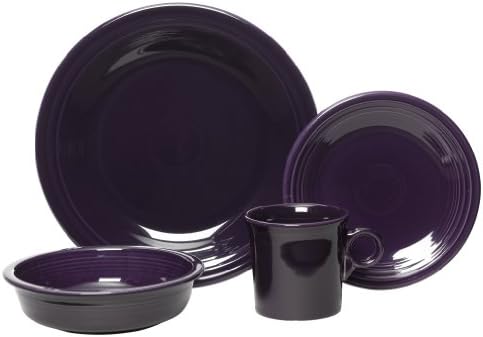
| Lilac | 1993–1995 | Discontinued | Two-year run; true purple; highly collectible |
| Persimmon | 1995–2006 | Discontinued | Bright orange-red; often confused with vintage red |
| Sapphire | 1996–1997 | Discontinued | Bloomingdale’s exclusive; deep blue-purple |
| Chartreuse | 1997–1999 | Discontinued | Modern version of 1950s chartreuse |
| Pearl Gray | 1999–2001 | Discontinued | Cooler than vintage gray; slight shimmer |
| Juniper | 1999–2001 | Discontinued | Deep blue-green |
| Cinnabar | 2000–2010 | Discontinued | Brownish-red |
| Sunflower | 2001–present | Active | Bright saturated yellow |
| Plum | 2002–2005 | Discontinued | Deep purple |
| Shamrock | 2002–2021 | Discontinued | Medium green |
| Tangerine | 2003–2017 | Discontinued | Vivid orange |
| Scarlet | 2004–present | Active | Modern red; fully lead-free and uranium-free |
Modern Colors Released 2010–Present With Production Dates
| Color | Years Active | Status | Note |
|---|---|---|---|
| Ivory | 2008–present | Active | Cooler than vintage old ivory; does not react under UV |
| Lemongrass | 2009–2024 | Discontinued | Pale yellow-green |
| Paprika | 2010–2016 | Discontinued | Muted warm red |
| Flamingo | 2012–2013 | Discontinued | Coral-pink; very short two-year run |
| Lapis | 2013–present | Active | Medium blue |
| Poppy | 2014–present | Active | Warm orange-red |
| Slate | 2015–2022 | Discontinued | Cool blue-gray |
| Sage | 2015–2018 | Discontinued | Muted gray-green |
| Claret | 2016–2017 | Discontinued | Deep wine red; one-year run |
| Foundry | 2016–present | Active | Charcoal gray |
| Daffodil | 2017 | Discontinued | Bright yellow; one-year annual color |
| Mulberry | 2018–2024 | Discontinued | Deep purple-plum |
| Meadow | 2019–present | Active | Medium sage green |
| Butterscotch | 2020–2024 | Discontinued | Warm golden amber |
| Twilight | 2021–present | Active | Deep teal-blue |
| Peony | 2022–present | Active | Soft blush pink |
| Jade | 2023–present | Active | Rich medium green |
| Sky | 2024–present | Active | Pale greenish-blue |
| Linen | 2025–present | Active | 2025 annual color; cream; evokes vintage old ivory |
| Lavender | 2026–present | Active | 2026 annual color; first true lavender since Lilac (1993–1995) |
Colors That Appear in Both Eras — The Cross-Era Confusion Guide
Knowing how to read a Fiestaware backstamp to confirm era is the definitive resolution for every cross-era confusion but knowing the visual differences speeds identification before you flip the piece.
Seven Fiestaware color names appear in both the vintage era and the modern line. Several are similar enough to cause misidentification at estate sales, thrift stores, and online auctions where photographs do not show the backstamp.
Cross-Era Color Comparison Table
| Color Name | Vintage Version | Modern Version | Key Visual Difference | Definitive Test |
|---|---|---|---|---|
| Cobalt Blue | 1936–1951: deep royal blue | 1986–2021: near-identical; fractionally brighter | Subtle brightness; side-by-side required | Backstamp: lowercase = vintage |
| Turquoise | 1937–1969: slightly deeper blue-green tone | 1988–present: brighter, cleaner teal | Vintage looks slightly faded next to modern | Backstamp: ® = modern |
| Yellow | 1936–1972: warm, buttery, slightly muted | 1986–present: brighter, more lemony | Modern is noticeably more saturated in direct comparison | Backstamp and ring base pattern |
| Rose | 1951–1959: dusty, grayed, muted pink | 1986–present: more saturated, cleaner pink | Vintage has a distinctly dusty tone | Vintage only in 1950s color group |
| Ivory | 1936–1951: warm cream; glows bright orange under UV | 2008–present: cooler, more white-leaning; no UV reaction | UV test is definitive in seconds | UV blacklight test |
| Chartreuse | 1951–1959: yellow-green; slightly warmer | 1997–1999: very similar; fractionally cooler | Nearly identical visually; mark is the only reliable test | Backstamp era |
| Gray | 1951–1959: warm neutral gray; matte finish | 1999–2001 (Pearl Gray): cooler with a slight shimmer | Pearl Gray has a visible shimmer; vintage is flat | Mark + color name difference |
For form-by-form authentication using shape and mold details alongside color, the complete Fiestaware authentication guide covers every distinguishing physical characteristic beyond the backstamp.
The Sapphire Problem — One Color That Fools Even Experienced Collectors
Sapphire (1996–1997) was produced exclusively for Bloomingdale’s as a retailer-exclusive modern color and ran for only approximately two years of full production.
It is a deep blue-purple — not a blue — and experienced collectors consistently confuse it with vintage cobalt blue, particularly in artificial lighting where the purple undertone is less visible.
In natural daylight, sapphire’s purple cast becomes apparent when compared directly to cobalt. The mark on the bottom is the only reliable test: sapphire always carries an uppercase FIESTA with the ® symbol, placing it definitively in the post-1986 era.
Despite being a modern piece with no vintage connection, sapphire’s short run makes it genuinely scarce, with per-piece prices of $60–$150+ for pieces in excellent condition.
The Rarest Fiestaware Colors and What They Are Worth
Rarity in Fiestaware is determined by production window length not by the age of a piece. A vintage yellow piece from 1938 is less scarce than a vintage chartreuse piece from 1955 because yellow ran for 36 years while chartreuse ran for eight.
The same principle applies to modern colors: lilac (1993–1995) at two years of production is rarer than periwinkle blue (1989–2006) at 17 years.
Vintage Color Rarity Hierarchy
| Rank | Color | Production Window | Rarity Reason | Value Range (per piece) |
|---|---|---|---|---|
| 1 | Medium Green | 1959–1969 (10 years) | Shortest window; never revived | $150–$800+ depending on form |
| 2 | Original Red (uranium) | 1936–1943 (7 years) | Uranium glaze; wartime production halt | $50–$300+ depending on form |
| 3 | Forest Green | 1951–1959 (8 years) | Short 1950s color group | $40–$200 depending on form |
| 4 | Chartreuse | 1951–1959 (8 years) | Short 1950s color group | $40–$200 depending on form |
| 5 | Gray | 1951–1959 (8 years) | Short 1950s color group | $40–$200 depending on form |
| 6 | Rose | 1951–1959 (8 years) | Short 1950s color group | $35–$180 depending on form |
| 7 | Yellow | 1936–1972 (36 years) | Full-run color; highest supply of any vintage color | $15–$80 depending on form |
Most Valuable Discontinued Modern Colors
- Lilac (1993–1995): Only two years of production made lilac a genuine purple rarity — it has never been reintroduced; pieces in excellent condition sell for $80–$200+ each.
- Sapphire (1996–1997): A Bloomingdale’s-exclusive deep blue-purple produced for approximately two years; commands $60–$150+ per piece and is frequently confused with vintage cobalt by inexperienced buyers.
- Periwinkle Blue (1989–2006): A 17-year run made it widely loved; complete place settings are the most sought-after format; individual pieces sell for $20–$60.
- Pearl Gray (1999–2001): Only two years of modern production; distinguished from vintage gray by its cooler tone and shimmer; $30–$80 per piece.
- Flamingo (2012–2013): One of the shortest modern runs at two years; coral-pink tone; increasingly sought-after as the secondary market tightens; pricing is rising from the $25–$60 range.
- Cobalt Blue (1986–2021): The 2021 retirement of a 35-year active color drove immediate secondary market activity; prices have increased 20–35% since retirement across most forms.
How Fiestaware’s Annual Color Retirement Cycle Works
Fiesta Tableware Company maintains 13–16 active colors at any time. When a new color is introduced typically one per year released in January as a limited-edition launch followed by a full collection in April an existing color must be retired to make room.
No competitor explains what this means for buyers as a forward-looking strategy.
The retirement of Cobalt Blue in 2021 is the best documented case study: a color active since the 1986 relaunch, with 35 years of continuous production, was retired without substantial advance notice.
Collectors who held inventory experienced 20–40% price appreciation on the secondary market within the first year of retirement.
Recent Annual Color Releases and Retirements (2019–2026)
| Year | New Color Introduced | Colors Retired That Year | Notes |
|---|---|---|---|
| 2019 | Meadow | — | — |
| 2020 | Butterscotch | — | — |
| 2021 | Twilight | Cobalt Blue, Shamrock | Cobalt retirement shocked the collector community after 35 years |
| 2022 | Peony | — | — |
| 2023 | Jade | — | — |
| 2024 | Sky | Lemongrass, Mulberry, Butterscotch | Multiple retirements cleared space for future introductions |
| 2025 | Linen | — | Cream tone evoking vintage old ivory; limited pieces sold out quickly |
| 2026 | Lavender | — | First true lavender in the line since Lilac (1993–1995) |
How to Buy Before a Color Gets Retired — What to Watch For
- Monitor Fiesta Factory Direct (fiestafactorydirect.com) directly: Color retirement announcements appear on the official site with varying lead times; subscribing to the brand’s email list gives the earliest notice.
- Watch for simultaneous bulk discounting across authorized retailers: When multiple authorized dealers begin discounting the same color at 20–30% simultaneously, retirement is frequently imminent.
- Annual color releases happen in January: Limited-edition pieces for the new annual color launch at noon on the Tuesday of release week; the 2024 Sky limited pieces and 2025 Linen limited pieces both sold out within hours.
- Complete dinner services gain value faster than individual pieces: A full service for eight in a retiring color commands significantly more as a set than the equivalent number of individual pieces — buyers pursuing complete services act quickly.
- Post-retirement secondary market appreciation has historically run 20–40% within the first year for short-run or well-loved colors; Cobalt Blue (retired 2021) is the documented benchmark case.
Fiestaware Color Combinations — How to Mix and Match
Mix-and-match color use has been embedded in Fiestaware’s design philosophy since 1936. The original line was priced so that families could buy one color at a time and build a coordinated mixed table over time.
Every color produced since the 1986 relaunch is designed to coordinate across the full active palette there is no wrong combination within the modern line, though some pairings read more cohesively than others.
Classic Color Combination Frameworks
| Combination Style | Colors | Best For |
|---|---|---|
| Bold contrast | Cobalt + Scarlet + Sunflower | Dramatic table statement; holiday entertaining |
| Warm neutrals | Linen + Butterscotch + Ivory | Understated; pairs naturally with wood surfaces |
| Cool coastal | Turquoise + Sky + White | Summer dining; beach house aesthetic |
| Jewel tones | Jade + Twilight + Mulberry | Rich; suited to evening entertaining |
| Citrus splash | Turquoise + Sunflower + Butterscotch + Lemongrass | Bright; playful everyday use |
| Earth tones | Foundry + Meadow + Poppy | Autumn table; farmhouse and natural settings |
| Vintage-inspired | Cobalt + Ivory + Yellow + Turquoise | Recreation of the classic original four-color palette |
Mixing Vintage and Modern Colors at the Same Table
Vintage and modern Fiestaware pieces can be used together at the same table because the concentric ring design is consistent across both eras. The challenge is managing color expectations.
Vintage cobalt and modern cobalt blue are close enough in tone to mix without creating visual tension.
Vintage turquoise and modern turquoise read differently — vintage sits slightly more muted, modern sits brighter — and work best as intentional contrast rather than as a matched pair.
Vintage yellow and modern yellow differ in saturation; mixing them creates a layered effect that reads as deliberate rather than mismatched.
Linen (2025) was explicitly designed to evoke vintage old ivory, making it a natural complement to table settings that incorporate genuine vintage ivory pieces.
Frequently Asked Questions About Fiestaware Color
What are the original Fiestaware colors?
Fiestaware launched with five colors in 1936: red, cobalt blue, light green, yellow, and old ivory. Turquoise was added in 1937, bringing the founding palette to six. Yellow is the only original color that remained in continuous production through the full vintage run (1936–1972).
How many Fiestaware colors have been made in total?
Fiestaware has been produced in more than 56 distinct colors since 1936 across both the vintage era and the modern revival. Only 13–16 colors are active at any one time; the rest are discontinued.
Several color names appear in both eras but are produced with different glaze formulations.
What is the rarest and most valuable Fiestaware color?
Medium green (1959–1969) is the rarest vintage color, produced for only 10 years and never revived.
A 5-piece medium green place setting routinely sells above $1,000 at auction, and individual pieces command 2–5× the price of the same form in common vintage colors like yellow or turquoise.
Is there a difference between vintage and modern Fiestaware turquoise?
Yes, vintage turquoise (1937–1969) is a slightly deeper, blue-green tone; modern turquoise (1988–present) reads as a brighter, cleaner teal. Side-by-side, vintage turquoise appears slightly faded by comparison.
The backstamp is definitive: a lowercase ink stamp confirms vintage; an uppercase FIESTA with ® confirms modern.
What Fiestaware colors contain uranium?
Original red (1936–1943) and old ivory (1936–1951) both contained uranium oxide in their glaze formulas. Depleted uranium was used in red from 1959–1972.
Modern Fiestaware (1986–present) contains no uranium in any color — old ivory is the most overlooked uranium color, and it glows bright orange under a UV blacklight.
What is the new Fiestaware color for 2025?
The 2025 annual color is Linen, a cream-toned shade described by Fiesta Tableware Company as contemporary, elegant, and complementary.
Limited-edition pieces launched in January 2025; the full Linen collection became available in April 2025. The color is new to the line but evokes the warmth of vintage old ivory.
Which discontinued modern Fiestaware colors are most collectible?
Lilac (1993–1995) and Sapphire (1996–1997) are the most sought-after discontinued modern colors because of their two-year-or-less production runs. Periwinkle Blue (1989–2006) and Pearl Gray (1999–2001) also command premiums, particularly for complete sets.
Cobalt Blue, retired in 2021 after 35 continuous years, has appreciated 20–40% on the secondary market since retirement.
How do I mix Fiestaware colors for a table setting?
Any combination of current Fiestaware colors will coordinate visually — the line is designed for mixing. The most cohesive mixed tables pair two or three colors from the same temperature family (warm with warm, cool with cool) and add one contrast color as an accent.
Named Fiesta combinations include Citrus Splash (turquoise, sunflower, butterscotch, lemongrass) and a vintage-inspired grouping of cobalt, ivory, yellow, and turquoise.
What Fiestaware colors were only made in the 1950s?
Four colors were produced exclusively from 1951 to 1959: forest green, rose, chartreuse, and gray. All four were introduced together in fall 1951 and retired in 1959, giving each a production window of approximately eight years — shorter than any of the original 1936 colors.
How can I tell vintage old ivory from modern ivory?
The UV blacklight test is definitive: vintage old ivory glows bright orange under UV due to its uranium oxide content; modern ivory (2008–present) shows no UV reaction.
Visually, vintage old ivory is warmer and creamier; modern ivory is cooler and leans more white. The backstamp confirms era — a lowercase ink stamp is vintage; an uppercase FIESTA with ® is modern.
About the Author & Reviewer
Sarah Emirone, Author
Sarah researches and writes SafeKitchn’s dinnerware and kitchenware guides, with a focus on material safety, lead content, and manufacturer specifications. She cross-references product data sheets, safety certifications, and regulatory filings (including FDA and Prop 65 records) before publishing, and updates articles when new information becomes available.
James Daniels, Reviewer
James reviews SafeKitchn’s material safety content for scientific accuracy. He holds a B.Sc in inorganic chemistry and works as a materials researcher, with particular focus on the composition and safety behavior of glass, ceramic, and metal used in kitchenware.