

The marks on the bottom of a Fiestaware piece tell you its age, its manufacturer, and — critically — whether it is safe to use daily.
Understanding Fiestaware vintage markings is the fastest way to separate a valuable 1936 find from a modern reproduction, confirm an estate sale price, or decide whether a piece belongs in your cabinet or on your shelf.
Most identification guides give you a simplified rule and stop there. This guide gives you the complete picture: every mark type, every era, every safety signal, and every exception that the simplified rules get wrong.
Written by Sarah Emirone | Reviewed by James Daniels, B.Sc, Inorganic Chemist & Materials Researcher | Updated September 2026 | See How We Test | Filed under: Identification & Authentication
The Two Types of Fiestaware Markings and What Each Means
Every Fiestaware marking falls into one of two physical categories — ink backstamp or in-mold impression — and the distinction between them changes how you use the mark as a dating tool.
Treating both types as interchangeable is the root cause of the most common misidentification mistakes made by collectors.
Ink Backstamp Markings — What They Look Like and When They Were Used
An ink backstamp is a printed mark applied by hand stamp after the glaze color was laid down and before the final clear glaze coat was fired. This placement means the mark is permanently sealed under the glaze; it cannot be washed off, rubbed away, or faked after the fact.




Ink stamps appear primarily on flat pieces such as plates, platters, and saucers. Homer Laughlin used four distinct ink stamp variants across the vintage production period from 1937 to 1972.
The lowercase ink stamp rule is the one clean rule with no exceptions: if a Fiestaware piece has an ink backstamp where the word “fiesta” is written entirely in lowercase script letters, that piece is definitely vintage, produced between 1936 and 1972.
No post-1986 Fiestaware has a lowercase ink stamp. This rule works only for ink stamps, not in-mold impressions.
| Ink Stamp Variant | Appearance | Notes |
|---|---|---|
| Variant 1 | “fiesta” script + HLCo USA | Most common early stamp |
| Variant 2 | “fiesta” script + MADE IN U.S.A. | “Made in” written out in full |
| Variant 3 | GENUINE “fiesta” + H..Co USA | “GENUINE” above logo; “Co” often blurred |
| Variant 4 | In-mold “fiesta” + HLC USA or MADE IN USA | Pressed impression used on hollow pieces |
In-Mold Markings — Why These Are Harder to Date
An in-mold mark is pressed directly into the clay body before glazing and firing. It appears as a raised or recessed impression and is used primarily on hollow items such as mugs, pitchers, and bowls.
The problem for collectors: old production molds — including molds with lowercase “fiesta” impressions — were reused when Homer Laughlin relaunched the line in 1986. This means a piece can have a lowercase in-mold impression and still be a post-1986 modern piece.
If your lowercase mark is pressed into the clay rather than printed in ink, do not rely on letter case alone. Check for the ® symbol. If it is present anywhere on the mark, the piece is post-1986, regardless of whether the “fiesta” text is uppercase or lowercase.
The presence of the letter “H” embedded in the in-mold impression is also a definitive post-1986 signal. Its absence does not confirm vintage — it simply removes one modern indicator, requiring you to cross-check color and form.
What the Words and Symbols on a Fiestaware Mark Actually Mean
Every element of a Fiestaware backstamp carries a specific meaning tied to its production era. Reading the mark correctly means understanding what each word, abbreviation, and symbol signals — and which elements appear across eras versus which are era-exclusive.
Decoding HLC, H-L-Co, and Homer Laughlin Variants
HLC / H-L-Co / HLCo — Homer Laughlin China Company, the original manufacturer of Fiestaware since 1936. Appears on both vintage and modern pieces. Not a dating signal by itself.
GENUINE — Added above “fiesta” on some vintage ink stamps. Its presence confirms vintage production; its absence does not disconfirm it, as not all vintage pieces carried this word.
USA / MADE IN USA — Appears on both vintage and modern pieces. Not a reliable dating differentiator on its own.
Lead Free — Appears on post-1986 pieces only. Its presence is a definitive modern indicator. No vintage piece (1936–1972) carries this text.
® (registered trademark symbol) — Used only from 1986 onward. Its presence on any mark — ink or in-mold — confirms the piece is post-1986, without exception.
Circular logo pattern — The “FIESTA HLC USA” arranged in a circle is a post-1986 modern era marking only.
FIESTA in all capital letters — Uppercase “FIESTA” on an ink stamp indicates post-1986 production. No vintage ink stamp uses all-caps for the brand name.
The Registered Trademark ® Symbol — The Most Overlooked Dating Signal
The ® registered trademark symbol is the fastest single-signal test for pieces where the in-mold mark is ambiguous.
Vintage Fiestaware from 1936 to 1972 carries no registered trademark symbol. Homer Laughlin did not use ® on Fiesta marks during the original production run.
When the line was revived in 1986, the ® symbol was incorporated into the new marking system. This means any piece — regardless of whether the “fiesta” text appears uppercase or lowercase — is post-1986 if it carries the ® symbol.
Most competitor guides mention the letter-case rule prominently and bury or omit the ® test entirely. For in-mold marks specifically, the ® is more reliable than letter case.
How to Read Fiestaware Date Codes on Post-1992 Pieces
If your piece has a cluster of three or four letters printed below the “FIESTA” logo, it was made after 1992, definitely not vintage.
This immediately resolves the identification question for modern pieces and gives you a precise production quarter if you know how to decode the sequence.
The Complete Date Code Letter System (1986–Present)
Homer Laughlin began applying date codes to select pieces in 1986, with broader use from 1992 onward. From 1986 to 2011, the code consisted of three letters. From 2012 onward, a fourth letter was added.
The first two letters (or first three from 2012) identify the year using a sequential alphabet system. The last letter identifies the production quarter.
Quarter key: A = Q1 (Jan–Mar) · B = Q2 (Apr–Jun) · C = Q3 (Jul–Sep) · D = Q4 (Oct–Dec)
| Code | Year | Code | Year | Code | Year |
|---|---|---|---|---|---|
| AA | 1986 | MM | 1998 | YY | 2010 |
| BB | 1987 | NN | 1999 | ZZ | 2011 |
| CC | 1988 | OO | 2000 | AAA | 2012 |
| DD | 1989 | PP | 2001 | BBB | 2013 |
| EE | 1990 | 2002 | CCC | 2014 | |
| FF | 1991 | RR | 2003 | DDD | 2015 |
| GG | 1992 | SS | 2004 | EEE | 2016 |
| HH | 1993 | TT | 2005 | FFF | 2017 |
| II | 1994 | UU | 2006 | GGG | 2018 |
| JJ | 1995 | VV | 2007 | HHH | 2019 |
| KK | 1996 | WW | 2008 | III | 2020 |
| LL | 1997 | XX | 2009 | JJJ | 2021 |
2022 Exception: In 2022, Fiesta Tableware Company skipped the code “KKK” and moved directly to LLL. If your piece carries a code that appears to skip a step in the alphabetical sequence, this is the reason: the piece was produced in 2022 or later.
No competitor date code table documents this skip. LLL = 2022, MMM = 2023, NNN = 2024, OOO = 2025.
Reading examples: OOA = Q1 of 2000 · AAAB = Q2 of 2012 · LLLC = Q3 of 2022
Why Pre-1992 Vintage Pieces Cannot Be Pinpointed by Marking Alone
Fiestaware produced between 1936 and 1972 carried no year-coded marking system. A vintage ink stamp confirms that a piece was made sometime within that 36-year window, but it cannot tell you whether the plate is from 1938 or 1965.
Narrowing the date range for a vintage piece requires cross-referencing three signals: the mark type (confirms vintage era), the color (each color has a documented production window), and the piece form (certain forms were discontinued mid-run).
No single vintage mark resolves to an exact year — only a date range recoverable through color.
Fiestaware Vintage Markings by Era — What Each Period Looks Like
Three distinct marking eras define Fiestaware’s production history: original vintage (1936–1972), a 13-year production gap (1973–1985 — no Fiestaware was manufactured), and the modern revival (1986–present).
Each era’s marks are visually distinct once you know the specific signals.
Original Vintage Era Marks (1936–1972) — The Four Variants
All four vintage ink stamp variants share the same core characteristic: “fiesta” written in lowercase script. The differences between them are wording and layout variations that evolved across the 36-year production run.
All four confirm vintage status equally; no variant is more authoritative than another for authentication purposes.
| Variant | Key Feature | Presence of “GENUINE” | HLC Notation |
|---|---|---|---|
| Variant 1 | Script “fiesta” + HLCo USA | No | HLCo |
| Variant 2 | Script “fiesta” + MADE IN U.S.A. | No | Not shown |
| Variant 3 | GENUINE + script “fiesta” + H..Co USA | Yes | H..Co (Co blurred) |
| Variant 4 | In-mold “fiesta” + HLC USA | No | HLC |
Modern Revival Era Marks (1986–Present) — Key Visual Differences
- FIESTA in all capital letters appears on ink stamps — no vintage ink stamp uses uppercase for the brand name.
- The ® registered trademark symbol is present on virtually all post-1986 marks, in both ink and in-mold forms.
- “Lead Free” text appears on most post-1986 pieces, confirming the 1986 glaze reformulation.
- A circular logo arrangement — “FIESTA HLC USA” set in a ring — is used on some modern pieces and does not appear on any vintage mark.
- The letter “H” embedded in in-mold marks indicates post-1986 production when present.
- Three- or four-letter date codes are present from 1992 onward, immediately identifying modern pieces.
Does All Fiestaware Have Markings? How to Identify Unmarked Pieces
For the full Fiestaware identification guide covering color timelines and form-based dating, the marking system is only one part of the picture — because not all genuine Fiestaware left the factory with a mark.
An unmarked piece is not automatically fake or worthless. Homer Laughlin intentionally left specific piece types unmarked throughout the vintage production period.
Which Vintage Pieces Were Intentionally Left Unmarked
- Juice tumblers were never stamped because the cylindrical form and small base area did not accommodate the stamp footprint.
- Demitasse cups were too small to carry a legible ink stamp at production volume.
- Teacups were left unmarked in the vast majority of cases, though a small number of exceptions exist from certain production periods.
- Salt and pepper shakers were never marked — the flat bottom of the shaker base was too limited in surface area.
- Egg cups were produced without marks throughout the vintage run.
- Sweets comports (compotes) exist in both marked and unmarked versions; batch variation determined which received a stamp.
- Some early ashtrays were left unmarked, depending on production run; others carry the standard vintage ink stamp.
- Some onion soup bowls were stamped, while others from the same era were not — production variation rather than design intent.
How to Authenticate an Unmarked Piece Without a Mark
- Check the color — compare the piece against the known vintage palette: red, cobalt blue, ivory, yellow, light green, turquoise, rose, gray, dark green, chartreuse, and medium green. If the color is not on this list (for example, persimmon, flamingo, or apricot), the piece is post-1986.
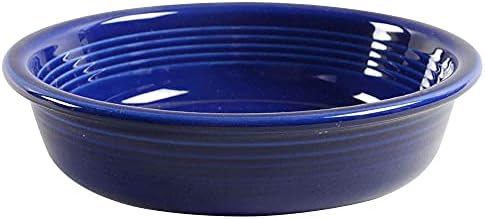
- Check the rings — genuine Fiestaware has concentric rings wrapping the entire piece, with rings spaced progressively wider toward the rim. Knock-offs typically have wrong ring spacing, rings that stop partway, or rings only on the rim.
- Check the form — cross-reference the specific piece shape against known production windows. Certain forms (such as the carafe and covered onion soup bowl) were discontinued mid-run, which narrows the date range significantly.
- Check the glaze depth — vintage glaze tends toward a richer, deeper saturation than modern reproductions. Vintage red specifically has a darker, slightly murkier orange-red cast; post-1995 persimmon reads as a brighter, cleaner orange-red.
- Check for paper label residue — some early pieces used paper labels rather than ink stamps; the adhesive residue may still be faintly visible under strong direct lighting, confirming the piece was marketed as authentic Fiestaware.
What Fiestaware Markings Tell You About Lead, Cadmium, and Radioactivity
The mark on the bottom of a Fiestaware piece is a safety signal, not just a dating signal. Pieces produced between 1936 and 1972 contain lead and cadmium in their glaze formulations.
Pre-1943 red pieces contain uranium oxide. The 1986 production revival marked a complete reformulation of any piece with “Lead Free” text or an uppercase FIESTA mark with a ® symbol is from the post-1986 era and meets all current FDA food safety standards.
Which Marking Eras Correspond to Which Hazards
| Era | Mark Characteristics | Primary Safety Concern |
|---|---|---|
| 1936–1943 (vintage) | Lowercase ink stamp, no ® | Red: uranium oxide (EPA advises against food use); other colors: lead in glaze |
| 1943–1959 (vintage, no red produced) | Lowercase ink stamp, no ® | Non-red colors contain lead; no uranium in production during this period |
| 1959–1972 (vintage) | Lowercase ink stamp, no ® | Red: depleted uranium; other colors: cadmium and lead at levels exceeding modern FDA limits |
| 1973–1985 | No Fiestaware produced | N/A |
| 1986–present | Uppercase FIESTA, ® symbol, “Lead Free” | Lead-free, cadmium-free, uranium-free; fully FDA compliant |
For a detailed breakdown of uranium oxide in Fiesta’s original red glaze and radiation level measurements, the evidence base extends to documented U.S. Nuclear Regulatory Commission assessments and health physics research.
Practical Safety Guidance Based on Your Piece’s Mark
- Lowercase ink stamp, red color (1936–1943): Do not use for daily food service. The U.S. EPA advises against using uranium-glazed ceramics for food or drink. The NRC classifies radiation levels as low but not zero; occasional display use poses minimal risk.
- Lowercase ink stamp, red color (1959–1972): Depleted uranium was used in place of natural uranium; radiation levels are lower than pre-1943 pieces but still register above background on a Geiger counter. The same advisory applies — display rather than daily food use is the safer approach.
- Lowercase ink stamp, non-red colors (any vintage year): Lead is locked within the glaze matrix and does not readily leach under normal use conditions. Most collectors and food safety guidance consider these safe for occasional use; those who prefer caution display rather than eat from them.
- Uppercase FIESTA mark and/or “Lead Free” text: Fully safe for everyday food and drink use; all current FDA standards are met.
- Any vintage piece with chips or cracks: Do not use for food service, regardless of color. A damaged glaze surface can leach both lead and uranium compounds at significantly higher rates than intact glaze.
- If your piece’s era is uncertain: Use a 3M LeadCheck swab as initial home screening; send to a certified laboratory for XRF testing if comprehensive results are needed.
How to Spot Fiestaware Reproductions and Look-Alikes Using the Markings
The most common authentication errors made by new collectors are not caused by deliberate forgeries; they are caused by misreading modern pieces as vintage or confusing similar-colored pieces from different eras.
The marking always has the final word, provided you apply the correct rules to the correct mark type.
The Four Most Common Fiestaware Marking Mistakes
- Assuming lowercase in-mold = vintage: Old production molds with lowercase impressions were reused after the 1986 revival. A lowercase in-mold mark is not a reliable vintage confirmation on its own. Always check for the ® symbol and the letter “H” in the mark before concluding the piece is vintage based on an in-mold impression.
- Assuming unmarked = fake or worthless: Several genuine vintage piece types were never stamped at the factory. An unmarked juice tumbler or salt shaker in the correct vintage color and with correct ring patterning is very likely an authentic piece — not a reproduction.
- Confusing persimmon (post-1995) with vintage red: Persimmon is a modern color introduced in 1995 that reads as a bright, clear orange-red. Vintage red — especially pre-1943 — is darker and carries a murkier orange cast. If the bottom shows a ® mark, it is a persimmon without question.
- Dating by color alone without checking the piece form: Yellow was produced across the entire vintage line from 1936 to 1972. A yellow piece could originate from any vintage year. Cross-check the specific piece shape against known production windows for that form to narrow the date range; color alone is insufficient when a color ran the full production period.
Look-Alike Brands That Mimic Fiestaware Markings
- Harlequin (Homer Laughlin): Made by the same manufacturer but sold exclusively through Woolworth stores; the mark will not say “Fiesta,” and the ring pattern and piece profiles differ from Fiesta forms.
- Riviera (Homer Laughlin): Also manufactured by HLC; features square or angular edges rather than the rounded Fiesta profile; no Fiesta concentric ring banding.
- Caliente (Paden City Pottery): Bright colors and rounded forms closely resemble Fiestaware; the mark will read “Caliente” or “Paden City” rather than “fiesta.”
- Vistosa (Taylor, Smith & Taylor): Uses a very similar color palette, including a radioactive red glaze; markings read “Vistosa” or “TST” and can be distinguished from Fiesta marks once you know both systems.
- Foreign imitations: Generally lack the HLC manufacturer identification; walls tend to be thinner and less uniform; ring banding is typically imprecise or inconsistent in width and spacing.
For a side-by-side breakdown of how Fiestaware markings differ from Harlequin pottery, the manufacturer overlap between the two lines makes mark reading the only reliable distinguishing method.
Using Markings and Color Together to Establish Value
Value in Fiestaware is determined by the intersection of marking era, color, and piece form; no single factor produces a valuation on its own.
A vintage ink stamp on a yellow plate occupies a different value tier than the same ink stamp on a medium green plate, because medium green was produced for only 10 years (1959–1969) and is the rarest color in the original line.
Value Hierarchy by Era and Color
| Marking Era | Color | Relative Value |
|---|---|---|
| Vintage ink stamp (1936–1972) | Medium green | Highest — 2–5× other vintage colors for the same form |
| Vintage ink stamp (1936–1943) | Red (uranium-era) | High — uranium content adds measurable collector premium |
| Vintage ink stamp (1951–1959) | Chartreuse, dark green, gray, rose | High — short production window of approximately 8 years |
| Vintage ink stamp (any vintage year) | Cobalt blue, turquoise, ivory | Moderate |
| Vintage ink stamp (any vintage year) | Yellow, light green | Moderate — ran the full vintage line; higher supply |
| Post-1986 uppercase FIESTA mark | Any color | Lower — modern pieces occupy a separate collector market |
For a full breakdown of why medium green commands the highest collector premiums across all Fiestaware colors, the 10-year production window and the difficulty of distinguishing it from modern greens drive both scarcity and price.
Which Piece Forms Command the Highest Premiums Regardless of Mark
- Carafe with stopper was produced only from 1936 to 1946, making it one of the shortest-window forms in the vintage line and consistently the most sought-after at auction.
- Covered onion soup bowls command a premium in any vintage color due to their complex two-piece form and higher attrition rate from lids being separated or broken.
- Bulb candle holders are desirable because they were not reproduced in the post-1986 revival, making all existing examples definitively vintage.
- Vintage teapot (produced in two sizes; the medium teapot was discontinued in 1943) commands premiums, particularly in the medium size, which had the shortest production window.
- Sweets comport (compote) — the footed presentation dish — is scarcer in the marked variant than the unmarked version and commands a premium accordingly.
- Syrup pitcher with lid is rarely found intact (lids are frequently lost or broken), making complete examples significantly more valuable than lidless ones.
Ready to take identification further? Cross-reference your mark with the complete Fiestaware color timeline to pin down the exact production window for your piece, or use the vintage Fiestaware value guide to understand what your authenticated piece is worth on the current collector market.
Frequently Asked Questions About Fiestaware Vintage Markings
Does a lowercase “fiesta” mark always mean the piece is vintage?
A lowercase ink stamp definitively confirms vintage production (1936–1972) — that rule holds without exception. A lowercase in-mold impression does not confirm vintage, because old molds were reused after the 1986 revival. For in-mold marks, check for the ® symbol; if present, the piece is post-1986 regardless of letter case.
What do the three or four letters on the bottom of my Fiestaware mean?
They are a production date code used from 1992 onward. The first two letters (or three from 2012) identify the year using a sequential alphabet system starting at AA=1986; the last letter identifies the production quarter (A=Q1, B=Q2, C=Q3, D=Q4). A code of OOA means Q1 of 2000; AAAB means Q2 of 2012.
Why doesn’t my Fiestaware have any markings on the bottom?
Certain piece types were intentionally left unmarked because their form could not accommodate a stamp — including juice tumblers, demitasse cups, most teacups, salt and pepper shakers, and egg cups. An unmarked piece is not automatically fake; verify authenticity using color, ring pattern, and piece form cross-referenced against known production windows.
What does HLC mean on Fiestaware?
HLC stands for Homer Laughlin China Company, the original manufacturer of Fiestaware from 1936. Variations include H-L-Co, HLCo, and in modern pieces, the full name written out. HLC appears on both vintage and modern pieces and is not a reliable dating signal on its own.
Is my vintage Fiestaware safe to use for food?
Non-red vintage pieces are generally considered safe for occasional use, as lead in intact vintage glazes does not readily leach under normal conditions. Original red pieces (1936–1943) contain uranium oxide, and the U.S. EPA advises against using uranium-glazed ceramics for food service. Never use any vintage piece — regardless of color — if the glaze is chipped or cracked.
How can I tell if my piece is persimmon or vintage red?
Flip the piece and look for the ® registered trademark symbol — if present, the piece is post-1986 persimmon, definitively. Without ®, examine the color directly: vintage red has a darker, murkier orange-red tone while persimmon is a brighter, cleaner orange-red. A Geiger counter will register above background radiation on genuine pre-1972 red but not on persimmon.
When did Fiestaware become lead-free?
Homer Laughlin reformulated all Fiestaware glazes to be lead-free and cadmium-free when the line relaunched in 1986 after a 13-year hiatus. Any piece marked “Lead Free” or carrying an uppercase FIESTA mark with a ® symbol was made in or after 1986 and meets all current FDA food safety standards.
What is the rarest and most valuable Fiestaware marking era?
The vintage ink stamp era (1936–1972) is the most collectible. Within that era, medium green (produced only 1959–1969) commands premiums of 2–5× the same form in other vintage colors. Pre-1943 uranium-red is the second most sought-after, and the short-run colors from 1951–1959 (chartreuse, dark green, gray, rose) also command significant collector premiums.
How do I know if an in-mold mark is vintage or post-1986?
Check for three signals in sequence: first, the ® symbol — if present, post-1986; second, the letter “H” embedded in the impression — if present, post-1986; third, cross-check the color against the vintage palette and the form against known production windows. An in-mold mark without ® or H, in a verified vintage color and form, is likely vintage but requires all three checks before concluding.
What is the difference between the four vintage ink stamp variants?
All four variants share the lowercase “fiesta” in script and all confirm vintage status equally. The differences are wording and layout: Variant 3 adds “GENUINE” above the logo; Variant 2 spells out “MADE IN U.S.A.” rather than just “USA”; the “Co” in “H-L-Co” on Variant 3 frequently appears blurred together; and minor changes to the letterform of the “f” evolved gradually across the 36-year production run.
About the Author & Reviewer
Sarah Emirone, Author
Sarah researches and writes SafeKitchn’s dinnerware and kitchenware guides, with a focus on material safety, lead content, and manufacturer specifications. She cross-references product data sheets, safety certifications, and regulatory filings (including FDA and Prop 65 records) before publishing, and updates articles when new information becomes available.
James Daniels, Reviewer
James reviews SafeKitchn’s material safety content for scientific accuracy. He holds a B.Sc in inorganic chemistry and works as a materials researcher, with particular focus on the composition and safety behavior of glass, ceramic, and metal used in kitchenware.