

Gibson dinnerware is not made in the United States. Despite being an American-headquartered, family-owned company based in Los Angeles, California, Gibson Overseas Inc. manufactures its dinnerware primarily in China, with additional production in Thailand, Vietnam, and India.
The company maintains 15 offices in China alone, offices in Thailand, Vietnam, and India, and works with over 400 factories worldwide, a manufacturing footprint that it describes openly on its own website.
If you landed here looking for a quick answer, that is it. If you want to understand what that answer actually means for the quality, safety, and value of what you are buying and how Gibson’s manufacturing model compares to the alternatives, this article covers all of it.
Written by Sarah Emirone | Reviewed by James Daniels, B.Sc, Inorganic Chemist & Materials Researcher | Updated September 2026 | See How We Test | Filed under: Origin & Manufacturing
Who Is Gibson Overseas Inc.? Understanding the Company Behind the Brand
Most buyers who purchase Gibson dinnerware from Amazon, Walmart, Target, or Wayfair do not realize they are buying from a company called Gibson Overseas Inc.
The consumer-facing brands — Gibson Home, Gibson Elite, and Gibson Everyday — are product line names, not the corporate name. The parent company has “Overseas” built directly into its legal name, which accurately describes its business model from the outset.
The Company’s Origin and Structure
Gibson Overseas Inc. was founded in 1979 by Nejat Gabbay, an entrepreneur who built the company from a small operation into one of the largest dinnerware suppliers in the United States.
The company is still family-owned and is currently operated by Nejat Gabbay’s sons. Gibson’s corporate headquarters are in Commerce, California, near Los Angeles, where the company employs over 600 people in the United States across design, sales, marketing, logistics, and management functions.
According to its own profile, Gibson describes itself as “considered the largest maker of Chinese ceramics worldwide” — a phrase that appears in company documentation and directly addresses the manufacturing question.
The company has partial ownership in three of the largest factories in Asia, giving it a degree of vertical integration uncommon in the import-model housewares industry.
This ownership stake, combined with 20-plus offices across Asia, means Gibson’s relationship with its manufacturing base is closer to a vertically integrated producer than a simple importer purchasing from third-party factories.
The Brand Naming Strategy
The gap between the company name (Gibson Overseas) and the consumer-facing brand name (Gibson Home) is not accidental.
“Overseas” in a corporate name carries specific connotations for buyers who are researching the country of origin; it signals an import model.
The consumer brand names Gibson Home and Gibson Elite carry no such signal.
This naming structure is common in the housewares import industry and is not illegal, but it means buyers who do not look past the product brand name will not encounter clear information about manufacturing origin in typical retail browsing.
Where Specifically Is Gibson Dinnerware Made?
The manufacturing picture for Gibson is not a single-country answer. Different product lines and materials are produced in different locations based on manufacturing capability, cost, and factory relationships.
China — The Primary Manufacturing Base
China is Gibson’s dominant production country for dinnerware. The company’s stoneware, porcelain, and ceramic collections, which represent the large majority of its dinnerware volume, are produced in Chinese factories.
Gibson states it has 15 offices in China and partial ownership in three of Asia’s largest factories, giving it substantial control over Chinese production compared to brands that simply source from independent suppliers.
The Chinese ceramic manufacturing industry is highly developed and capable of producing dinnerware across the full quality spectrum, from low-cost earthenware to high-grade vitrified porcelain.
Gibson’s position as a large-volume buyer with factory ownership stakes gives it greater leverage over quality consistency than smaller importers.
That said, the breadth of Gibson’s catalog — covering dozens of collections across multiple sub-brands at a wide range of price points — means quality control outcomes vary across the range.
Thailand, Vietnam, and India — Secondary Production Locations
Gibson explicitly references offices and production relationships in Thailand, Vietnam, and India.
These countries serve specific manufacturing needs, typically for materials or product categories where local expertise, cost structures, or factory relationships offer advantages over Chinese production.
The specific product lines produced in each country are not itemized publicly by Gibson, and individual product pages at retailers may not specify which of these countries applies to a given set.
For buyers who specifically need country of origin information for a particular Gibson product — for import compliance, personal preference, or regulatory reasons, the most reliable source is the product packaging itself, which is required by U.S. Customs law to display country of origin.
This information may not always be easily accessible before purchase through an online retailer.
The Factory Ownership Factor — What It Changes
Gibson’s partial ownership of three major Asian factories is a meaningful differentiator from brands that operate purely as importers. When a company owns manufacturing capacity rather than simply purchasing from it, several things change:
- Quality specifications are enforced as an owner rather than requested as a customer, a distinction that affects how consistently production standards are maintained.
- Production scheduling can be controlled to avoid the shortcuts that occur when factories are managing competing client demands under time pressure.
- Design integration between the U.S. creative team and the manufacturing floor is tighter when the company has a permanent physical presence and ownership stake at the facility.
None of this changes the fundamental answer, Gibson dinnerware is made in Asia, not the USA, but it does distinguish Gibson’s model from import-only brands that have no operational connection to their production facilities.
Gibson’s Product Lines — and How Manufacturing Relates to Each
Gibson sells dinnerware under several distinct sub-brands, each positioned at a different quality and price tier. Understanding which line you are buying within determines what to expect in terms of material quality and design ambition.
Gibson Home — Everyday Accessible
Gibson Home is the entry-level consumer line, positioned for accessible everyday use. It covers a wide range of materials, including stoneware, porcelain, melamine, and wheat straw, at price points that compete directly with mass-market dinnerware at major retailers.

- CLASSIC DESIGN: a classic white coupe shape dinnerware set with everyday elegance.
- WHAT’S IN THE BOX: Service for 6 that includes 6 of each of the following: 10.25” Dinner Plates, 7.25” Dessert Plates, 6…
- AB-GRADE PORCELAIN: a durable, lightweight, BPA-free, and heat-resistant material made from 100% natural minerals. These…
The design approach is broad; Gibson Home includes both classic and contemporary styles, practical white-on-white sets, and seasonal or novelty collections.
This is the line most commonly seen under Gibson’s name at Walmart and Amazon at lower price points.
Gibson Elite — Mid-Range with Artisan Aesthetics
Gibson Elite is the brand’s mid-range tier, positioned above Gibson Home on both price and design ambition.
Elite collections frequently use reactive glaze stoneware, a technique that produces intentional variation in glaze color and texture across pieces, giving each item a unique appearance.
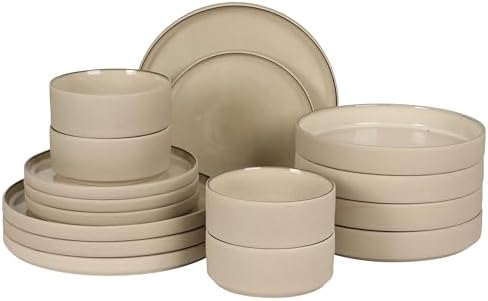
- FOUR PLACE SETTINGS: This complete set includes four 10-inch dinner plates, four 8-inch dessert plates, four 8.5-inch di…
- EXPERTLY CRAFTED: Gibson Elite is part of a renowned family of legacy brands with over 40 years of expertise in enhancin…
- ART ON THE TABLE: Each plate and bowl showcases the perfect balance of artistry and technique. A glossy reactive glaze c…
This places Gibson Elite in direct competition with artisan-aesthetic stoneware brands at higher price points, while maintaining Gibson’s cost-efficient manufacturing model.
Collections like Gelston, Sunveil, Pasco, and Solana Coast are representative Elite lines: stoneware with matte reactive glazes, coupe shapes, and modern silhouettes.
Gibson Everyday — Value Tier
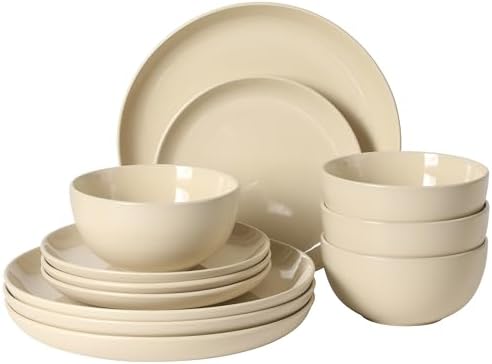
- A COMPLETE SET INCLUDES: Four 10.5-inch dinner plates, four 8-inch dessert plates and four 6-inch cereal bowls. Recogniz…
- WEAR-RESISTANT STONEWARE: Sturdy stoneware dinnerwares set crafted to serve meals every day for any style, occasion, and…
- QUIET SOPHISTICATION: Soft, matte glaze provides a dreamy texture as a smooth backdrop for various plating styles. Off-w…
Gibson Everyday is the budget end of the Gibson range, covering functional, no-frills dinnerware sets at the lowest price points in the catalog.
It serves the segment of buyers for whom durability and price are the primary considerations, with design as a secondary factor.
Licensed and Private Label Lines
Beyond its own consumer brands, Gibson Overseas produces dinnerware under licensed brand names including Mr. Coffee, Oster, Sunbeam, and Martha Stewart, and has historically supplied private label programs for major retailers.
This means that some dinnerware sets sold under well-known brand names at major retailers are Gibson-manufactured products, even when the Gibson name does not appear on the packaging.
Buyers who encounter a Gibson-made set under a licensed name are getting the same manufacturing model — Asian factory production designed and QC’d by Gibson’s Los Angeles team.
The Safety Question: Is Chinese-Made Gibson Dinnerware Safe?
This is the question most buyers are actually asking when they search for where Gibson dinnerware is made. The concern is specifically about lead and cadmium in ceramic glazes, a documented risk in the dinnerware category that is not unique to Chinese manufacturing but is associated with it in consumer awareness.
What Gibson Says About Lead Content
Gibson Overseas has addressed the lead question directly in Amazon Q&A responses and on its compliance page. The company states: “Our products may contain a minimal amount of lead.
We at Gibson Overseas understand your concern with lead in dinner plates and other tableware. That is why we are committed to meeting all applicable standards… Our products are tested and approved by the FDA and are safe to be on the market.”
This statement contains an important piece of distinct information. “May contain a minimal amount of lead” combined with “meets FDA standards” reflects a real regulatory structure: under FDA Compliance Policy Guide CPG 7117.06, dinnerware is not required to be entirely lead-free; it is required to leach lead established thresholds below when tested with an acidic solution.
The FDA threshold for lead leaching from a flat dinnerware surface is 3.0 mg/L. A product that meets this threshold is legally “food-safe” under FDA standards, even if trace lead is present.
Gibson’s compliance page further confirms that its products comply with Title 21 of the Code of Federal Regulations governing food contact materials, and with California Assembly Bill 1200 requirements for cookware chemical disclosure effective January 1, 2024.
“FDA Compliant” Is Not the Same as “Lead-Free”
This distinction matters for you who are making purchasing decisions based on chemical safety rather than regulatory compliance status.
A product that is FDA-compliant meets the legal threshold, but it does not necessarily mean lead is absent. As Gibson’s own statement notes, its products “may contain a minimal amount of lead.”
If you want to specifically avoid all measurable lead rather than lead above the FDA threshold, the correct search is for dinnerware explicitly certified as lead-free with third-party test results showing 0.0 ppm or below-detection lead, from manufacturers who publish those results.
This is a higher standard than FDA compliance, and it is not what Gibson certifies to.
The practical risk context: the FDA thresholds are designed to protect against lead exposure from normal food contact use.
For healthy adults using dinnerware with intact glazes for typical meals, FDA-compliant dinnerware presents a very low exposure risk.
The higher-concern scenarios are: young children and pregnant women (for whom any additional lead exposure is more significant), chipped or cracked pieces (where glaze integrity is compromised), and acidic foods stored in direct contact with the dish surface for extended periods.
For a full comparison of dinnerware materials ranked by chemical safety, see our non-toxic dinnerware guide.
The 38% Non-Compliance Context
Market sampling data from 2023, cited in ceramic industry compliance reporting, indicated that approximately 38% of ceramic dinnerware products tested in that period did not meet market requirements for lead and cadmium migration.
This is a category-wide figure, not Gibson-specific, and it reflects the reality that compliance in imported ceramic dinnerware is not uniformly enforced at the point of entry.
It is a reason for buyers who prioritize chemical safety to look for third-party certified lead-free dinnerware rather than relying on regulatory compliance alone, regardless of brand.
How Gibson Compares to American-Made Dinnerware Alternatives
Buyers who specifically want dinnerware made in the United States, whether for supply chain transparency, labor standards, or personal preference, have a shorter list of options than they might expect.
American-Made Dinnerware Options
- HF Coors — Ceramic dinnerware manufactured in Tucson, Arizona, since 1925 (moved from Inglewood, California). Produces vitrified ceramic in the American white tradition, sold for both commercial and residential use. FDA and Prop 65 certified. Higher price point than Gibson, but a genuine USA-made product with documented domestic manufacturing.
- Corelle (Vitrelle glass plates and bowls only) — Corelle’s Vitrelle glass plates and bowls are produced at its Corning, New York, facility. Stoneware pieces and mugs in Corelle sets are made in China. Only the glass dinnerware, not the full set contents, arries USA manufacturing. For details, see our guide on unbreakable dishes like Corelle.
- Fiesta Tableware — Produced in Newell, West Virginia by The Homer Laughlin China Company. Fiesta is lead-free certified and one of the most widely available genuinely American-made dinnerware brands at mainstream price points.
The Price Reality
American-made ceramic dinnerware consistently costs more than equivalent products from Gibson’s import model.
A 16-piece stoneware set from Gibson Elite typically retails for $40–$80. A comparable set from HF Coors or an equivalent domestic producer costs significantly more.
For buyers whose priority is domestic manufacturing, this premium is the straightforward cost of that preference. For buyers whose priority is value and design variety, Gibson’s scale, factory ownership, and design investment make it a competitive option at its price points, provided they understand the manufacturing origin and safety certification status they are accepting.
For a broader comparison of dinnerware materials and brands across safety, durability, and manufacturing origin, see our best dinnerware sets for everyday use guide and carrying out lead tests for dinnerware.
Before purchasing any Gibson set where lead-free status matters specifically to your household, look for the country of origin on the product packaging and request or search for the specific lead leach test results for that collection, not just a general statement of FDA compliance.
Frequently Asked Questions
Is Gibson Home the same company as Gibson Overseas
Yes. Gibson Home, Gibson Elite, and Gibson Everyday are consumer-facing product line names operated by Gibson Overseas Inc.
The parent company’s legal name includes “Overseas” to reflect its global manufacturing model, while the consumer brand names were chosen without that reference. All Gibson Home, Elite, and Everyday products come from the same corporate structure.
What materials does Gibson use for its dinnerware?
Gibson produces dinnerware in stoneware, porcelain, earthenware, opal glass, melamine, and wheat straw across its product lines. The specific material for any given set is listed on the product page.
Gibson Elite collections most frequently use reactive glaze stoneware; Gibson Home covers a wider material range, including porcelain and melamine at various price points.
Does Gibson own its factories?
Partially. Gibson states it has partial ownership in three of the largest factories in Asia and maintains 15 offices in China, plus offices in Thailand, Vietnam, and India.
This gives Gibson greater operational integration with its manufacturing base than a pure import model, though the majority of its 400-plus factory relationships are with independently owned facilities.
How does Gibson Elite differ from Gibson Home?
Gibson Elite is the mid-range tier with a design emphasis on artisan aesthetics, reactive glaze finishes, matte surfaces, embossed textures, and contemporary silhouettes that compete visually with higher-priced artisan stoneware.
Gibson Home is the accessible everyday tier with a broader range of styles at lower price points. Both are manufactured in the same countries under the same corporate structure; the difference is design ambition and price positioning, not manufacturing origin.
Does Gibson make dinnerware for other brands?
Yes. Gibson Overseas produces dinnerware under licensed brand names, including Mr. Coffee, Oster, Sunbeam, and Martha Stewart, and supplies private label programs for major retailers.
Dinnerware sold under these names is manufactured using the same model Asian factory production designed and quality-controlled by Gibson’s U.S. team.
About the Author & Reviewer
Sarah Emirone, Author
Sarah researches and writes SafeKitchn’s dinnerware and kitchenware guides, with a focus on material safety, lead content, and manufacturer specifications. She cross-references product data sheets, safety certifications, and regulatory filings (including FDA and Prop 65 records) before publishing, and updates articles when new information becomes available.
James Daniels, Reviewer
James reviews SafeKitchn’s material safety content for scientific accuracy. He holds a B.Sc in inorganic chemistry and works as a materials researcher, with particular focus on the composition and safety behavior of glass, ceramic, and metal used in kitchenware.