

Corelle has been producing dinnerware since 1970, and in that time, it has released well over 100 patterns, from the plain white Winter Frost that launched the brand to bold floral designs that defined the 1970s and 1980s kitchen aesthetic.
If you are searching for the most popular Corelle patterns, you may be trying to identify a set you already own, find replacement pieces for a discontinued design, or choose a currently available pattern for everyday use.
This guide covers all three. It maps the brand’s most enduring patterns by era, explains what makes certain designs collectible, and tells you where current patterns differ meaningfully from discontinued ones.
Written by Sarah Emirone | Reviewed by James Daniels, B.Sc, Inorganic Chemist & Materials Researcher | Updated September 2026 | See How We Test | Filed under: Buying, Care & Product Guides
What Makes a Corelle Pattern Popular — and Why It Matters Before You Buy
A Corelle pattern’s popularity is not a single thing; it splits into two distinct categories that require different buying strategies.
The first is current best-sellers: patterns actively sold by Corelle today, widely available at retailers, and chosen primarily for daily household use.
The second is collectible patterns: discontinued designs with active secondary markets on eBay, Etsy, and Replacements.com, valued for nostalgia, rarity, or the aesthetic of a specific design era.
Understanding which category you are shopping in determines where you look, what you pay, and what risks you take.
A buyer looking for an everyday set who accidentally purchases a discontinued pattern on the secondary market may find replacement pieces unavailable when a bowl eventually chips.
A collector who buys a current in-production pattern expecting appreciation in value will be disappointed, as only discontinued patterns with verified collector demand hold or increase in resale value.
The patterns covered in this guide are drawn from both categories, organized so you can identify which group applies to your situation before you spend any money.
The Most Popular Corelle Patterns Current (Actively Sold Today)
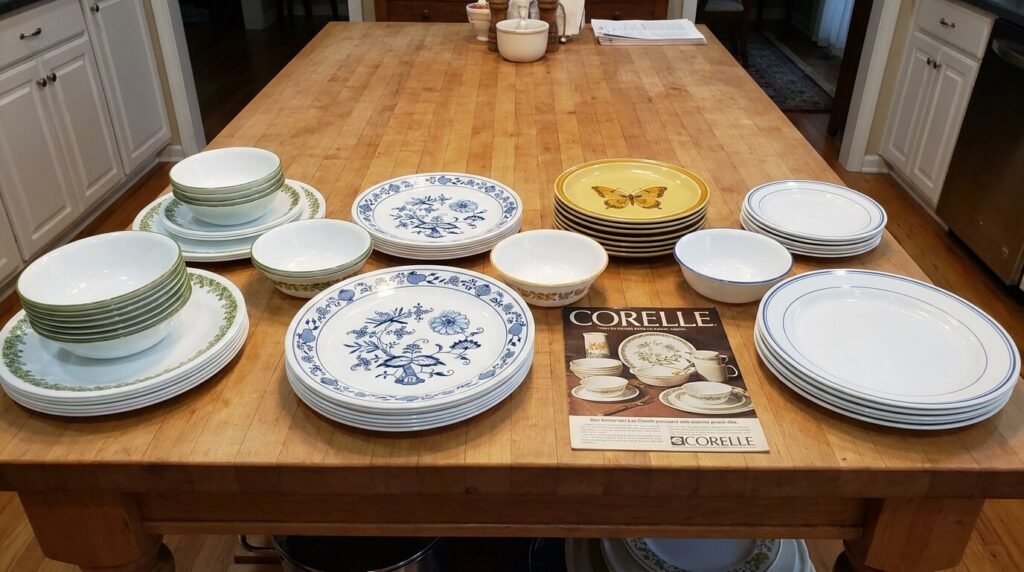
The most practical starting point for most buyers is the range of patterns currently in production.
These are available at Amazon, Walmart, Target, and directly from Corelle, with full sets and individual replacement pieces accessible at retail prices.
Winter Frost White — The All-Time Best Seller
Winter Frost White is Corelle’s most popular pattern across its entire 55-year production history. Introduced in 1970 as the brand’s first design, it remains in continuous production and consistently outsells every decorated pattern Corelle offers.

- SPACE SAVING AND LIGHTWEIGHT: Half the space and half the weight of traditional ceramics – Corelle Vitrelle is ultra sli…
- BUILT TO LAST: Our unique, three-layer tempered glass is resistant to chips & cracks and 3x more durable than traditiona…
- STACKABLE: Vitrelle’s slim profile means it stacks neatly in your cupboard and in your dishwasher.
The design is, deliberately, not a design; it is plain white Vitrelle glass with no printed decoration of any kind. Three practical facts explain its enduring sales position: it coordinates with any table setting, any kitchen decor style, and any other pattern in the Corelle range.
Buyers who add pieces over time, upgrade to larger sets, or mix patterns across a table will find Winter Frost White integrates without conflict.
Corelle itself uses Winter Frost White as its baseline food photography surface in product marketing, a signal of how universally neutral it is.
- Pattern introduced: 1970
- Status: Active, continuously produced
- Available in: Round plates (6.75″, 8.5″, 10.25″), bowls (18 oz, 28 oz), mugs
- Best for: Anyone who changes kitchen decor frequently, households that mix patterns, buyers who want the safest replacement-piece guarantee over the long term
Mystic Gray — The Leading Current Decorated Pattern
Among Corelle’s actively produced decorated patterns, Mystic Gray has emerged as one of the top-selling designs in recent years.
The pattern features a soft gray speckle across the plate surface, not a rim border design like most of Corelle’s traditional patterns, but an all-over textural treatment that gives the set a modern, matte-look aesthetic without committing to a specific motif.
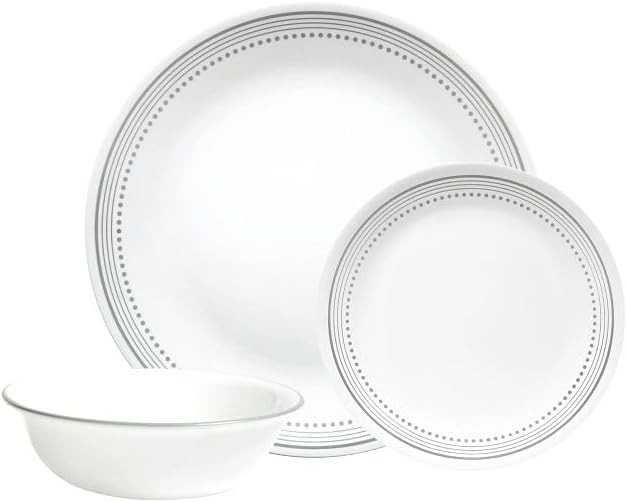
- Nothing-else-like-it, triple-layer-strong glass plates and bowls highly resist chips and cracks
- Plates and bowls are lightweight and easy to handle
- Ultra-hygienic, non-porous and easy-to-clean plates and bowls
This places it well with contemporary kitchen trends that favor neutral, minimalist table settings over traditional floral or geometric borders. It is available as an 18-piece set for six and is widely stocked across major retailers.
- Pattern introduced: 2020s
- Status: Active
- Best for: Modern kitchen aesthetics; buyers who want a decorated pattern with the versatility of a neutral
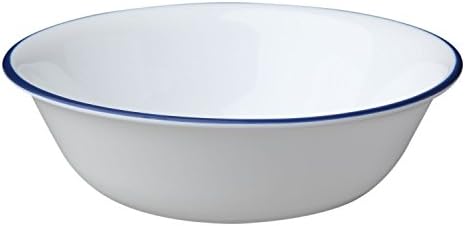
Indigo Speckle — Current Boho-Modern Option
Indigo Speckle shares the all-over speckle format of Mystic Gray but uses a deeper blue tone.
It appeals to buyers who want color on the table without committing to a specific illustrated motif, and it fits particularly well with linen table settings and natural wood furniture.

- 18-PIECE SET: Includes (6) 10-1/4-inch dinner plates, (6) 8-1/2-inch salad plates and (6) 18-oz soup/cereal bowls. This …
- LIGHT AND STRONG: Say goodbye to chips and cracks with Corelle’s triple-layer-strong glass plates and bowls. This durabl…
- LOW MAINTENANCE: This dinnerware set is designed to provide the best dining experience while requiring low maintenance. …
Like Mystic Gray, it represents Corelle’s shift away from border-only decorated patterns toward full-surface textural designs.
- Pattern introduced: 2020s
- Status: Active
- Best for: Blue-toned or coastal kitchen aesthetics; buyers who find solid white too plain but traditional floral patterns too busy
Timber Shadows — Current Option for Darker Aesthetics
Timber Shadows is a square-plate-format pattern with an organic, wood-grain-inspired gray-and-brown surface treatment.
It is one of Corelle’s few current patterns that works well with dark kitchen aesthetics, dark cabinetry, dark countertops, or a masculine, minimal table setting.

- 18-PIECE SET: Includes (6) 10-1/2-inch dinner plates, (6) 9-inch salad plates and (6) 22-oz soup/cereal bowls. This set …
- LIGHT AND STRONG: Say goodbye to chips and cracks with Corelle’s triple-layer-strong glass plates and bowls. This durabl…
- LOW MAINTENANCE: This dinnerware set is designed to provide the best dining experience while requiring low maintenance. …
The square plate format is a distinct visual departure from the traditional round coupe style that Corelle has used since 1970.
- Pattern introduced: 2020s
- Status: Active
- Best for: Modern or industrial kitchen aesthetics; buyers who prefer square plate formats
Related: Corelle Patterns before 2005 Guide
The Most Collected Vintage Corelle Patterns
The vintage Corelle collector market is active and, for certain patterns, surprisingly competitive.
The designs most sought after by collectors share a common characteristic: they are inseparable from a specific cultural moment, the 1970s American kitchen, in a way that makes them recognizable and emotionally resonant to buyers who grew up with them.
Spring Blossom Green (Crazy Daisy) — 1970–1986
Spring Blossom Green, nicknamed “Crazy Daisy” by the collectors who have documented it most extensively, is the most recognized vintage Corelle pattern among collectors.
Introduced in 1970 alongside the brand’s launch, the pattern features small stylized green daisy flowers arranged as a repeating border on white Vitrelle glass. The flowers are a bold, flat graphic green — not naturalistic — which gives the pattern its retro character.

- VITRELLE: Our patented, made in USA, triple layered glass offer unrivaled strength and lightweight, making it a trusted …
- 18-PIECE SET: Includes (6) 10-1/4-inch dinner plates, (6) 6-3/4-inch appetizer plates and (6) 18-oz soup/cereal bowls. T…
- EASY TO CLEAN: Strong and non porous glass resist food odor retention and sticking, ensuring flawlessly easy cleaning. S…
It was produced until 1986, making it one of the longest-running decorated patterns in Corelle’s history. Complete sets in good condition sell on eBay and Etsy for $50 to $200, depending on piece count and condition.
Single dinner plates typically sell for $8–$20. The coordinating Pyrex and CorningWare pieces in the same pattern are also widely collected, driving additional demand from buyers who want matching bakeware and dinnerware.
- Production period: 1970–1986
- Identifying features: Small stylized green daisy flowers in a repeating border; plain white center; coupe-style plate
- Current secondary market value: $5–$20 per single piece; $50–$200 for larger sets
- Where to find: eBay, Etsy, estate sales, thrift stores, Replacements.com
Butterfly Gold — 1970–1988
Butterfly Gold was introduced in the same year as Spring Blossom Green and ran slightly longer. The pattern combines stylized butterflies and flower motifs rendered in warm gold and yellow on white Vitrelle glass, with a broad gold border at the plate rim.
It is distinctly 1970s in its color palette — the gold and warm yellow tones are characteristic of the harvest-gold kitchen aesthetic that dominated American home design in that decade.

Among collectors, Butterfly Gold is often cited alongside Spring Blossom Green as one of the two foundational vintage Corelle patterns — the designs that define what “vintage Corelle” looks like to most people.
Sets in good condition carry similar values to Spring Blossom Green: $10–$150, depending on size and completeness.
- Production period: 1970–1988
- Identifying features: Broad gold rim border; alternating butterfly and flower motifs; warm gold-yellow palette
- Current secondary market value: $10–$150 per set
- Where to find: eBay, Etsy, Replacements.com, thrift stores
Old Town Blue — 1972–1987
Old Town Blue was designed by artist Cynthia Gerow in 1972, drawing explicit inspiration from the Meissen blue onion pattern — a centuries-old German porcelain design.
The result is a Corelle interpretation of traditional European blue-and-white tableware: a cobalt blue border pattern featuring stylized plant motifs on white glass. It gave Corelle buyers an option that looked closer to fine china than the daisy-and-butterfly designs of the same era.
- Set of 6 bowls. Bundle and save!
- Break and chip resistant, made from our patented Vitrelle glass technology
- Space saving: lightweight and thin, yet extremely durable
Corelle revisited this pattern in 2013 with a reissue called “True Blue” — an updated version of Old Town Blue adjusted for contemporary tastes.
Consumer research at the time reportedly showed True Blue as the clear preference over the other vintage-inspired patterns Corelle evaluated, including Butterfly Gold and Spring Blossom Green.
The original Old Town Blue pieces remain sought after by collectors; the True Blue reissue is now itself discontinued, creating a secondary market for that version as well.
- Production period: 1972–1987 (original); True Blue reissue 2013–discontinued
- Identifying features: Cobalt blue border; stylized plant/floral motifs in Meissen blue-and-white tradition
- Current secondary market value: $10–$50 per piece; $50–$150+ for complete sets
Shadow Iris — 1986–2020
Shadow Iris is the most commercially durable of Corelle’s decorated patterns, running in various versions from 1986 through 2020 — a 34-year production span that makes it the longest-running decorated pattern in the brand’s history after Winter Frost White.
The pattern features tall purple iris flowers with green foliage on white glass with a green-tinted rim. It was produced in three distinct format versions: the original rimmed plate design (1986–2015), the square version (2009–2020), and the coupe body version (2016–2020).
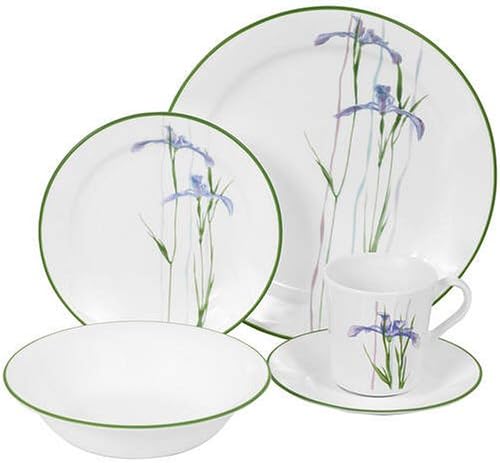
- 20-piece dinnerware set, service for 4
- 4 each: 10-1/4-inch dinner plate; 7-1/4-inch salad plate; 18-ounce bowl; 6-inch saucer, 9-ounce cup
- Thermally bonded, tempered-glass construction; strong, lightweight, and chip-resistant
Because of its long production run, Shadow Iris is one of the more accessible discontinued Corelle patterns on the secondary market — pieces are plentiful, and prices are moderate. Full sets sell for $50–$100; individual pieces for $10–$50.
For buyers who own Shadow Iris and need replacement pieces, the secondary market is well-supplied relative to shorter-run patterns.
- Production period: 1986–2020 (multiple format versions)
- Identifying features: Purple iris flowers with green foliage; green-tinted rim; available in round rimmed, round coupe, and square formats
- Current secondary market value: $10–$100, depending on format and set size
Indian Summer — 1977–1983
Indian Summer belongs to Corelle’s 1977 Expressions Livingware line, which was the brand’s first departure from the simple single-color border format used in the 1970s.
The Expressions line used multiple colors and placed the design at the center of the plate rather than only as a rim border. Indian Summer features a warm orange-and-brown botanical motif that reflects the harvest-themed kitchen aesthetic popular in the late 1970s.
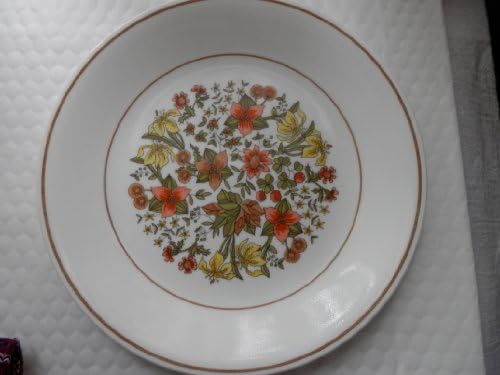
- Collectible vintage corelle
- Livingware
- Indian Summer design, fall colors
It is actively discussed in collector communities and appears regularly in thrift stores and estate sales.
- Production period: 1977–1983
- Identifying features: Warm orange-brown botanical motif at plate center; part of Expressions Livingware format
- Current secondary market value: $5–$15 per piece; $30–$100 per set
Corelle Pattern Eras: A Reference by Decade
Understanding when a pattern was made helps both buyers who want to identify a piece they have found and collectors who want to date an acquisition accurately.
| Era | Visual Characteristics | Notable Patterns |
|---|---|---|
| 1970–1976 (Livingware launch) | Nature-inspired motifs; warm gold, green, brown palettes; single-color rim borders; plain white plate centers | Winter Frost White, Spring Blossom Green, Butterfly Gold, Snowflake Blue, Old Town Blue, Woodland Brown |
| 1977–1986 (Expressions Livingware) | Multi-color designs; motifs placed at plate center, not just rim; richer botanical and floral illustrations | Indian Summer, Blue Heather, Meadow, April, Wildflower, Batik |
| 1980s–1990s | Bolder colors; wider palette; mix of contemporary and heritage themes | Shadow Iris (1986), Abundance, Country Cottage, Callaway Ivy, Rosemarie |
| 2000s–2015 | Mix of classic and contemporary; introduction of square plate formats | Square Shadow Iris (2009), True Blue (2013), Corelle Boutique lines |
| 2016–present | Full-surface textural patterns; all-over speckle and organic treatments; minimal illustrated borders | Mystic Gray, Indigo Speckle, Timber Shadows, Ocean Blue |
How to Identify a Corelle Pattern You Already Own
Many people discover a set at an estate sale, receive one as a gift, or inherit dishes from a family member without knowing the pattern name.
Identifying the pattern correctly matters for two reasons: it determines whether replacement pieces are available, and it helps establish resale value if you decide to sell.
Step-by-Step Pattern Identification
- Check the back of the plate first. Nearly all Corelle pieces carry a backstamp on the underside. Older pieces (pre-2000) typically show the “Corelle by CorningWare” or “Corelle Livingware” logo alongside a pattern name or production code. Post-2000 pieces generally show the “Corelle” wordmark and pattern name directly.
- Note the plate format. Corelle uses two primary plate formats: rimmed (with a flat outer rim around the eating surface) and coupe (a single continuous curve from edge to center with no flat rim). Most patterns produced before the mid-2000s used the rimmed format; patterns introduced after approximately 2005 more commonly use the coupe format. Square plates were introduced in 2009. Format helps narrow the production era before you identify the specific motif.
- Identify the motif location. Patterns produced from 1970 to 1976 place all decoration as a border at the plate rim, with a plain white center. Patterns from the 1977 Expressions Livingware line onward begin placing decoration at or near the plate center. This single observation rules out half the production timeline immediately.
- Use the color palette to estimate the decade. Golds, warm yellows, greens, and harvest browns indicate 1970s production. Blues, purples, and green ivy patterns suggest the 1980s–1990s. All-over speckle and textural treatments indicate 2016 or later.
- Cross-reference against pattern libraries. The most complete online resources for Corelle pattern identification are Corelle Corner (a collector-maintained pattern library) and Replacements.com (which lists patterns by name and photo and indicates current availability of replacement pieces).
The Lead Safety Issue Specific to Decorated Vintage Patterns
Corelle’s Vitrelle glass base material has never contained lead or cadmium. The documented concern is specific to decorated patterns on pre-2005 pieces.
Decorative glazes and inks applied to Corelle dinnerware before more stringent FDA and California Prop 65 standards were widely enforced sometimes contained detectable lead levels present not in the glass itself but in the printed decoration on the food-contact surface of the plate.
Independent testing published and maintained by lead-safety advocates has confirmed elevated lead readings in several vintage decorated Corelle patterns — particularly those using bright red, orange, and yellow pigments, which historically required lead-containing compounds to achieve their color intensity.
The patterns most frequently cited in this context include some versions of Butterfly Gold, Spring Blossom Green, and other brightly colored 1970s designs.
Corelle’s own guidance, updated following renewed consumer attention to this issue in 2019, states that pre-2005 decorated Corelle pieces should be used for display only, not for food service.
This guidance applies specifically to decorated patterns. Plain white Corelle (Winter Frost White) has no documented lead concern; the decoration concern is entirely about printed pigments, not the glass material.
For anyone using vintage decorated Corelle for daily meals, a common practice given how durable the dishes are, the practical response is:
- Switch pre-2005 decorated pieces to display use and replace them with post-2005 certified lead-free collections for food service.
- Continue using Winter Frost White pieces of any age, as these carry no documented decoration-related lead risk.
- Verify that any currently purchased set carries an FDA or California Prop 65 lead-free certification, which all new Corelle sets sold in the United States are required to meet.
For more details on safe dinnerware choices across materials and brands, see our non-toxic dinnerware guide.
Where to Find Discontinued Corelle Patterns
The secondary market for discontinued Corelle is well-established. Most patterns can be found if you are willing to look across multiple platforms.
Primary Sources for Discontinued Patterns
- Replacements.com — the most organized source for discontinued dinnerware of all brands; patterns are listed by name with photos, individual piece availability, and fixed pricing. Higher prices than marketplace platforms, but more reliable condition descriptions and authentication.
- eBay — the largest volume of vintage Corelle listings; prices vary widely and require more buyer diligence on condition photos and seller reviews. Best for buyers who know exactly what they are looking for and can assess condition from photographs.
- Etsy — strong for individually curated vintage Corelle pieces; sellers often specialize in specific eras or patterns; pricing is moderate, and presentation quality is typically higher than eBay for vintage pieces.
- Facebook Marketplace and local buy-sell groups — useful for finding large sets at lower prices, particularly from sellers clearing estate contents; requires local pickup or willingness to arrange shipping.
- Thrift stores and estate sales — the most affordable source; requires patience and repeated visits; Spring Blossom Green, Butterfly Gold, Shadow Iris, and Indian Summer appear frequently, given their long production runs and large original distribution.
For a broader look at durability and how Corelle compares to modern alternatives, see our guide on unbreakable dishes like Corelle. If you are evaluating whether to keep using vintage pieces or switch to a current production set, see our lead-free dishes testing guide.
If you are replacing pieces from a specific collection, check Replacements.com first; it is the most reliable single source for confirming whether individual pieces are currently available and at what price before you search less organized platforms.
Frequently Asked Questions
u003cstrongu003eWhat is the most popular Corelle pattern of all time?u003c/strongu003e
Winter Frost White is Corelle’s best-selling pattern across its entire history and the only pattern that has remained in continuous production since the brand’s 1970 launch. u003cbru003eu003cbru003eAmong decorated patterns, Spring Blossom Green (Crazy Daisy) and Butterfly Gold are the most recognized and widely collected vintage designs.
u003cstrongu003eAre vintage Corelle patterns safe to use for food?u003c/strongu003e
The Vitrelle glass base of all Corelle is safe for food contact. The safety concern is specific to decorated patterns on pre-2005 pieces, where printed glazes and inks may contain lead. u003cbru003eu003cbru003eCorelle’s official guidance is that pre-2005 decorated pieces should be used for display only; plain white (Winter Frost White) pieces of any age carry no documented decoration-related concern.
u003cstrongu003eHow do I find the name of my Corelle pattern?u003c/strongu003e
Check the backstamp on the underside of the plate; most Corelle pieces printed the pattern name directly on the base. u003cbru003eu003cbru003eIf the stamp is absent or illegible, note the plate format (rimmed vs. coupe), motif location (rim border vs. center), and color palette, then cross-reference with the Corelle Corner pattern library online or Replacements.com’s photo database.
u003cstrongu003eWhich discontinued Corelle patterns are most valuable to collectors?u003c/strongu003e
Spring Blossom Green and Butterfly Gold are the most widely recognized and actively traded vintage patterns. Old Town Blue and Indian Summer have strong collector communities. u003cbru003eu003cbru003eShadow Iris, because of its long production run, is more accessible and less scarce than the 1970s patterns. Rarity, condition, and set completeness drive value more than pattern name alone.
u003cstrongu003eCan I still buy Spring Blossom Green or Butterfly Gold new?u003c/strongu003e
No. Both patterns were discontinued in the 1980s and are no longer produced. Replacement pieces and sets are available exclusively through the secondary market — eBay, Etsy, Replacements.com, and thrift stores. u003cbru003eu003cbru003eCorelle evaluated reviving these patterns in a 2012 vintage-inspired collection project but chose to produce only True Blue (a reinterpretation of Old Town Blue) based on consumer research.
u003cstrongu003eWhat is the difference between Corelle Livingware and Corelle Expressions Livingware?u003c/strongu003e
Livingware is Corelle’s original product line, launched in 1970, which used single-color border designs around the rim of the plate with a plain white center. u003cbru003eu003cbru003eExpressions Livingware, introduced in 1977, used multi-color designs and placed decoration at the center of the plate rather than only at the rim. u003cbru003eu003cbru003eMost of the recognizable 1970s patterns (Spring Blossom Green, Butterfly Gold, Old Town Blue) belong to the original Livingware line; patterns like Indian Summer and Blue Heather belong to the Expressions line.
u003cstrongu003eWhere is the best place to buy replacement pieces for discontinued Corelle patterns?u003c/strongu003e
Replacements.com is the most reliable source it lists individual pieces by pattern name with photos and condition descriptions. u003cbru003eu003cbru003eeBay offers the largest volume at more variable prices. Etsy is reliable for individually curated pieces. u003cbru003eu003cbru003eFor lower-cost sets, local thrift stores and estate sales are the most affordable option, but require patience.
u003cstrongu003eDo current Corelle patterns hold their value like vintage ones?u003c/strongu003e
Currently, u003cstrongu003eu003cspan style=u0022text-decoration: underline;u0022u003eu003ca href=u0022https://safekitchn.com/newest-corelle-patterns/u0022 target=u0022_blanku0022 rel=u0022noreferrer noopeneru0022u003enewly produced Corelle patternsu003c/au003eu003c/spanu003eu003c/strongu003e do not appreciate while they remain in production, because replacement pieces are freely available at retail. u003cbru003eu003cbru003eA pattern only becomes collectible after discontinuation, and only if it develops an active collector community. u003cbru003eu003cbru003eBuying a current Corelle pattern as an investment is not supported by the secondary market history. u003cbru003eu003cbru003eThe patterns that have collector value today (Spring Blossom Green, Butterfly Gold, Old Town Blue) were not bought as investments; they became collectible because of their cultural associations and the nostalgia of buyers who grew up with them.
About the Author & Reviewer
Sarah Emirone, Author
Sarah researches and writes SafeKitchn’s dinnerware and kitchenware guides, with a focus on material safety, lead content, and manufacturer specifications. She cross-references product data sheets, safety certifications, and regulatory filings (including FDA and Prop 65 records) before publishing, and updates articles when new information becomes available.
James Daniels, Reviewer
James reviews SafeKitchn’s material safety content for scientific accuracy. He holds a B.Sc in inorganic chemistry and works as a materials researcher, with particular focus on the composition and safety behavior of glass, ceramic, and metal used in kitchenware.