

Restaurant crockery and cutlery aren’t the same category of equipment, even though most buying guides talk about them like they are.
Crockery is the ceramic tableware, plates, bowls, cups, while cutlery is the flatware you eat with: forks, knives, spoons.
Get the terms straight first, because the material questions, the grade questions, and the quantity questions all depend on knowing which piece you’re actually shopping for.
This guide covers both sides: the correct terminology if you’re studying F&B service, and the real numbers, materials, stainless steel grades, and how many of each item to stock per seat if you’re the one placing the order.
Written by Sarah Emirone | Reviewed by James Daniels, B.Sc, Inorganic Chemist & Materials Researcher | Updated September 2026 | See How We Test | Filed under: Buying, Care & Product Guides
What Do Crockery and Cutlery Actually Mean?
Crockery refers to ceramic tableware used for serving and eating food, such as plates, bowls, cups, and saucers.
Cutlery refers to the utensils used to eat, such as food forks, knives, and spoons, sometimes called flatware.
The two terms get used interchangeably in casual conversation, but in hospitality and procurement, mixing them up leads to real confusion when you’re trying to source products or read a supplier catalog.
Crockery vs. Cutlery vs. Silverware vs. Glassware
| Term | Formal Definition | Typical Material | Supplier Catalog Category |
|---|---|---|---|
| Crockery | Ceramic tableware: plates, bowls, cups, saucers, platters | Porcelain, bone china, stoneware, earthenware | “Dinnerware” or “Tableware” |
| Cutlery / Flatware | Eating utensils: forks, knives, spoons | Stainless steel (18/10, 18/8, 18/0) | “Flatware” |
| Silverware | Historically, silver-plated flatware, now often used loosely for any flatware | Electro Plated Nickel Silver (EPNS) or stainless steel | “Silverware” or “Flatware” (overlaps with cutlery) |
| Glassware | Drinking vessels and glass serving pieces | Glass (tempered, crystal, soda-lime) | “Glassware” or “Barware” |
The mismatch that trips people up most: “silverware” gets used as a catch-all term for flatware even in restaurants that don’t own a single piece of actual silver.
Full breakdown of crockery, cutlery, and glassware terms is worth a look if you’re ordering from a supplier who uses these categories inconsistently.
What Is EPNS Silverware?
EPNS stands for Electro Plated Nickel Silver, an alloy of copper, zinc, and nickel that’s electroplated with a thin layer of actual silver, typically 10 to 15 microns thick.
It looks and feels like solid silver flatware at a fraction of the cost, which is why it shows up in formal hotel and banquet settings.
The plating wears down over years of commercial dishwasher cycles, which is the main reason most restaurants now default to stainless steel instead.
What’s Included in a Restaurant Crockery and Cutlery List?
A restaurant crockery and cutlery list breaks into two separate inventories: ceramic tableware and flatware, and both need to be sized to your seating capacity and service style before you place an order.
Essential Crockery Items
- Dinner plates, typically 10 to 12 inches, are the primary vessel for main courses and the highest-volume item you’ll order.
- Side or bread plates, usually 6 to 8 inches, handle appetizers, bread service, and smaller courses.
- Soup bowls are necessary for any menu with broths, dals, or creamy soups, and should be sized to match your typical portion.
- Dessert or cereal bowls double as multi-purpose bowls for pasta, rice, or small plates beyond their namesake use.
- Cups and saucers for coffee and tea service round out the core set, with espresso cups as a separate line item if you serve specialty coffee.
Essential Cutlery/Flatware Items
- Dinner forks and dinner knives are the highest-turnover items in any flatware inventory and should be ordered with the largest buffer.
- Dessert forks and spoons are smaller versions used for the final course, and skipping them forces awkward substitutions during service.
- Soup spoons are a separate item from teaspoons — using one for the other looks unprofessional and affects portion pacing.
- Steak knives or specialty cutlery (fish knives, seafood forks) should only be added if your menu specifically calls for them, since idle specialty pieces just add storage and washing overhead.
- Teaspoons for coffee and tea service tend to walk off faster than any other flatware item, so order these with an extra buffer.
What Is the Best Material for Restaurant Crockery?
Porcelain is the best all-around material for most restaurants, because it balances durability, low water absorption, and dishwasher/microwave compatibility better than the alternatives.


The right choice still shifts depending on your concept — a rustic café benefits from stoneware’s handmade look in ways a fine-dining room wouldn’t.
Porcelain, Bone China, and Stoneware Compared
| Material | Firing Temp | Durability | Best For |
|---|---|---|---|
| Porcelain | Above 1,200°C | High; low chip and stain absorption | Busy restaurants needing daily dishwasher/microwave use |
| Bone china | High, with bone ash added | Strong despite a thin, lightweight profile | Fine dining, upscale hotel service |
| Stoneware | High, but lower than porcelain | Durable but chips more easily than porcelain | Casual and mid-tier restaurants wanting a handcrafted look |
| Earthenware | Lower temperature firing | Lower; porous and prone to absorbing moisture | Theme restaurants prioritizing rustic aesthetics over heavy daily volume |
Porcelain wins on pure operational grounds. Bone china wins on presentation if your price point supports the replacement cost.
Earthenware is the one to be cautious with; its porous body looks great on a shelf, but won’t survive 200 covers a night the way porcelain will.
Is Melamine Crockery Good for Restaurants?
- Melamine is nearly unbreakable and dishwasher-safe, making it a strong fit for buffets, outdoor seating, and high-turnover fast-casual concepts.
- It should never go in a microwave — the resin isn’t rated for it, and heating it with acidic foods risks leaching compounds into the food.
- It lacks the visual weight and translucency of ceramic, so it reads as less elegant in a fine-dining setting, regardless of pattern quality.
- Its low cost and near-total resistance to breakage make it a reasonable trade for operations where dish loss from drops and impacts outweighs presentation concerns.
18/10 vs. 18/8 vs. 18/0: What Stainless Steel Grade Do You Actually Need?
The difference between 18/10 and 18/8 stainless steel flatware is smaller than most suppliers’ marketing suggests; both come from the same Grade 304 alloy family, and the gap in nickel content rarely changes how the flatware performs in daily use. 18/0, by contrast, is a genuinely different alloy with a real durability trade-off.
What the Numbers Actually Mean
18/10, 18/8, and 18/0 describe the percentage of chromium and nickel in the stainless steel alloy.
The first number is always chromium, which drives rust resistance, and the second is nickel, which adds shine and further corrosion resistance.
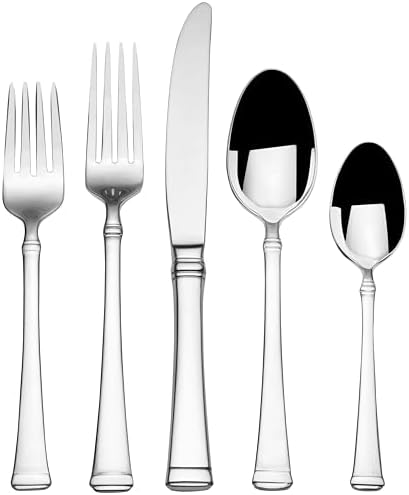


18/10 (10% nickel) and 18/8 (8% nickel) both fall under Grade 304 stainless, and steel mills often produce “18/10” flatware at nickel levels as low as 8.2% since that still clears the legal threshold for the label.
18/0 uses the 400-series alloy with no nickel at all, making it magnetic, more prone to pitting, and noticeably cheaper to replace when lost or stolen, which is exactly why cafeterias and high-turnover institutions favor it.
For the full technical comparison, see the detailed guide to USA-made stainless steel flatware grades.
Why Grade and Weight Are Not the Same Thing
| Spec | What It Controls | What It Does NOT Control |
|---|---|---|
| Grade (18/10, 18/8, 18/0) | Corrosion resistance, shine, hypoallergenic properties | Thickness, bend resistance, overall sturdiness |
| Weight (forged, extra-heavy, heavy, medium) | Thickness, bend resistance, in-hand feel | Rust resistance, shine, nickel content |
| Forged | Single piece of thick steel, pattern runs through the whole handle | Grade — forged pieces exist in both 18/10 and 18/0 |
| Extra-heavy / Heavy / Medium | Progressively thinner gauge, lower cost, lower bend resistance | Grade — again, independent of the alloy chosen |
This is the specification most buyers get backwards. A fork stamped 18/10 tells you nothing about whether it will bend under normal use; that’s entirely a function of the gauge, sold separately as forged, extra-heavy, heavy, or medium weight.
A restaurant chasing durability should be asking about weight category first and grade second, not assuming a higher nickel number means a sturdier piece.
How Much Crockery and Cutlery Does a Restaurant Need Per Seat?
Most restaurants need roughly three times their seat count in crockery and cutlery per item, one set in active service, one in the wash cycle, and one in reserve for peak volume or breakage.
That multiplier shifts up or down depending on your service style and how fast a given item tends to break or disappear.
The Par Stock Formula by Cover Count
- Start with your total seat count, or “covers” — for example, a 60-seat restaurant.
- Multiply by 3 for standard high-turnover items like dinner plates and dinner forks: 60 covers × 3 = 180 units minimum.
- Multiply by 4 for items prone to faster loss or breakage, such as teaspoons and side plates, since these disappear or chip faster than the rest of the set.
- Add a 10–15% buffer on top of the calculated total for special events, private bookings, or unexpected volume spikes.
- Round up to match how the item is sold — flatware typically comes in dozens, so a 180-unit target becomes a 15-dozen order.
Adjusting Par Stock for Service Style
- Buffet service needs a higher crockery multiplier than plated service, since guests return to the buffet table multiple times per meal and often set down a used plate before grabbing a clean one.
- Fine dining with multiple courses needs more total place settings per cover than casual dining, since each course may require its own plate and flatware piece.
- Fast-casual and quick-service concepts using melamine or reusable plastic can run a lower multiplier, since these materials tolerate rougher handling with less attrition.
- Banquet and catering operations should stock toward the higher end of the buffer range, since transport and off-site service increase breakage risk beyond normal dining-room use.
How Much Should a Restaurant Budget for Crockery and Cutlery?
A reasonable starting point is 2 to 4 percent of your total startup budget allocated to tableware, which covers crockery, cutlery, and glassware together.
Use the restaurant tableware budget calculator to run the numbers against your own seat count and service style rather than relying on a flat percentage alone.
Typical Budget Percentage and Replacement Costs
- Budgeting 2 to 4 percent of total startup costs for tableware is a workable baseline for a new restaurant of any size or concept.
- Fine dining concepts using bone china or forged 18/10 flatware should plan toward the higher end of that range, since per-unit costs run well above porcelain and stamped stainless steel.
- Melamine and 18/0 stainless steel keep both upfront and replacement costs lower, which matters more for high-turnover, high-attrition environments than for formal dining rooms.
- Strategic tableware selection has been reported to cut replacement costs by up to 40 percent when operators match material and grade to their actual breakage and turnover patterns instead of buying based on appearance alone.
How Often to Replace Crockery and Cutlery
- Crockery in daily commercial use typically shows visible wear — chipping, staining, glaze dulling — within 12 to 24 months, depending on material and dishwasher chemical strength.
- Flatware in 18/0 grade wears and pits faster than 18/10 or 18/8, and high-turnover cafeterias should expect to replace it more frequently as a trade-off for its lower upfront cost.
- Track loss and breakage by item category rather than treating your whole inventory as one number, since teaspoons and side plates typically need replenishment far more often than dinner plates or forks.
- Set a standing reorder point at roughly 80 percent of your calculated par stock, so replacement orders go out before a shortage affects service.
Ready to size an actual order instead of guessing at quantities?
The formulas and comparisons above give you the numbers, seat count, service style, and material needed to get a supplier quote that matches your restaurant instead of a generic package.
Frequently Asked Questions
What is the difference between cutlery and flatware?
In most commercial contexts, the terms are interchangeable and refer to the same forks, knives, and spoons. “Flatware” is more common in North American supplier catalogs, while “cutlery” is used more broadly elsewhere.
Is 18/10 stainless steel really better than 18/8 for restaurant cutlery?
Only marginally, both grades come from the same Grade 304 alloy, and the nickel difference rarely affects real-world performance.
What actually determines durability is the weight category (forged, extra-heavy, heavy, or medium), which is a separate specification from the grade.
What is forged flatware?
Forged flatware is made from a single piece of thick stainless steel, with the pattern running through the entire handle rather than being stamped onto a thinner sheet.
It’s the most durable and expensive flatware category, typically reserved for fine dining and upscale hotels.
What is the best crockery material for a busy restaurant?
Porcelain is the strongest all-around choice for high-volume service, since it resists chipping and staining while handling daily dishwasher and microwave use.
Stoneware and bone china both have their place, but porcelain offers the best balance of durability and cost for daily operations.
How many plates should a restaurant have per seat?
A common baseline is three plates per seat: one in active service, one in the wash cycle, and one in reserve. High-attrition items like side plates may need a 4x multiplier instead.
What percentage of a restaurant’s budget should go to tableware?
A reasonable starting point is 2 to 4 percent of the total startup budget for crockery, cutlery, and glassware combined. Fine dining concepts using premium materials should plan toward the higher end of that range.
What is silverware made of?
Traditional silverware is Electro Plated Nickel Silver — a copper, zinc, and nickel alloy plated with a thin layer of real silver, usually 10 to 15 microns thick. Many restaurants now use the term loosely to mean any stainless steel flatware, even without actual silver content.
How often should a restaurant replace its cutlery?
Most commercial flatware needs partial replacement within 1 to 3 years, depending on grade and volume, with 18/0 pieces wearing faster than 18/10 or 18/8.
Tracking loss by item category rather than the whole set gives a more accurate reorder timeline.
About the Author & Reviewer
Sarah Emirone, Author
Sarah researches and writes SafeKitchn’s dinnerware and kitchenware guides, with a focus on material safety, lead content, and manufacturer specifications. She cross-references product data sheets, safety certifications, and regulatory filings (including FDA and Prop 65 records) before publishing, and updates articles when new information becomes available.
James Daniels, Reviewer
James reviews SafeKitchn’s material safety content for scientific accuracy. He holds a B.Sc in inorganic chemistry and works as a materials researcher, with particular focus on the composition and safety behavior of glass, ceramic, and metal used in kitchenware.