

A 19-year-old with a spinal cord injury and an 80-year-old with Parkinson’s can use the same lipped plate, but almost nothing written about lipped plates for the disabled treats them as different audiences with different needs.
The category covers any plate with a raised edge built to stop food sliding off and help someone scoop with one hand or with a limited grip.
It is more than just listing products. Few pages get the terminology right, fewer still check the red-plate statistic they’re repeating, and almost none mention that Medicare — the program every elderly-focused article leans on — doesn’t even apply to most people searching this exact phrase.
Written by Sarah Emirone | Reviewed by James Daniels, B.Sc, Inorganic Chemist & Materials Researcher | Updated September 2026 | See How We Test | Filed under: Accessible & Adaptive Dining
What Is a Lipped Plate for the Disabled?
A lipped plate for the disabled overlaps heavily with adaptive plates for the elderly, but it isn’t the same audience.
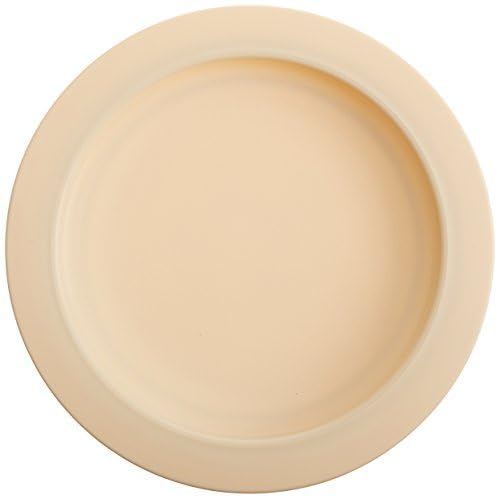
A lipped plate is any plate with a raised edge built around one job: stopping food from sliding off so someone can push it onto a fork or spoon without a second hand to steady the dish.
Lipped plates can serve both old and young people dealing with cases such as a spinal cord injury, cerebral palsy, multiple sclerosis, or a developmental disability, rather than age-related decline.
The plate itself doesn’t care about the diagnosis. What matters is which function is impaired: grip, coordination, or the ability to use both hands.
Conditions and Ages That Use Lipped Plates
- Cerebral palsy affects muscle control from early childhood, and a lipped plate gives a child something to push food against without needing precise hand-eye coordination.
- Spinal cord injuries often leave someone with the use of only one hand or arm, which is the exact problem a raised wall on one side of a plate solves.
- Multiple sclerosis and other progressive neurological conditions change grip strength and coordination over time, so the right plate today may not be the right plate in two years.
- Tremor-causing conditions, including Parkinson’s and essential tremor, scatter food off a flat plate before it reaches the mouth.
- Stroke survivors frequently regain partial hand function on one side, which is why orientation — left-handed versus right-handed use — matters as much as the plate type itself.
Lipped Plate vs. Scoop Plate vs. Plate Guard vs. Inner-Lip Plate
Within the broader types of crockery, these four terms get used interchangeably across nearly every product listing, even though they describe four structurally different things.
| Term | Structure | Best for |
|---|---|---|
| Inner-lip plate | Raised wall built into the entire rim, all the way around | Maximum spill containment; works regardless of hand orientation |
| Scoop plate | Raised wall on one side only; rest of the rim stays low | One-handed eating, where the user pushes food against a single edge |
| Plate guard | A separate clip-on ring added to a plate the person already owns | Keeping existing dinnerware while adding a raised edge |
| Lipped plate (general term) | Any plate with a raised edge — covers the first three | Used loosely in product titles; not a precise category on its own |
An inner-lip plate beats a scoop plate for someone who switches hands during a meal, since the raised wall works no matter which side they’re pushing from. A plate guard wins when keeping familiar dinnerware matters more than buying anything new.
Do Red Lipped Plates Really Help People Eat More?
Boston University biopsychologist Alice Cronin-Golomb ran the original study in 2004, after nursing home staff noticed residents with advanced Alzheimer’s weren’t finishing meals.
Her team compared food intake on red plates against white ones and found patients ate 25% more from the red plates, not 24%, and not because the color itself is magic.



Alzheimer’s disease damages contrast sensitivity before it damages appetite, so food on a white plate can become genuinely hard to see; a high-contrast color fixes that specific problem.
Another research said that fluid intake with red or blue drinkware resulted to 84% improvement.
Material and Microwave Safety at a Glance
| Material | Microwave-safe | Dishwasher-safe |
|---|---|---|
| Melamine (most common) | No | Yes |
| Polypropylene plastic | Sometimes — check the label | Yes |
| Silicone | Often — check the label | Yes |
| Stoneware or ceramic | Yes, if labeled | Yes |
Melamine is the material in most lipped plates, and it’s the one most likely to get reheated by mistake.
Choosing a Lipped Plate by Need
The right-lipped plate comes down to which hand function is actually impaired, not the name of the underlying condition.
Two people with the same diagnosis can need completely different equipment, and two people with unrelated diagnoses can end up needing the same plate.
One-Handed Eating and Limited Hand Function
- A scoop plate works well for someone with a consistent dominant hand, since the single raised wall sits exactly where they push.
- Grip strength that changes week to week, common during multiple sclerosis flare-ups, calls for a lightweight plate guard over a heavier inner-lip plate, since it’s easier to swap out as needs shift.
- A non-slip mat underneath either design adds stability for someone who can only steady the plate with a forearm, not a free hand.
- Suction-base plates need a hard, flat, clean table to work; a tablecloth or textured placemat breaks the seal and cancels the benefit.
Lipped Plates for Children and School-Age Users
- Children with cerebral palsy or developmental coordination disorder often do better with a scoop plate sized smaller than the standard 9-inch adult version, since an oversized plate makes the scooping motion harder, not easier.
- A school occupational therapist can request adaptive eating equipment as part of a child’s Individualized Education Program, a funding path with no equivalent for adult users.
- Suction-base plates are common in classroom settings, since cafeteria and lunchroom tables get wiped down constantly, which keeps the seal-dependent base working as intended.
- Color and pattern matter more for children with sensory processing differences than for adults; a plain, single-color plate is usually the safer starting point before introducing anything more visually complex.
Funding and Cost for Lipped Plates
Why Medicaid, Not Medicare, Is the Relevant Program for Most Disabled Users
Medicaid HCBS waivers in some states can cover adaptive or specialized equipment that helps a person live at home and avoid institutional care, but coverage rules vary by state and by waiver.
Medicaid DME rules generally track the Medicare-style definition of equipment that is reusable, medically oriented, and not useful to someone without an illness or injury.
For children, schools may provide adaptive eating equipment through an IEP when occupational therapy or related evaluation shows it is needed for school participation, including mealtime access at school.
Typical Price Ranges by Plate Type
| Plate type | Typical price range | What drives the cost |
|---|---|---|
| Plate guard (clip-on) | $8–$15 | Works with existing dinnerware; cheapest entry point |
| Scoop plate | $12–$22 | Single-piece molded construction |
| Inner-lip plate (full rim) | $15–$28 | More plastic and a more complex mold than a one-sided scoop |
| Suction-base plate | $15–$30 | The vacuum-seal mechanism adds manufacturing cost |
For a first purchase, a $12–$22 scoop plate is the better test than jumping straight to a full inner-lip plate — it confirms whether one-sided scooping solves the problem before paying more for all-around coverage that might not be needed.
Frequently Asked Questions About Lipped Plates for the Disabled
What is a lipped plate for the disabled?
It’s a plate with a raised edge built to stop food from sliding off, so someone with limited grip, coordination, or one-handed use can push food onto a fork or spoon.
The raised wall can run around the full rim or just one side, depending on the design. The shape solves a physical problem, not a cosmetic one.
What’s the difference between a lipped plate and a scoop plate?
A scoop plate has a raised wall on one side only. An inner-lip plate, often called a “lipped plate” in product titles, has the raised edge running around the entire rim.
The scoop plate suits a consistent dominant hand; the inner-lip plate suits someone who switches hands or has equal weakness on both sides.
Are the lipped plates dishwasher and microwave-safe?
Most are dishwasher safe regardless of material. Melamine, the most common material, should not go in the microwave — check for a microwave-safe symbol on the underside before assuming otherwise.
Polypropylene and silicone versions are sometimes microwave-safe, but the label is the only reliable way to know.
Can children use lipped plates?
Yes, children with cerebral palsy or developmental coordination differences often benefit from a smaller scoop plate sized down from the standard 9-inch adult version.
A school occupational therapist can also build adaptive eating equipment into a child’s Individualized Education Program. That funding path has no equivalent for adult users.
What is an inner-lip plate?
It’s a plate with a raised wall running around the entire rim, not just one side. That makes it useful for someone who switches hands during a meal or has weakness on both sides. It’s often the plate people mean when they search the general term “lipped plate.”
Are lipped plates only for the elderly?
No, the audience searching this term skews younger than the audience searching for elderly-specific adaptive plates, including people with spinal cord injuries, cerebral palsy, and multiple sclerosis.
The plate doesn’t distinguish between age-related and other causes of limited hand function. Age has nothing to do with whether the design works.
How do I clean a lipped plate with a suction base?
Detach the suction base from the plate before washing, since the vacuum mechanism can trap water and wear out faster if washed intact. Most bases can be hand-washed with warm water and dish soap.
Check the manufacturer’s care instructions for whether the base is dishwasher-safe on its own.
About the Author & Reviewer
Sarah Emirone, Author
Sarah researches and writes SafeKitchn’s dinnerware and kitchenware guides, with a focus on material safety, lead content, and manufacturer specifications. She cross-references product data sheets, safety certifications, and regulatory filings (including FDA and Prop 65 records) before publishing, and updates articles when new information becomes available.
James Daniels, Reviewer
James reviews SafeKitchn’s material safety content for scientific accuracy. He holds a B.Sc in inorganic chemistry and works as a materials researcher, with particular focus on the composition and safety behavior of glass, ceramic, and metal used in kitchenware.