

Walk through any housewares aisle, and two names keep showing up for everyday dinnerware: Corelle and Gibson. Both are affordable, widely available, and consistently marketed toward families and casual dining households.
But Corelle vs Gibson is not a comparison between two similar products; it is a comparison between fundamentally different materials and design philosophies.
Corelle builds around Vitrelle glass, a lightweight laminated glass engineered for durability and space efficiency. Gibson Home builds around stoneware and ceramic dishes, prioritizing decorative aesthetics and heavier construction.
This guide breaks down every meaningful difference between the two brands: material, weight, chip resistance, oven safety, design, price, and long-term value, so you can make a confident decision based on what your kitchen and household actually need, not just which name you recognize.
Written by Sarah Emirone | Reviewed by James Daniels, B.Sc, Inorganic Chemist & Materials Researcher | Updated September 2026 | See How We Test | Filed under: Brand & Product Comparisons
Quick Comparison: Corelle vs Gibson Dinnerware
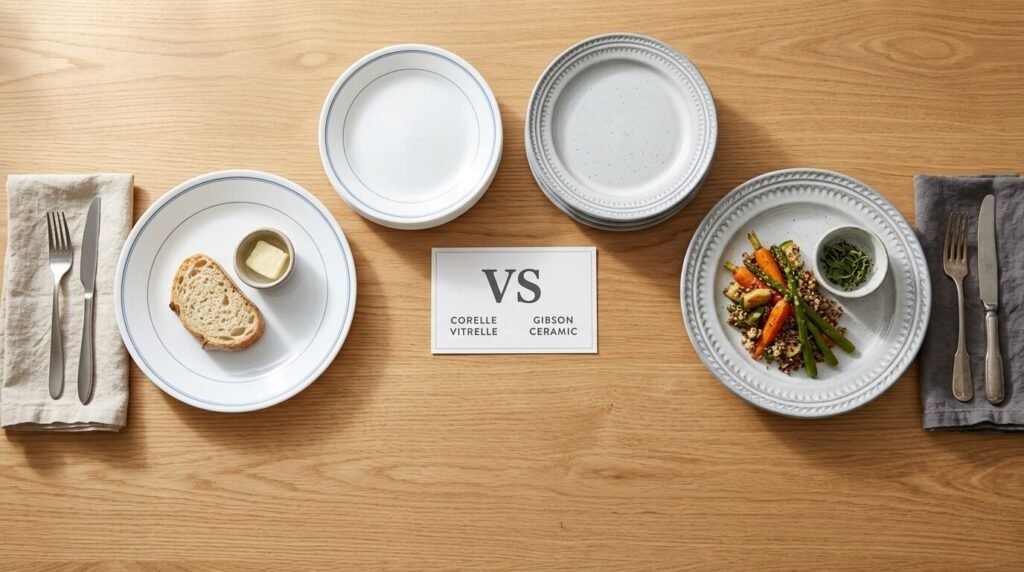
| Feature | Corelle (Vitrelle Glass) | Gibson (Stoneware/Ceramic) |
|---|---|---|
| Primary Material | Triple-layer laminated glass | Stoneware, ceramic, porcelain |
| Weight | Very lightweight | Heavier and denser |
| Thickness | Thin and slim | Thicker construction |
| Chip Resistance | Excellent | Moderate |
| Break Behavior | Shatters under hard impact | Chips or cracks under impact |
| Microwave Safe | Yes | Yes (most collections) |
| Dishwasher Safe | Yes | Yes |
| Oven Safe | No | Yes (most stoneware lines) |
| Heat Retention | Low | High |
| Thermal Shock Resistance | Good | Moderate |
| Stackability | Excellent | Moderate |
| Design Style | Minimalist, clean, modern | Rustic, decorative, trendy |
| Lead-Free Certified | Yes | Yes |
| Price Range | Budget to mid-range | Budget to mid-range |
| Best For | Families, small kitchens, RV, everyday use | Formal dining, aesthetic kitchens, oven cooking |
| Replacement Availability | Open stock is widely available | Varies by collection |
What Is Gibson Dinnerware?
Overview of Gibson Home
Gibson Home is an American housewares company(with over 300 factories worldwide and 18 offices in Asia) that has built a broad presence in the affordable dinnerware market.
The brand distributes through major retailers, including Walmart, Target, and Amazon, positioning itself as an accessible everyday tableware option for households across a wide range of budgets and design preferences.
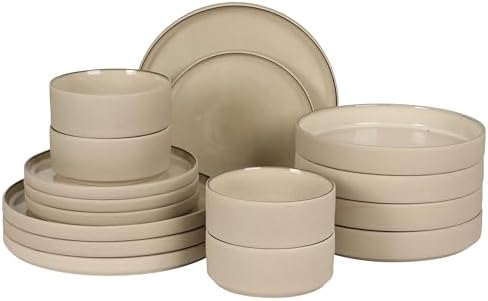
- FOUR PLACE SETTINGS: This complete set includes four 10-inch dinner plates, four 8-inch dessert plates, four 8.5-inch di…
- EXPERTLY CRAFTED: Gibson Elite is part of a renowned family of legacy brands with over 40 years of expertise in enhancin…
- ART ON THE TABLE: Each plate and bowl showcases the perfect balance of artistry and technique. A glossy reactive glaze c…
Gibson does not anchor its identity to a single signature material the way Corelle does with Vitrelle glass; instead, it operates across multiple material categories and design collections, giving it a wider but less specialized footprint in the modern kitchen market.
What Gibson Dinnerware Is Made Of
Gibson’s catalog spans several material types depending on the collection. Most of its popular everyday lines are built from stoneware dinnerware, dense fired clay that produces heavy, durable pieces with a substantial feel.

- WHAT’S IN THE BOX: Service for 4 that includes 4 of each of the following: 11” Dinner Plates, 8.25” Dessert Plates, 6” (…
- CARE INSTRUCTIONS: beautiful black dishes that are also dishwasher and microwave safe
- STONEWARE/DOUBLE REACTIVE GLAZE: reactive refers to a technique how multiple colors within the glaze react together to c…
Some collections use ceramic dinnerware in lighter formulations, while higher-end Gibson Elite lines include porcelain dinnerware options that lean toward a more refined aesthetic.
This material variety means Gibson can appeal to buyers across a wider range of dining contexts, from rustic farmhouse settings to more contemporary table arrangements.
Main Features of Gibson Dinnerware
Several consistent qualities across its collections define Gibson dinnerware:
- Heavier construction: Stoneware and ceramic build give dishes a solid, premium feel in hand
- Decorative tableware variety: Wide range of patterns, textures, and color options across collections
- Rustic and modern aesthetics: Collections span farmhouse-style stoneware to cleaner contemporary tableware designs
- Oven-safe capability: Most stoneware lines handle oven temperatures, adding cooking and serving flexibility
- Heat retention: Dense ceramic holds warmth longer at the table than lightweight glass alternatives
- Affordable price point: Full sets available at budget-friendly prices, competitive with major lightweight dinnerware brands
Corelle vs Gibson: Key Differences
Material Comparison
This is the defining difference between the two brands. Corelle is built on Vitrelle glass, a triple-layer laminated glass developed by Corning Inc. that produces extraordinarily thin, lightweight, and impact-resistant dishes.
Gibson primarily builds on stoneware and ceramic dishes, fired clay materials that are denser, heavier, and produced through an entirely different industrial process.
These are not variations of the same product; they represent two distinct material philosophies. Glass and ceramic behave differently under heat, impact, and daily use in ways that matter for real household decision-making.
Weight and Thickness Differences
The weight gap between Corelle and Gibson is immediately obvious when you pick up a plate from each brand. A standard Corelle Vitrelle dinner plate weighs roughly half what a comparable Gibson stoneware plate does.
Corelle’s thin profile also means it stacks far more efficiently; six Corelle plates take up roughly the space of three Gibson stoneware plates in a cabinet.

- Ultra-hygienic, non-porous and easy-to-clean plates and bowls; Dishwasher, microwave and preheated-oven safe
- Plates and bowls are lightweight and easy to handle; Plates and bowls stack compactly, taking up half the space of ceram…
- Nothing-else-likeNothing-else-like-it, triple-layer-strong glass plates and bowls highly resist chips and cracks-it, tri…
For households managing limited storage or prioritizing lightweight dinnerware for children, seniors, or everyday convenience, this weight and thickness difference has real daily implications.
Durability and Break Resistance
Both brands offer durable dinnerware, but they handle stress differently. Corelle’s Vitrelle glass is genuinely break-resistant dinnerware under normal household conditions.
The laminated glass layers distribute impact forces across the dish surface rather than concentrating them at a single point. Gibson stoneware is dense and solid, but ceramic dishes crack or chip under impacts that glass might survive.
Conversely, when Vitrelle does break under extreme force, it shatters into multiple pieces. Stoneware tends to fracture into fewer, larger pieces.
Neither breakage pattern is ideal, but Corelle’s day-to-day break resistance is difficult to match at a comparable price point.
Chip and Scratch Resistance
Corelle’s chip-resistant plates have a meaningful edge here. The laminated glass construction of Vitrelle distributes edge impact more evenly than ceramic, making rim chipping considerably less common under daily stacking and handling.
Gibson stoneware is more vulnerable to chipping at plate edges when dishes knock together in cabinets or during washing.
On scratch resistance, ceramic dinnerware from Gibson holds up reasonably well against metal cutlery contact, while Vitrelle glass can show fine surface scratches over the years of heavy use.
Overall, Corelle’s chip resistance is its strongest durability advantage over Gibson’s ceramic and stoneware lines.
Heat Retention Comparison
Gibson stoneware wins clearly on heat retention. Dense ceramic dishes hold warmth significantly longer than tempered glass dinnerware, a practical advantage during longer meals when food sits on the table before everyone is served.
Corelle’s Vitrelle glass is thermally lighter and cools food faster after serving.
For buyers who regularly host meals or simply prefer food to stay warmer longer, Gibson’s stoneware heat retention is a genuine functional benefit. For households where this matters less than weight and storage, Corelle’s glass profile is the more practical trade-off.
Which Brand Is Better for Everyday Use?
Best for Families and Kids
Corelle is the stronger choice for family-friendly dinnerware.
Its lightweight construction makes it easy for children to carry and handle independently, its chip-resistant Vitrelle glass survives the drops and knocks of active family dining better than ceramic, and its dishwasher-safe performance holds up to high-volume daily use without special handling.
For households with young children where breakage, weight, and easy cleaning are the primary concerns, Corelle’s practical profile consistently outperforms Gibson stoneware in the categories that matter most at a busy family table.
Best for Small Kitchens and Apartments
Corelle again. The stackable dinnerware advantage of Vitrelle glass is hard to overstate in compact kitchen situations. Corelle plates nest tightly in cabinets, freeing up meaningful shelf space compared to bulkier Gibson stoneware stacks.
For apartment kitchen essentials where every inch of storage counts, Corelle’s thin profile and uniform stackability make it the more practical daily choice.
Gibson stoneware is not designed with compact storage optimization in mind; its heavier, thicker construction takes up considerably more space per piece at equivalent set sizes.
Best for Formal Dining Presentation
Gibson takes this category. Its decorative tableware collections, particularly Gibson Elite lines featuring stoneware and porcelain dinnerware, bring visual warmth, texture, and personality to the table that Corelle’s minimalist glass profile does not replicate.
For table settings where aesthetics and atmosphere contribute meaningfully to the dining experience, dinner parties, holiday meals, or simply a household that cares deeply about how the table looks, Gibson’s range of rustic and contemporary ceramic designs delivers what Corelle’s functional glass aesthetic cannot.
Best for Lightweight Handling
Corelle wins decisively. Vitrelle glass is significantly lighter than any stoneware or ceramic alternative Gibson produces.
This matters across multiple household contexts for senior-friendly dinnerware, where plate weight affects daily comfort and independence, for children managing dishes at the table, and for anyone who simply values not having to work hard to carry a full set of plates from cabinet to table and back.
Weight is one of Corelle’s most consistently cited advantages by real household users, and Gibson stoneware cannot compete in this specific category by material nature.
Best for Long-Term Durability
Corelle holds a slight edge for long-term everyday durability in high-volume household use.
Its chip resistance keeps pieces looking newer for longer, and its glass surface does not absorb food stains or odors the way ceramic glazes can over the years of use.
Gibson stoneware is genuinely durable and built to last, but its greater susceptibility to edge chipping means visible wear accumulates faster under identical daily conditions.
For households running dishes through the dishwasher daily, stacking frequently, and using them for every meal, Corelle’s durability profile tends to hold up better over a multi-year lifespan.
Safety Comparison: Corelle vs Gibson
Lead-Free and Food-Safe Standards
Both Corelle and Gibson Home produce lead-free dinnerware that meets FDA food contact standards for the US market.
Corelle’s Vitrelle glass is inherently inert glass that does not react chemically with food under normal use conditions. Gibson’s stoneware and ceramic dishes use food-safe glaze formulations certified to meet current safety requirements.
For either brand, purchasing current production runs from established retail channels eliminates the lead-related concerns that are more relevant with vintage dinnerware or uncertified imported products from markets with less stringent regulatory oversight.
Microwave and Dishwasher Safety
Corelle is fully microwave-safe and dishwasher-safe across all standard Vitrelle collections, with no limitations or special handling required.
Gibson’s stoneware and ceramic dishes are generally microwave-safe dishes as well, though individual collections may carry specific temperature or duration recommendations worth checking before use.
Both brands handle standard dishwasher-safe dinnerware cycles reliably. Corelle’s consistency across microwave and dishwasher use is one of its practical advantages; buyers do not need to track which specific pieces in a set carry which limitations.
Oven Safety Comparison
Gibson’s stoneware collections carry a clear advantage in oven safety. Most Gibson stoneware lines are oven-safe, allowing dishes to move from countertop preparation to oven cooking and back to the table for serving.
Corelle Vitrelle glass is not oven-safe; the laminated glass construction is not designed for sustained dry oven heat.
For households that regularly bake casseroles, roast vegetables in serving dishes, or want dinnerware that doubles as bakeware, Gibson stoneware’s oven-safe capability is a meaningful functional advantage that Corelle simply does not offer.
BPA and Non-Toxic Material Concerns
Both brands are non-toxic dinnerware options that do not involve BPA or plastic-based chemical concerns in the dish material itself.
Corelle’s Vitrelle glass contains no plastic; it is pure laminated glass throughout. Gibson’s stoneware and ceramic dishes are made of clay with ceramic glaze, equally free of plastic-based compounds.
The BPA concern is more relevant in melamine or composite plastic dinnerware products, which neither of these brands produces in their primary collections.
For households prioritizing chemical safety in food-contact materials, both Corelle and Gibson sit in clean territory.
Design and Style Comparison
Corelle’s Minimalist and Functional Design
Corelle’s design identity is built around clean simplicity. The signature Vitrelle glass finish produces plates with a smooth, slightly glossy surface and a bright white base that suits minimalist tableware setups, neutral kitchen color schemes, and modern dining aesthetics.
Pattern options through the Corelle Boutique line add decorative variety while maintaining the brand’s overall restrained visual character.
Corelle dishes look neat, consistent, and functional. They complement rather than dominate the table setting, which is exactly what a certain type of household wants from everyday dinnerware.
Gibson’s Decorative and Trendy Collections
Gibson Home takes a very different design approach. Its collections span rustic farmhouse stoneware with earthy tones and textured surfaces, contemporary ceramic patterns with geometric designs, and Gibson Elite lines that push toward more premium visual territory.
This breadth gives Gibson genuine design flexibility; buyers can find collections that match farmhouse kitchen décor, modern dining room aesthetics, or transitional styles that sit between the two.
For households where the dinnerware needs to contribute actively to the visual identity of the space rather than simply function quietly, Gibson’s decorative range offers considerably more options.
Color and Pattern Variety
Gibson offers broader color and pattern variety than Corelle across its full product range.
While Corelle provides clean white bases with printed patterns, Gibson’s stoneware collections include reactive glazes, mixed earth tones, hand-painted style motifs, and seasonal tableware releases that change with holiday and trend cycles.
For buyers who want their dishes to reflect a specific aesthetic personality or who enjoy updating their table setting seasonally, Gibson’s range of colorful dinnerware and patterned dinnerware collections provides considerably more expressive options.
Which Brand Looks More Premium?
In different contexts, either brand can appear more premium. Corelle’s clean glass finish looks refined in modern minimalist kitchens where simplicity reads as intentional and sophisticated.
Gibson’s stoneware texture and earthy palette look premium in rustic or farmhouse dining settings where handcrafted-feeling ceramic dishes communicate warmth and care.
If forced to compare directly on perceived material quality, Gibson’s heavier stoneware construction tends to feel more premium in hand; the weight and thickness that make it less practical also make it feel more substantial.
Corelle feels precise and deliberate; Gibson feels substantial and warm.
Corelle vs Gibson Durability Comparison
Resistance to Chipping
Corelle’s chip resistance is one of its most documented real-world advantages over ceramic alternatives.
The Vitrelle glass laminate distributes edge impact forces more effectively than ceramic clay, meaning Corelle plates consistently show fewer chips over equivalent periods of daily household use.
Gibson stoneware chips more readily at plate rims when pieces knock together during storage, washing, or stacking — a common complaint in long-term user reviews of stoneware dinnerware generally.
For households that value keeping dishes looking new for as long as possible, Corelle’s chip resistance advantage is meaningful and consistent.
Resistance to Cracking and Shattering
Stoneware is generally more resistant to internal cracking under normal use; its dense ceramic construction absorbs minor stress without fracture.
Vitrelle glass can develop hairline fractures under repeated mechanical stress over time, though this is uncommon under normal household conditions.
When either material does break completely, the failure pattern differs: Corelle shatters into multiple glass pieces, while Gibson stoneware typically fractures into fewer, larger ceramic chunks.
Both are genuinely durable dinnerware options that rarely break under standard household conditions. The distinction matters most in environments with above-average mechanical stress.
Everyday Wear and Tear
Under daily conditions, repeated dishwasher cycles, regular stacking, and daily meal service, Corelle tends to maintain its appearance better over time.
Its glass surface resists staining and odor absorption more effectively than ceramic glaze, which can develop microscopic surface porosity over the years of use.
Gibson stoneware is durable but shows the effects of heavy daily use more visibly, particularly in glaze wear around rim edges and cutlery marks on the plate surface.
For households running dishes through maximum daily cycles, Corelle’s glass surface ages more gracefully under equivalent stress.
Which Brand Lasts Longer?
Both brands are built for long-term household use, and either can last many years with reasonable care. Under maximum daily use conditions, Corelle’s chip resistance and stain-resistant glass surface give it a slight durability edge.
For households that treat dishes more carefully and prioritize aesthetics over pure functional resilience, Gibson stoneware can match or exceed Corelle’s lifespan.
The honest answer is that durability depends as much on how dishes are used and stored as it does on which brand produced them; both are competent choices for multi-year household service.
Price and Value Comparison
Budget-Friendly Dinnerware Options
Both Corelle and Gibson Home sit comfortably in the affordable dinnerware segment, making them accessible to a wide range of household budgets.
Corelle’s entry-level sets, typically 12 to 18-piece Vitrelle collections, are priced competitively with Gibson’s stoneware starter sets at major retailers.
Gibson occasionally undercuts Corelle slightly at the absolute entry price point, particularly for smaller sets, but the gap is rarely significant enough to be a deciding factor on its own.
Both brands represent genuine value for everyday dinnerware at prices well below premium ceramic or glass alternatives.
Long-Term Value and Replacement Availability
Corelle has a clear advantage in long-term replacement availability. The brand sells open stock dinnerware pieces for many of its core collections, meaning individual plates, bowls, or mugs can be replaced without purchasing a full new set.
Gibson’s replacement availability varies significantly by collection; some lines are sold as sets only, and discontinued patterns can be difficult to source.
For households that plan to use a dinnerware set for many years and want the ability to replace broken pieces individually, Corelle’s open stock system provides meaningfully better long-term practical value.
Warranty and Brand Reputation
Corelle carries a strong brand reputation built over decades of consistent household performance, backed by the manufacturing heritage of Corning Inc.
The Vitrelle glass technology has a documented track record that buyers can evaluate through long-term user feedback spanning multiple generations of household use.
Gibson Home has a solid reputation as a reliable, affordable dinnerware brand, though its broader product range means quality can vary more noticeably between collections than it does across Corelle’s more standardized Vitrelle lineup.
For buyers who prioritize brand confidence alongside price, Corelle’s reputation is the more established of the two.
Which Brand Offers Better Overall Value?
For most everyday household use cases, Corelle offers better overall value, with its chip resistance, lightweight practicality, consistent microwave and dishwasher safety, open stock replacement system, and long-term durability profile adding up to a more complete package at a comparable price point.
Gibson offers better value for buyers who specifically need oven-safe capability, prefer ceramic aesthetics, or want a wider range of decorative designs at an accessible price.
The best value answer depends on which features your household actually uses daily for pure practical performance; Corelle leads; for design flexibility and oven use, Gibson is the stronger choice.
Conclusion
Final Comparison Summary
Corelle and Gibson Home are both solid dinnerware brands serving the everyday household market, but they are optimized for meaningfully different priorities. Corelle excels in lightweight practicality.
Its Vitrelle glass construction delivers chip resistance, easy storage, consistent microwave and dishwasher safety, and long-term durability that suits busy family kitchens and compact living spaces.
Gibson Home excels in decorative ceramic and stoneware aesthetics. Its heavier construction, oven-safe capability, and broader design range suit households where the look of the table and cooking flexibility matter more than portability and storage efficiency.
Key Takeaways
- Choose Corelle for lightweight handling, chip resistance, compact storage, and high-volume everyday family use
- Choose Gibson Home for oven-safe stoneware, decorative designs, heat retention, and aesthetic dining presentations
- Both brands are lead-free, food-safe, microwave-safe, and dishwasher-safe under standard use conditions
- Corelle has stronger open stock replacement availability for long-term set maintenance
- Gibson offers a wider design and color variety for households that prioritize table aesthetics
- For pure everyday practical performance and value, Corelle is the stronger all-around choice for most households.
About the Author & Reviewer
Sarah Emirone, Author
Sarah researches and writes SafeKitchn’s dinnerware and kitchenware guides, with a focus on material safety, lead content, and manufacturer specifications. She cross-references product data sheets, safety certifications, and regulatory filings (including FDA and Prop 65 records) before publishing, and updates articles when new information becomes available.
James Daniels, Reviewer
James reviews SafeKitchn’s material safety content for scientific accuracy. He holds a B.Sc in inorganic chemistry and works as a materials researcher, with particular focus on the composition and safety behavior of glass, ceramic, and metal used in kitchenware.