

Both Luminarc and Corelle occupy a unique corner of the dinnerware market, glass-based, lightweight, and built for daily household use.
But when buyers actually sit down and compare Luminarc vs Corelle side by side, the differences become clearer and more meaningful than they first appear.
Luminarc is a French brand producing tempered opal glass dinnerware with a distinctly European design sensibility.
Corelle is an American brand built on Vitrelle glass, a proprietary laminated glass technology developed by Corning Inc. that prioritizes ultra-lightweight performance and chip resistance above almost everything else.
Choosing between them comes down to what your household actually values most. This guide covers material technology, weight, durability, safety, design, and value, giving you a complete picture of how these two glass dinnerware brands compare so you can make the right call for your kitchen.
Written by Sarah Emirone | Reviewed by James Daniels, B.Sc, Inorganic Chemist & Materials Researcher | Updated September 2026 | See How We Test | Filed under: Brand & Product Comparisons
Quick Comparison: Luminarc vs Corelle
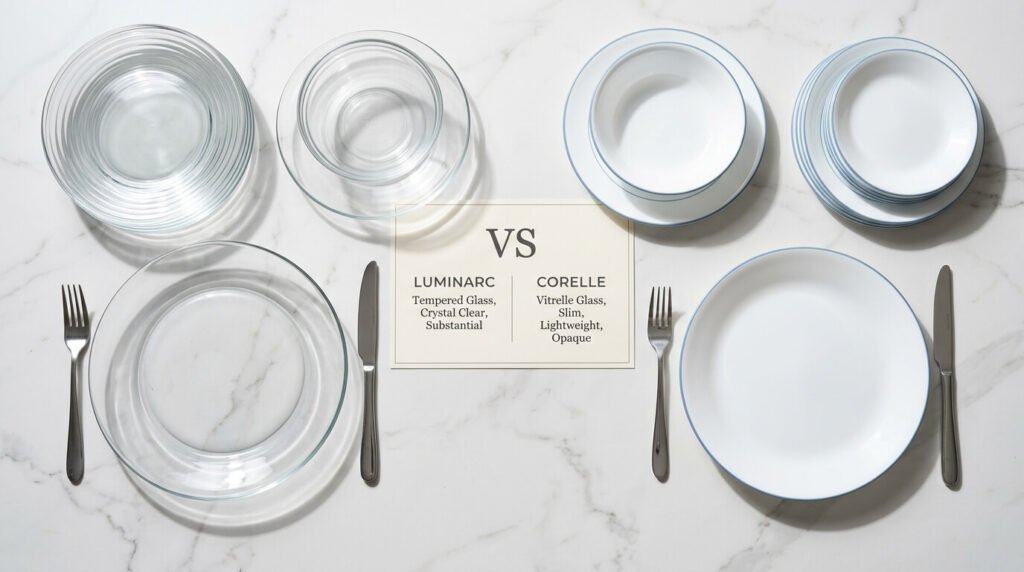
| Feature | Luminarc (Opal/Tempered Glass) | Corelle (Vitrelle Glass) |
|---|---|---|
| Origin | France — Arc International | USA — Corning Inc. |
| Primary Material | Tempered opal glass | Triple-layer laminated Vitrelle glass |
| Weight | Lightweight | Ultra-lightweight |
| Thickness | Moderate profile | Thin and slim |
| Chip Resistance | Good | Excellent |
| Break Behavior | Shatters under hard impact | Shatters under hard impact |
| Microwave Safe | Yes (most collections) | Yes — all collections |
| Dishwasher Safe | Yes | Yes |
| Oven Safe | Some collections | No |
| Thermal Shock Resistance | Good | Good |
| Heat Retention | Moderate | Low |
| Stackability | Good | Excellent |
| Design Style | Modern European, decorative | Minimalist, clean, functional |
| Color & Pattern Range | Wide — patterns and colors | Moderate — mostly white base |
| Lead-Free Certified | Yes | Yes |
| Price Range | Budget-friendly | Budget to mid-range |
| Open Stock Replacement | Limited by collection | Widely available |
| Best For | Design-conscious buyers, modern kitchens | Families, small kitchens, RV, daily use |
What Is Luminarc?
Overview of the Luminarc Brand
Luminarc is a glassware and dinnerware brand produced by Arc International, one of the world’s largest glass manufacturers headquartered in France.
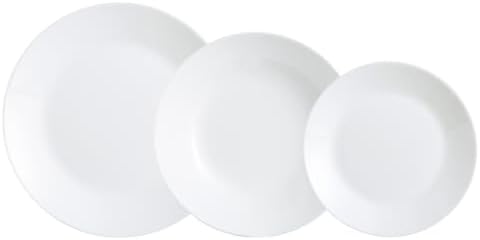
- Dishwasher safe.
- Microwave and oven safe.
- Elegant and refined.
The brand has a deep French glassware heritage stretching back decades and has grown into a globally distributed product line sold across Europe, the Middle East, Asia, and, increasingly, North American retail markets.
Arc International’s manufacturing scale gives Luminarc a strong position in the affordable glass dinnerware segment, allowing it to produce consistently quality-controlled products at price points accessible to a broad consumer base.
What Luminarc Dinnerware Is Made Of
Luminarc dinnerware is produced primarily from tempered glass and opal glass, two related but distinct glass formulations.
Opal glass, sometimes called opalware, is an opaque tempered glass that gives dishes a white, porcelain-like appearance while retaining the strength of tempered glass.

- Made in France
- Recyclable, eco-friendly, extra resistant tempered glass, 100% healthy material, extra resistant, cadmium and lead free,…
- Suitable for microwave, refrigerator safe
The tempering process involves heating the glass to high temperatures and then rapidly cooling it, which creates internal compression that significantly increases its resistance to impact and thermal shock compared to standard untreated glass.
This opal glass manufacturing process is Arc International’s core production expertise.
Main Features of Luminarc
Luminarc brings a consistent set of practical qualities to the everyday dinnerware category:
- Lightweight handling: Noticeably lighter than ceramic or stoneware alternatives, though slightly heavier than Corelle Vitrelle
- Affordable pricing: Positioned as budget-friendly dinnerware accessible to a wide range of household budgets
- Heat resistance: Tempered glass construction tolerates moderate heat from microwaves and dishwashers reliably
- Modern European designs: Collections reflect contemporary design trends with clean lines, decorative patterns, and color variety
- Wide product range: Covers full dinnerware sets, individual bowls, mugs, serving pieces, and drinkware under one brand
- Thermal shock resistance: Engineered to handle temperature transitions that standard glass could not survive
Luminarc vs Corelle: Key Differences
Material Technology Comparison
The material difference between these two brands is fundamental.
Corelle’s Vitrelle glass is a triple-layer laminated glass with three bonded glass layers fused under heat and pressure, producing an unusually thin and lightweight sheet that is stronger than its dimensions suggest.

- 18-PIECE SET: Includes (6) 10-1/4-inch dinner plates, (6) 6-3/4-inch appetizer plates and (6) 16-oz soup/cereal bowls. T…
- LIGHT AND STRONG: Say goodbye to chips and cracks with Corelle’s triple-layer-strong glass plates and bowls. This durabl…
- LOW MAINTENANCE: This dinnerware set is designed to provide the best dining experience while requiring low maintenance. …
Luminarc’s opal glass is a single-body tempered glass formulation; the opacity comes from mineral additives, and strength comes from the tempering process rather than lamination.
Both are meaningfully stronger than standard glass, but the construction methods differ entirely. Vitrelle’s laminated structure gives Corelle its signature thinness; opal glass manufacturing gives Luminarc its porcelain-like visual quality.
Weight and Thickness Differences
Corelle is lighter. The Vitrelle glass technology produces dishes that are thinner and lighter than comparable Luminarc opal glass pieces. Corelle’s dinner plates weigh notably less, and the difference is immediately felt when handling either brand.
Luminarc is still lightweight dinnerware by ceramic or stoneware standards, but it cannot match Corelle’s ultra-lightweight profile.
For compact storage, Corelle’s thinner construction also stacks more efficiently, fitting more plates into the same cabinet space than Luminarc’s slightly thicker opal glass profile allows.
Durability and Break Resistance
Both brands offer genuine break-resistant dinnerware performance, but Corelle has a documented edge in real-world household durability.
The Vitrelle triple-layer structure distributes impact forces across the dish surface more effectively than single-body tempered glass, giving Corelle better resistance to the drops and knocks of daily family use.
Luminarc’s tempered opal glass is solidly durable, significantly stronger than standard glass, but under equivalent impact conditions, Corelle tends to survive situations that Luminarc does not.
When either material does break under extreme force, both shatter rather than chip, which is a characteristic shared by all glass-based dinnerware.
Chip and Scratch Resistance
Corelle’s chip-resistant plates lead in this category. The laminated glass structure of Vitrelle distributes edge impact more evenly, making rim chipping considerably less frequent under daily stacking and handling.
Luminarc’s opal glass edges are more vulnerable to chipping when pieces knock together in storage or during washing, a common observation in long-term user experience with tempered glass dinnerware generally.
On scratch resistance, both materials show surface marks over years of heavy use with metal cutlery, though Luminarc’s slightly thicker surface profile may hide minor scratches marginally better than Corelle’s thinner glass finish.
Heat and Thermal Shock Resistance
This is a closer comparison than weight or chip resistance. Both Luminarc and Corelle handle thermal shock resistance well for everyday use, moving from dishwasher to room-temperature food service, from refrigerator storage to microwave reheating.
Luminarc’s tempered opal glass is specifically engineered for thermal shock performance and handles moderate temperature transitions reliably. Corelle’s Vitrelle glass performs similarly.
Neither brand is designed for extreme temperature transitions like direct stovetop use or moving from a freezer to a preheated oven, but for standard daily kitchen temperature ranges, both perform without issue.
Which Brand Is Better for Everyday Use?
Best for Families and Kids
Corelle is the stronger family-friendly dinnerware choice. Its ultra-lightweight construction makes plates and bowls easy for children to carry independently, and its chip resistance under daily family dining conditions consistently outperforms tempered glass alternatives.
For households with young children where plates get dropped, stacked carelessly, and run through the dishwasher constantly, Corelle’s Vitrelle durability profile holds up better over time.
Luminarc is a perfectly adequate family dinnerware option, but Corelle’s specific combination of low weight and superior chip resistance gives it a genuine practical edge in active family kitchen environments.
Best for Small Kitchens and Apartments
Corelle again. Its stackable dinnerware advantage is most obvious in compact living situations where cabinet space is genuinely limited.
Vitrelle’s thin, uniform profile allows plates to nest tightly a full set of Corelle plates, which tightly take up considerably less shelf space than an equivalent Luminarc set.
For apartment kitchen essentials where storage efficiency is a daily priority, Corelle’s space-saving dinnerware design is hard to match in the glass dinnerware category. Luminarc stacks reasonably well but cannot compete with Corelle’s storage density at equivalent plate counts.
Best for RV and Camping Use
Corelle is the clear pick for RV and camping dinnerware. Weight and space are at a premium in mobile living situations, and Corelle’s ultra-lightweight, highly stackable Vitrelle glass is purpose-suited to exactly these conditions.
Full RV dinnerware sets in Corelle take up minimal storage space and add negligible weight compared to ceramic or heavier glass alternatives.
Luminarc works fine for casual outdoor dining on a patio, but for genuine space-constrained mobile use, RVs, camper vans, and extended camping trips, Corelle’s practical advantages compound in ways that matter significantly.
Best for Frequent Dishwasher Use
Both brands are dishwasher-safe dinnerware and handle repeated cycles reliably. Corelle’s glass surface resists staining and surface degradation slightly better over very high cycle counts, maintaining its appearance longer under maximum daily dishwasher use.
Luminarc holds up well under standard dishwasher conditions and is the more affordable option to replace if sets do show wear over time.
For households running full dishwasher loads daily, both brands perform competently; the difference emerges more in appearance maintenance over a multi-year period than in any single-cycle performance metric.
Best for Long-Term Durability
Corelle edges ahead for long-term durability under daily household conditions. Its chip resistance preserves edge appearance over years of use, and its glass surface does not absorb stains or odors that can accumulate in surface-porous materials.
Luminarc is a genuinely durable dinnerware option well above average for its price point, but its opal glass edges show wear more visibly over equivalent periods of heavy daily use.
For households looking for dinnerware that they will not need to replace for many years, Corelle’s longevity profile under continuous use is the more reliable investment.
Safety Comparison: Luminarc vs Corelle
Lead-Free and Food-Safe Standards
Both Luminarc and Corelle produce lead-free dinnerware meeting current international food safety standards. Glass is inherently inert; neither tempered opal glass nor Vitrelle laminated glass reacts chemically with food under normal use conditions.
Arc International maintains compliance with European food safety regulations, which are among the strictest globally, and Corelle meets FDA food contact standards for the US market.
Buyers purchasing current production runs of either brand from established retail channels are getting food-safe glass dinnerware that has been properly tested and certified for everyday food contact use.
Microwave and Dishwasher Safety
Corelle is microwave-safe across all standard Vitrelle collections without exception.
Luminarc is generally microwave-safe dishes as well, though some decorative collections with metallic accents or specific glaze treatments may carry limitations; always verify the individual product label.
Both brands handle dishwasher-safe dinnerware cycles reliably under standard settings.
For households where microwave use is a daily constant and checking individual piece limitations is impractical, Corelle’s blanket microwave safety across its range is a genuine convenience advantage over Luminarc’s slightly more varied collection-by-collection specifications.
Oven Safety Differences
Some Luminarc collections carry oven-safe ratings for moderate temperatures, giving the brand a functional edge over Corelle for households that want dinnerware capable of occasional oven use.
Corelle Vitrelle glass is not oven-safe; the laminated glass construction is not designed for sustained dry oven heat.
This distinction matters for cooks who want serving dishes that can move from oven to table, though neither brand approaches the oven versatility of stoneware or ceramic alternatives.
If occasional oven use is on your list of requirements, checking Luminarc’s specific collection oven ratings is worth the extra step.
BPA and Non-Toxic Material Concerns
Both brands are non-toxic dinnerware options by material nature. Corelle’s Vitrelle is pure laminated glass, no plastic compounds, no BPA concerns.
Luminarc’s opal glass and tempered glass collections are similarly free of plastic-based chemical concerns. The BPA issue is relevant to plastic and melamine dinnerware products, not to glass-based dinnerware in either brand’s core lineup.
For households prioritizing chemical safety in food-contact materials, both Luminarc and Corelle sit cleanly in safe territory without requiring special handling precautions or certification verification beyond standard food-safe labeling.
Design and Style Comparison
Luminarc’s European Modern Aesthetic
Luminarc’s design identity is shaped by its French glassware heritage and Arc International’s attention to contemporary European design trends.
Collections range from clean white opal glass sets with minimal surface detail to patterned dinnerware featuring geometric motifs, floral designs, and seasonal tableware releases.
The overall aesthetic is modern, accessible, and visually engaging. Luminarc dishes are designed to be noticed at the table rather than simply function quietly in the background.
For buyers who want glass dinnerware that contributes actively to a kitchen’s visual identity, Luminarc’s European glassware design sensibility offers considerably more expressive options than Corelle.
Corelle’s Minimalist Functional Style
Corelle’s design language prioritizes function over form. The Vitrelle glass finish produces a smooth, bright white surface that is clean and consistent across collections, ideal for minimalist tableware setups and neutral kitchen aesthetics.
The Corelle Boutique line adds more decorative pattern options, but the overall design character remains restrained.
Corelle dishes are not trying to dominate the table setting; they are designed to be reliable, consistent, and visually neutral.
For households that value simplicity, or where the food presentation itself is meant to be the focus at the table, Corelle’s minimalist dining culture approach suits perfectly.
Color and Pattern Variety
Luminarc offers broader color and pattern variety across its full product range. Its opalware collections include colorful dinnerware options, patterned designs, and contemporary motifs that change seasonally, giving buyers who enjoy refreshing their table setting with current trends considerably more to choose from.
Corelle’s pattern range is more restrained, with clean white bases dominating and printed patterns offered through specific collections.
For design-conscious buyers who want their everyday tableware to reflect personality and current aesthetic preferences, Luminarc’s wider design catalog is a meaningful advantage.
Which Brand Looks More Premium?
Luminarc reads as more visually premium to most buyers at first glance, primarily because its opal glass surface has a porcelain-like opacity and glossy glass finish that communicates refinement in ways that Corelle’s thinner, lighter plates do not.
Corelle’s appearance is clean and precise but undeniably utilitarian.
In a side-by-side display, Luminarc’s heavier, more decorative pieces tend to look more like considered tableware choices.
In actual daily use, however, Corelle’s functional superiority, lighter weight, better chip resistance, and tighter stacking compensate for what it gives up visually to Luminarc.
Luminarc vs Corelle Durability Test
Resistance to Chipping
Corelle leads on chip resistance in real-world household conditions. The Vitrelle triple-layer laminate distributes rim impact forces more effectively than single-body opal glass, producing fewer visible edge chips over equivalent periods of daily use.
Luminarc’s tempered glass construction is chip-resistant by glass standards, but cannot match Corelle’s specific performance in this category.
Long-term household users consistently report that Corelle plates maintain their edge integrity longer than tempered glass alternatives, a practical advantage that compounds meaningfully over a multi-year product lifespan.
Resistance to Cracking
Both brands resist surface cracking well under normal household use conditions.
Luminarc’s tempered opal glass absorbs minor mechanical stress without internal fracturing, and its thermal shock resistance engineering specifically targets the temperature-change cracking that standard glass is vulnerable to.
Corelle’s Vitrelle construction similarly handles normal daily stress without cracking. Neither material develops the hairline fractures that can appear in ceramic dinnerware over time.
For standard household conditions, dishwasher cycling, stacking, and regular meal service cracking are not a meaningful concern with either brand.
Shattering Behavior Comparison
Both Luminarc and Corelle shatter when subjected to significant impact. This is a characteristic shared by all glass-based dinnerware, regardless of tempering or lamination technology.
The distinction is in threshold: Corelle’s Vitrelle lamination generally requires more force to trigger complete breakage than Luminarc’s opal glass, giving it a wider safety margin under the drops and knocks of daily household use.
When either material does shatter, tempered glass breaks into smaller, less sharp pieces than standard glass, a safety characteristic common to both brands that reduces injury risk compared to untreated glass breakage.
Which Dinnerware Lasts Longer?
Under continuous maximum daily use, Corelle generally maintains its condition longer.
Its chip resistance keeps edge appearance cleaner, its glass surface resists staining more effectively, and its Vitrelle construction tolerates the accumulated stress of high-volume household use better than Luminarc’s opal glass over equivalent time periods.
Luminarc is a genuinely long-lasting opalware durability option well above the average for its price range, but Corelle’s material engineering gives it a measurable longevity advantage that becomes increasingly evident over years of daily service rather than months.
Price and Value Comparison
Budget-Friendly Dinnerware Options
Both brands compete squarely in the affordable dinnerware segment, with full sets available at accessible price points through major retailers.
Luminarc often prices slightly lower than Corelle at equivalent set sizes, making it the more attractive entry point for budget-constrained buyers setting up a first kitchen or replacing a full set quickly.
Corelle’s pricing reflects its more specialized Vitrelle technology and established brand premium.
For buyers whose primary concern is minimizing upfront cost, Luminarc offers strong value at a lower initial investment than comparable Corelle sets.
Long-Term Replacement Availability
Corelle maintains a clear advantage in replacement availability. The brand sells open stock dinnerware pieces for many core collections, individual plates, bowls, and mugs, purchasable separately without buying a full new set.
This is particularly valuable for households that use dinnerware heavily over many years and inevitably break individual pieces.
Luminarc’s replacement availability varies by collection and region, and some lines are sold as complete sets only. For buyers planning a long-term relationship with a single dinnerware set, Corelle’s open stock system provides better practical flexibility.
Cost vs Durability Value
When evaluated on a cost-per-year-of-use basis, Corelle’s durability advantage makes its slightly higher upfront price competitive or superior to Luminarc over a multi-year household lifespan.
A Corelle set that lasts five or more years of heavy daily use without significant chipping represents stronger value than a less expensive Luminarc set that requires partial replacement after three years.
For short-term use, a temporary living situation, a student apartment, or a guest set, Luminarc’s lower upfront price makes it the more rational choice. For permanent household dinnerware, Corelle’s durability justifies the price differential.
Which Brand Offers Better Overall Value?
For most everyday household use cases, Corelle offers better overall long-term value through its superior chip resistance, ultra-lightweight handling, consistent microwave safety, excellent stackability, and open stock replacement system.
Luminarc offers better value for buyers who prioritize design variety, European aesthetic quality, lower initial cost, and occasional oven use in a glass dinnerware product.
Neither brand is universally superior; the better value answer depends entirely on which specific qualities your household uses and values daily. For pure practical performance over time, Corelle leads; for design flexibility and lower entry cost, Luminarc is the stronger choice.
Conclusion
Final Comparison Summary
Luminarc and Corelle are both capable, food-safe glass dinnerware brands that serve everyday household needs well. Corelle’s Vitrelle glass technology excels in lightweight practicality, chip resistance, stackability, and long-term durability under high-volume daily use.
Luminarc’s tempered opal glass offers stylish European design variety, solid thermal shock resistance, and accessible pricing that makes it a compelling option for design-conscious buyers and those setting up a kitchen on a tighter budget.
Both are genuine improvements over ceramic or stoneware alternatives for households that prioritize glass-based lightweight dinnerware.
Key Buyer Takeaways
- Both brands provide food-safe, lead-free, microwave-safe, and dishwasher-safe glass dinnerware
- Corelle is lighter, chips less, stacks better, and lasts longer under heavy daily use
- Luminarc offers more design variety, lower upfront cost, and some oven-safe options
- Weight and storage needs should guide the decision for compact kitchens and RV living
- Design preferences and aesthetic priorities favor Luminarc for modern European-style tables
Final Recommendation
Choose Corelle if ultra-lightweight daily convenience, chip resistance, and long-term durability are your top priorities. It is the stronger practical performer for busy family kitchens, small apartments, and RV living.
Choose Luminarc if modern design variety, value-focused dining, and a porcelain-like aesthetic at an accessible price point matter more to you.
Whichever direction you go, prioritize durability certifications, food safety labeling, and practical household needs over brand loyalty alone; both Luminarc and Corelle deliver genuine everyday performance worth the investment.
About the Author & Reviewer
Sarah Emirone, Author
Sarah researches and writes SafeKitchn’s dinnerware and kitchenware guides, with a focus on material safety, lead content, and manufacturer specifications. She cross-references product data sheets, safety certifications, and regulatory filings (including FDA and Prop 65 records) before publishing, and updates articles when new information becomes available.
James Daniels, Reviewer
James reviews SafeKitchn’s material safety content for scientific accuracy. He holds a B.Sc in inorganic chemistry and works as a materials researcher, with particular focus on the composition and safety behavior of glass, ceramic, and metal used in kitchenware.