

Most guides on Baccarat crystal patterns identification start with the mark. That’s backwards for a lot of people holding a piece right now, because plenty of genuine Baccarat crystal was never marked at all.
This guide separates two questions that get treated as one everywhere else: is this piece actually Baccarat, and which named pattern is it?
Then it walks through marks by era, physical tests, the patterns you’ll actually run into (Harcourt, Nancy, Massena, Tallyrand, Rohan), how to date a piece within a pattern’s production run, and how Baccarat compares to Waterford and Saint-Louis.
If you’ve got an unmarked piece from your grandmother’s cabinet, the section on pre-1936 pieces matters more than anything else here.
Written by Sarah Emirone | Reviewed by James Daniels, B.Sc, Inorganic Chemist & Materials Researcher | Updated September 2026 | See How We Test | Filed under: Identification & Authentication
Authentication vs. Pattern Identification — Why They’re Two Different Questions
A mark tells you who made the piece. A pattern match tells you what design it is.
Neither one, alone, answers the other question, and most identification guides skip straight past this, which is exactly why so many people end up stuck comparing a random etched logo to a pattern name and assuming a mismatch means fake.
What Authentication Actually Confirms
An acid-etched Baccarat logo, a paper label, or a laser-etched “Baccarat” confirms the manufacturer.
It says nothing about which pattern the piece is, how old it is within that pattern’s run, or whether it’s a common production line or a rare limited edition.
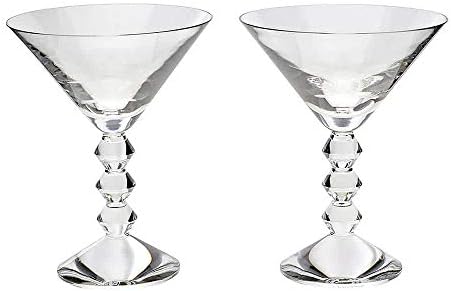


A genuine mark on a plain, unremarkable tumbler and a genuine mark on a rare 1920s Harcourt goblet carry the same authentication weight; the mark can’t tell you which one you’re holding.
What Pattern Identification Actually Confirms
Matching your piece’s cuts to a documented pattern like Nancy or Massena confirms the design, not the maker.
Baccarat’s cut patterns weren’t legally exclusive in the way a trademark is, and competing French and Czech houses produced visually similar deep-cut and grid patterns during the same eras.
A perfect cut match is strong evidence toward Baccarat, especially combined with weight and clarity, but it isn’t proof on its own, the way a verified mark is.
Related: Crystal Glass Patterns Identification
Related: Does Waterford Crystal Contain Lead
Baccarat Marks by Era: What to Look For and When
The mark you should be looking for depends entirely on when the piece was likely made, and using the wrong era’s checklist is the single most common mistake in Baccarat identification. Get the timeline right first.
Pre-1936: No Systematic Mark Exists
An unmarked piece from before 1936 is not automatically suspicious; it’s expected.
Baccarat did not adopt a systematic marking practice until the mid-1930s, and paper labels used earlier were often lost to handling, dishwashing, or age over the following decades.
For anything that looks pre-war in style, weight, and wear pattern, treat the absence of a mark as neutral information, not a red flag.
The evidence shifts entirely onto weight, clarity, and cut-pattern matching for these pieces, and that’s not a fallback method; it’s the only method that applies.
Post-1936 Acid-Etched Logo
| Detail | Specification |
|---|---|
| Introduced | Mid-1930s (1936 onward, based on documented company history) |
| Appearance | Circular acid-etched mark showing a carafe, wine glass, and goblet, alongside the word “Baccarat” |
| Location | Base of the piece, sometimes faint or partially worn — tilt under bright light and rotate slowly |
| Reliability | High, when present and undamaged |
Paper Labels and Modern Laser Etching
| Era | Mark Type | Notes |
|---|---|---|
| Pre-1936 (and some later pieces) | Rectangular or quadrilateral paper/foil label, often red with gold lettering | Frequently missing due to age; absence is not disqualifying |
| Contemporary (recent decades) | Laser-etched “Baccarat,” sometimes without the full circular logo | Common on current production; check nearby for a secondary logo etch |
| Limited editions/couture pieces | Hand-engraved signature, sometimes with a production number | Rare, but adds strong provenance when present |
Physical Tests: Weight, Lead Content, and Clarity
Weight is a real indicator, but it’s a comparative one, not an absolute one; you need something to compare against, or it’s just a guess.
Baccarat crystal runs roughly 24 to 30 percent lead oxide content, well above the European Union’s minimum 24 percent threshold for the “crystal” designation, and that lead content is what gives it both its density and its refractive brilliance.
The Weight and Density Test
- Hold the piece and compare it, mentally or physically, to an ordinary drinking glass of the same size — genuine lead crystal should feel noticeably heavier for its volume.
- Check for the absence of air bubbles inside the glass body, since pressed or lower-grade glass frequently traps small bubbles during production that lead crystal does not.
- Hold the piece to a bright light source and look for strong refraction and a slightly blue-white brilliance, rather than the flatter, more yellow-toned clarity typical of soda-lime glass.
- Compare the base thickness to known Baccarat catalog images of the same suspected pattern, since Baccarat’s cutting process typically leaves a thicker, more substantial base than mass-market reproductions.
Sound, UV Light, and Hardness Checks
- Tap the rim gently with a fingernail or a spoon — genuine lead crystal produces a clear, ringing tone that sustains briefly, while ordinary glass produces a shorter, duller sound.
- Shine a UV light on the piece in a dark room; lead crystal often shows a faint blue or violet glow that pressed glass typically does not produce.
- Run a fingertip along a cut edge — Baccarat’s facets are cut with enough precision that the edges feel crisp and even, not rounded or slightly uneven the way lower-cost pressed patterns often do.
- Treat all three checks as supporting evidence together, not as a single deciding test, since sound and UV response can vary with glass thickness and shape even within genuine pieces.
Named Baccarat Patterns and How to Tell Them Apart
Once you’ve got a sense of whether the piece is likely genuine, matching it to a specific pattern name is what actually lets you find replacements, price it accurately, or list it for sale correctly.
A handful of patterns account for most of what collectors run into.
Harcourt (1841) — Hexagonal Base, Structured Bowl
Harcourt is Baccarat’s most recognized pattern, created in 1841 and commissioned for King Louis-Philippe. It’s built around a hexagonal stem and base with a clean, architectural bowl shape.
The cutting is structural rather than dense, defined more by the faceted form itself than by an intricate surface pattern.
It remains in continuous production today, which is part of why it’s the pattern most people already recognize even without knowing its name.
Nancy (1909–2002) — Deep Grid Cut
Nancy ran in production from 1909 to 2002, one of Baccarat’s longest-running patterns, and is defined by a deep, tightly spaced grid cut that covers most of the glass surface.
The grid sits in contrast to Harcourt’s structural minimalism, where Harcourt relies on shape, and Nancy relies on dense surface cutting for its sparkle.
A near-century production run means Nancy pieces vary meaningfully in exact cut proportions depending on when within that span they were made.
Massena — Barrelled Orgue Bevel Cuts
Massena uses deep “orgue” bevel cuts etched directly into the crystal body, producing a barrelled, rounded silhouette rather than Nancy’s flatter grid or Harcourt’s angular hexagon.
The bevels run vertically in evenly spaced bands, giving the glass a fluted look under light that’s distinct from both other patterns at a glance, once you know what to check.
Tallyrand and Rohan — Distinguishing Two Similar Cuts
Tallyrand and Rohan get confused with each other more than any other pair on this list, because both use restrained, vertical faceting on a relatively simple silhouette rather than dense all-over cutting.
| Feature | Tallyrand | Rohan |
|---|---|---|
| Named for | Charles-Maurice de Talleyrand, French statesman | The House of Rohan, a French noble family |
| Cut style | Broad, flat vertical panels, fewer and wider facets | Narrower, more numerous vertical facets |
| Silhouette | Straight-sided, architectural | Slightly more tapered toward the base |
| Common products | Tumblers, decanters, barware sets | Stemware, wine glasses, more often than barware |
If your piece has wide, flat panels and shows up as a tumbler or decanter, lean Tallyrand. Narrower vertical facets on a stemmed glass point to Rohan.
Dating a Pattern Within Its Production Years
Naming the pattern correctly is not the same as dating the piece, and treating pattern identification as the finish line is where a lot of collectors stop short of the answer they actually need for insurance or resale purposes.
Why Pattern Name Alone Doesn’t Confirm a Decade
Nancy’s 1909–2002 production window covers roughly a century of manufacturing.
A Nancy tumbler from the 1920s and a Nancy tumbler from the 1980s share the same cut pattern but were made six decades apart, under different marking conventions, and likely at different price points relative to inflation.
Confirming “this is Nancy” answers the design question. It doesn’t answer when, and for appraisal or insurance purposes, when matters as much as which.
Cross-Referencing Cut Details, Product Type, and Catalog Records
- Compare the exact cut density and spacing against dated catalog images or verified auction listings, since even within one pattern name, cutting precision and spacing shifted slightly across decades of production.
- Check whether the specific product shape — a particular tumbler height, a specific stem style — was introduced or discontinued partway through the pattern’s overall run, since shape changes narrow the window faster than cut style alone.
- Cross-reference the pattern-plus-shape combination against documented auction or estate-sale records that list both the pattern name and a sale or production date, since matching listings elsewhere gives you a real anchor point rather than a guess.
- Factor in the marking era once the decade range narrows, since a Nancy piece with an acid-etched post-1936 logo can be dated more precisely than an unmarked one from the same broad pattern run.
Baccarat vs. Other Crystal Houses: Telling Them Apart
Baccarat isn’t the only French crystal house producing deep-cut, high-lead glassware from the same general eras, and mistaking a competitor’s piece for Baccarat is common enough to warrant its own comparison.
Baccarat vs. Waterford
| Feature | Baccarat | Waterford |
|---|---|---|
| Origin | Baccarat, France (founded 1764) | Waterford, Ireland |
| Signature style | Sharp, precise geometric cuts prioritizing clarity and refraction | Traditional, often more ornate patterns with heavier surface detail |
| Typical weight | Very heavy for size, high lead content | Also heavy, comparably high lead content |
| How to tell apart | Baccarat’s cuts favor precision and negative space; Waterford leans toward denser, more traditional Irish-cut ornamentation | — |
Baccarat generally wins on cut precision and restraint; Waterford leans into denser, more traditional ornamentation.
Baccarat vs. Saint-Louis and Lalique
| Feature | Baccarat | Saint-Louis | Lalique |
|---|---|---|---|
| Founded | 1764 | 1586 (crystal since 1767) | Early 20th century |
| Signature style | Precise faceted cuts, clarity-focused | Similar deep-cut faceting, historically, Baccarat’s closest domestic rival | Frosted, sculptural glass art rather than faceted tableware |
| Easiest tell | Compare cut precision and mark style directly against Saint-Louis, since silhouettes often overlap | Frosted, matte-finish surfaces immediately separate Lalique from both cut-crystal houses |
Saint-Louis is the one genuinely easy to confuse with Baccarat, since both houses produced similar deep-cut French crystal through overlapping eras; the mark and catalog cross-reference matter more here than with Lalique, which is visually distinct on sight.
What Your Pattern Means for Value
Pattern name is one of the biggest single factors in what a piece is worth, and it matters more than most sellers realize before they list something.
- Harcourt holds value consistently because it has stayed in continuous production since 1841, which means steady demand but also steady supply.
- Discontinued patterns like Nancy (ended 2002) or older Massena runs can command a premium specifically because replacement pieces are harder to source, not because the design itself is rarer than Harcourt.
- Limited editions and hand-engraved pieces, including numbered couture items, typically carry the highest premiums of any category on this list.
- Complete matched sets in a single discontinued pattern are worth meaningfully more per piece than the same items sold individually, since buyers replacing a set will pay for convenience.
- Condition affects value as much as pattern rarity does — chips, cloudiness from dishwasher etching, or a damaged stopper on a decanter can cut a piece’s value by half, regardless of how desirable the pattern is.
For the full picture of how these factors combine, see how the pattern affects the Baccarat crystal value.
If you’ve matched your piece to Nancy or Massena and want the deeper cut comparison between the two, see the detailed comparison of Nancy and Massena cuts.
For anything high-value, unusual, or still ambiguous after working through the steps above, an unmarked pre-1936 piece with an uncertain pattern match, for instance, a professional appraiser will settle it faster than continued guesswork.
Frequently Asked Questions
How can you tell if a crystal is Baccarat?
Look first for a mark — an acid-etched logo since 1936, a paper label on older pieces, or a laser etching on recent production.
If there’s no mark, weight, clarity, or cut-pattern matching against documented Baccarat patterns become your primary evidence. A genuine mark plus a documented pattern match together give the strongest confirmation.
Do all Baccarat crystals have a mark?
No. Baccarat had no systematic marking practice before 1936, so genuine pre-1936 pieces are commonly unmarked. Treat an unmarked older piece as needing pattern and weight analysis, not as evidence that it’s fake.
What is the most famous Baccarat pattern?
Harcourt, created in 1841 for King Louis-Philippe, is Baccarat’s most recognized pattern and has stayed in continuous production ever since.
Its hexagonal stem and structured bowl shape are what most people picture when they think of Baccarat stemware, even without knowing the pattern name.
What is the difference between the Baccarat Nancy and Massena patterns?
Nancy uses a deep, tightly spaced grid cut covering most of the surface, while Massena uses vertical barrelled bevel cuts that create a rounded, fluted silhouette.
Nancy ran from 1909 to 2002; Massena’s bevel style gives it a more sculptural, less flat-cut appearance overall.
How much lead is in Baccarat crystal?
Baccarat crystal typically contains 24 to 30 percent lead oxide, above the European Union’s 24 percent minimum threshold required for the “crystal” designation.
That lead content is what produces both the density and the strong light refraction associated with the brand.
Can you tell Baccarat crystal by weight?
Yes, as a comparative test rather than an absolute one, genuine lead crystal feels noticeably heavier for its size than ordinary glass or lower-lead imitations.
Pair the weight check with the absence of air bubbles and a ringing sound when tapped for a stronger read.
What year did Baccarat start marking its crystal?
Baccarat adopted its circular acid-etched logo, showing a carafe, wine glass, and goblet alongside the word “Baccarat,” starting in the mid-1930s.
Before that, marking was inconsistent and largely limited to paper labels that were frequently lost over time.
What is the rarest Baccarat crystal pattern?
Limited editions and hand-engraved, numbered couture pieces typically carry the highest rarity and value of any Baccarat category.
Among standard named patterns, discontinued lines with harder-to-source replacements, rather than the design’s original scarcity, tend to command the strongest premiums.
About the Author & Reviewer
Sarah Emirone, Author
Sarah researches and writes SafeKitchn’s dinnerware and kitchenware guides, with a focus on material safety, lead content, and manufacturer specifications. She cross-references product data sheets, safety certifications, and regulatory filings (including FDA and Prop 65 records) before publishing, and updates articles when new information becomes available.
James Daniels, Reviewer
James reviews SafeKitchn’s material safety content for scientific accuracy. He holds a B.Sc in inorganic chemistry and works as a materials researcher, with particular focus on the composition and safety behavior of glass, ceramic, and metal used in kitchenware.