

Dishes that don’t get silverware marks share one trait: a glaze or surface hard and smooth enough that metal can’t embed in it.
Porcelain, vitrified stoneware, and tempered glass all qualify to different degrees. But the marks themselves aren’t damage to your dishes, they’re metal rubbed off your flatware.
Once you understand that, the whole buying decision changes, and so does what actually removes them.
Here’s the mechanism, the materials that resist it best, and why your flatware matters as much as your plates do.
Written by Sarah Emirone | Reviewed by James Daniels, B.Sc, Inorganic Chemist & Materials Researcher | Updated September 2026 | See How We Test | Filed under: Buying, Care & Product Guides
Why Silverware Marks Happen — And Why They’re Not Actually Scratches
A silverware mark is a thin layer of metal transferred from your utensil onto your dish, not a scratch in the glaze.
Most ceramic glazes, especially porcelain, sit around 7 on the Mohs hardness scale. Stainless steel flatware sits lower, closer to 5.5–6.
When a knife or fork drags across the plate, the harder surface shaves microscopic particles off the softer one, the utensil, not the dish, and those particles smear across the plate as grey or black streaks.
Some sources claim harder dishes get more marked, since a harder glaze strips metal off flatware more aggressively. Others claim that harder dishes receive fewer marks, since the glaze resists embedding of metal.
Both are half right; the confusion comes from treating one variable as two. Hardness determines who loses material in the friction, almost always the softer flatware.
Surface smoothness and porosity determine whether that shed metal shows up as a visible mark or wipes away invisibly. A glassy, transparent glaze with no crystalline particles has nowhere for metal to catch, so marks barely show, even though the glaze is plenty hard.
A matte or opaque glaze, the kind that gets its whiteness from added mineral particles, has a microscopic texture that grabs shavings and holds them. That’s the real variable, not hardness alone.
The Metal-Transfer Mechanism: How Grey Marks Form
The friction happens most during cutting, scraping, or scooping anywhere a knife edge or fork tine drags with pressure across the surface.
Glossy opacifying crystals embedded in white glazes act like microscopic grit, and every pass of a fork tip that catches one shears off a tiny smear of metal.
Rougher glazes strip more metal per pass than smooth ones, which is why matte finishes mark up faster even when the base ceramic is just as hard.
Denby Pottery’s own care guidance notes that metal scouring pads and abrasive sponges cause the same effect during washing, roughening the surface permanently and making future marking worse.
The Removability Test: How to Tell a Mark From a True Scratch
- Run a fingernail across the mark. If it catches or you feel a groove, you’re likely dealing with an actual scratch, not a surface deposit.
- Rub a small section with a mild abrasive — baking soda paste or Bar Keepers Friend — for about 10 seconds.
- Check the result. If the mark lightens or disappears, it was a metal transfer, and the rest will come off the same way.
- If the mark hasn’t changed at all after gentle rubbing and the surface feels smooth (no catch on step 1), the ceramic itself may be discolored rather than marked, which points to a different issue, like staining from acidic foods.
A mark that responds to a 10-second rub was never a scratch. A groove your fingernail catches on is glaze damage, and no cleaner fixes that.
Which Dinnerware Materials Resist Silverware Marks Best
Porcelain and tempered glass resist marking best; stoneware and low-fired earthenware mark up fastest. The table below breaks down why, material by material.
| Material | Typical Hardness | Marking Tendency | Why |
|---|---|---|---|
| High-fired porcelain | Mohs ~7 | Low | Dense, glassy glaze with few embedded particles |
| Bone china | Mohs ~6–7 | Low | Smooth surface despite delicate appearance |
| Vitrified stoneware | Mohs ~5–6 | Moderate | Thicker glaze helps, but firing quality varies widely |
| Corelle Vitrelle glass | Mohs ~6 | Moderate to high | Very smooth but glossy surfaces show marks visibly |
| Melamine | N/A (plastic) | High | Softer than metal flatware, so it’s the melamine that scratches |
Porcelain and Bone China
Porcelain wins this comparison, and it’s not close. Its Mohs 7 hardness beats most stainless steel flatware outright, and vitrification glass formation inside the clay body during firing leaves almost no microscopic texture for metal to grab onto.

- ELEGANT AND SOPHISTICATED: Crisp white Parchment dinnerware elevates your table with a graceful silvery scroll design bo…
- COMPLETE 40-PIECE SET FOR 8: Includes 8 each of a 10-3/4 inch dinner plate, 8-1/4 inch salad plate, 8-1/2 inch rim soup …
- COMPLETE 40-PIECE SET FOR 8: Includes 8 each of a 10-3/4 inch dinner plate, 8-1/4 inch salad plate, 8-1/2 inch rim soup …
Bone china performs nearly as well despite looking fragile, since bone ash in its formula produces the same dense, glassy surface. Both still mark eventually, but it takes heavy daily use over the years to get there.
For the full comparison against stoneware, see the full comparison of porcelain vs. stoneware durability.
Vitrified Stoneware
Stoneware’s performance depends entirely on how it was fired, and that’s the honest answer instead of a vague “it depends.”
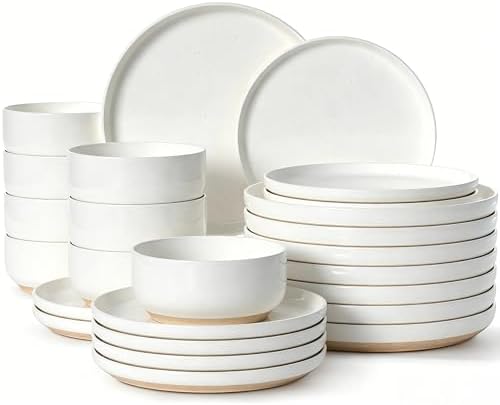
- 【Premium Healthy & Chef-Grade Durability】Crafted from premium lead-free and cadmium-free materials, this dinnerware set …
- 【Complete 24-Piece Dishes Set for 8】This dinnerware set includes 8x 10.2″ dinner plates, 8x 8″ salad plates, and 8x 5.5″…
- 【Space-Saving & Dishwasher and Microwave】Designed for convenience, these plates and bowls are perfectly stackable to max…
Properly vitrified stoneware, fired between 2,150°F and 2,330°F, develops a glassy, non-porous surface close to porcelain’s resistance.
Poorly fired or cheaply glazed stoneware, common in budget sets, stays porous and grabs metal shavings the way a rough matte finish does.
If you’re buying stoneware specifically to avoid marks, check that the listing explicitly says “vitrified”; the word does real work here.
Corelle Vitrelle Glass and Tempered Glass
Corelle marks more visibly than its reputation suggests, and the reason is glossiness, not hardness.
Vitrelle’s triple-layer glass construction resists chips and breaks well, and its surface hardness is comparable to good stoneware.

- 18-PIECE SET: Includes (6) 10-1/2-inch dinner plates, (6) 9-inch salad plates and (6) 22-oz soup/cereal bowls. This set …
- VITRELLE STRONG: Say goodbye to chips and cracks with Corelle’s triple-layer-strong glass plates and bowls. This durable…
- LOW MAINTENANCE: This dinnerware set is designed to provide the best dining experience while requiring low maintenance. …
But the finish is so smooth and reflective that any metal deposit shows up starkly against it, especially on white Corelle.
The marks wipe off just as easily as they do on porcelain; they’re just more visible while they’re there.
Melamine and Plastic Dinnerware
Melamine is the one material on this list where the dish, not the utensil, actually gets damaged.

- Vibrant Mediterranean-Inspired Design: Bring home the beauty of the Amalfi coast with this Portofino melamine dinner pla…
- Durable & Break-Resistant Construction: Made from high-quality melamine, these plates are shatterproof and scratch-resis…
- Perfect for Indoor & Outdoor Use: Whether you’re hosting a garden brunch, setting a festive summer table, or adding flai…
Plastic resin sits well below stainless steel on any hardness scale, so knives and forks scratch the plastic surface over time rather than leaving removable metal deposits.
Those scratches are real, permanent, and the reason old melamine plates look dull and grey, no matter how hard you scrub them.
It’s Not Just the Dish — Your Flatware Matters Just as Much
Your flatware’s nickel content changes how much metal it sheds onto your dishes, and most buying guides skip this entirely. Combine the wrong flatware with the wrong dish, and you’ll get heavy marking even on a “mark-resistant” plate.
| Dish Material | 18/10 Flatware | 18/8 Flatware | 18/0 Flatware |
|---|---|---|---|
| Porcelain/bone china | Lowest risk pairing | Low-moderate risk | Moderate risk |
| Vitrified stoneware | Low-moderate risk | Moderate risk | Higher risk |
| Corelle glass | Low risk, marks wipe off easily | Moderate, visible marking | Higher, more visible marking |
| Cheap/porous stoneware | Moderate risk | Higher risk | Highest risk pairing |
18/10 vs. 18/8 vs. 18/0 Stainless Steel Explained
For the difference between 18/10 and 18/8 stainless steel flatware in one sentence: the second number is nickel percentage, and higher nickel means a harder metal that sheds less onto your plates.
18/10 stainless (18% chromium, 10% nickel) is the standard for quality flatware and leaves the fewest marks of any metal utensil.
18/8 performs nearly as well. 18/0 has no nickel at all, is noticeably softer, and leaves marks that are both more frequent and harder to remove. Budget flatware that doesn’t list its composition is usually 18/0 or worse.
Utensil Materials That Never Leave Metal Marks
- Wooden utensils contain no metal and cannot leave metal-transfer marks, though they wear down and stain over time with regular use.
- Bamboo flatware shares wood’s mark-free property while holding up slightly better against moisture and warping.
- Silicone-tipped utensils avoid metal contact entirely, though they’re impractical for cutting.
- Titanium flatware, expensive and uncommon in home sets, is harder than most stainless steel and sheds even less metal.
Does the Dishwasher Make Silverware Marks Worse?
Yes, over years of use, hot water and detergent gradually etch the glaze, which is why dishes that resisted marking when new start marking more as they age.
The dishwasher isn’t creating the marks directly. It’s wearing down the surface that used to prevent them.
How Hot Water and Detergent Etch Glaze Over Time
Aggressive detergents combined with sustained high heat slowly strip metal ions out of the glaze surface, a process that accelerates in soft water with high-alkaline detergent formulas.
Each cycle removes a negligible amount on its own, but the effect compounds across hundreds of washes.
The result is a surface with more microscopic roughness than it had when new, exactly the texture that grabs metal shavings and holds them.
A ten-year-old porcelain plate can mark more easily than it did in year one, and the plate hasn’t changed materially. The glaze surface has.
Habits That Prevent Marks Regardless of Dishware
- Cutting food on a cutting board instead of directly on the plate removes the single biggest cause of marking.
- Lifting your fork to gather the last bite instead of scraping it across the plate cuts down on repeated friction in the same spot.
- Washing metal utensils separately from ceramics, even within the same dishwasher load, prevents flatware from clanging against plates during the cycle.
- Felt or cloth separators between stacked plates stop the unglazed foot ring on one plate from grinding against the glazed face below it.
How to Remove Silverware Marks From Dishes You Already Own
Start with how to remove silverware marks with Bar Keeper’s Friend, the most reliable method for most dishes. Here’s the full ranking, strongest to gentlest.
- Bar Keepers Friend — oxalic acid dissolves metal deposits chemically rather than relying on scrubbing, and it’s the fastest method for stubborn marks.
- Baking soda paste — a gentle abrasive that works well for light marking and is safe on nearly every glaze.
- Cream of tartar — mildly acidic and slightly more aggressive than baking soda, useful for marks that resist the gentler approach.
- Whitening toothpaste — the same mild abrasives that lift stains from teeth work on metal deposits, though it’s the slowest of the four.
Bar Keepers Friend and Other Mild Abrasives
Bar Keepers Friend doesn’t damage properly glazed dishes when used correctly, and the chemistry explains why.
Its active ingredient, oxalic acid, dissolves metal deposits rather than physically grinding them off, so the glaze itself isn’t under abrasive stress the way it would be with steel wool.
Dampen the dish, sprinkle a light amount onto the marks, rub gently with a soft cloth, and rinse. Skip it on unglazed stoneware, hand-painted antiques, or anything with metallic trim.
When a Mark Won’t Come Off — What That Tells You
If a mark survives a proper Bar Keepers Friend treatment, run the removability test again before assuming your dish is ruined.
Some marks are older and more embedded, and a second treatment, letting the paste sit for a minute before rinsing, clears most of what a quick pass misses.
A mark that still won’t budge after repeated treatment, especially one that your fingernail can feel as a groove, is a genuine scratch, and no cleaner reverses actual glaze damage.
Best Silverware-Mark-Resistant Dinnerware to Buy
Prioritize glossy, transparent glazes over matte or heavily opaque ones, and pair them with 18/10 flatware for the lowest marking risk available.
- Wedgwood, Royal Doulton, and Lenox all make high-fired porcelain with the glassy, low-porosity glaze that resists marking best.
- Duralex and Arcoroc tempered glass plates resist scratches and marks nearly as well as porcelain, at a lower price point.
- Denby’s vitrified stoneware carries a hard, dense glaze — a rarer trait in stoneware than manufacturers often claim.
- Look for “vitrified” in stoneware product descriptions — the term signals the higher firing temperature that actually matters.
- For restaurant-grade durability at home, commercial porcelain built for high-turnover kitchens tends to outperform consumer lines at a similar price.
For a broader buying list beyond mark resistance alone, see the best dinnerware sets for everyday use.
Dark and Patterned Dishes vs. White Dishes
Dark and patterned dishes hide marks better, but they don’t resist marking any more than white dishes do. The metal transfer happens at the same rate regardless of color.
What changes is visibility: grey metal deposits show up starkly against white or pale glaze and blend into charcoal, navy, or heavily patterned surfaces.
If marks bother you more than they bother your dishwashing routine, choosing a darker set solves the visual problem without changing the underlying material science.
Is It Safe to Eat Off Scratched or Marked Dishes?
Metal-transfer marks are cosmetic and pose no safety concern; you can keep eating off them without issue. The deposits sit on the surface and wash away with normal cleaning; they don’t leach into food the way a damaged glaze might.
Genuine scratches or chips that penetrate the glaze are a different matter, since they can expose underlying material and, in some older or lower-quality ceramics, raise separate questions about lead safety concerns in vintage or damaged dishware.
If a plate has deep grooves you can catch with a fingernail, or visible crazing, that’s the point to consider replacing it.
Dealing with a full set of marked dishes and don’t want to replace them? Run the removability test on two or three plates first.
If the marks lift with a quick Bar Keepers Friend pass, the rest of your set will clean up the same way in one afternoon.
If you’re shopping for a replacement set instead, match glossy porcelain or tempered glass with 18/10 flatware, and you’ll rarely see a mark worth mentioning.
Frequently Asked Questions
Are silverware marks permanent?
No, in almost all cases. They’re metal deposits sitting on the glaze surface, not damage to it, and they come off with a mild abrasive like Bar Keepers Friend or baking soda.
Does Bar Keepers Friend damage dishes?
Not when used correctly on properly glazed ceramics. It’s oxalic acid that dissolves metal deposits chemically rather than grinding them off, though it should be avoided on unglazed surfaces or hand-painted antiques.
Why does Corelle get grey marks so easily?
Corelle’s glossy, reflective surface makes any metal deposit stand out visually, even though its actual hardness resists marking about as well as good stoneware. The marks aren’t more frequent; they’re just more visible.
Is porcelain or stoneware better for avoiding silverware marks?
Porcelain wins in most cases, thanks to its higher Mohs hardness and glassier, less porous glaze. Vitrified stoneware can come close, but only when it’s actually fired at high temperature rather than just labeled “stoneware.”
What flatware doesn’t leave marks on plates?
Wooden, bamboo, and silicone-tipped utensils never leave metal marks, since they contain no metal to transfer. Among metal flatware, 18/10 stainless steel leaves the fewest and lightest marks.
Does the dishwasher make silverware marks worse over time?
Yes, gradually. Hot water and detergent slowly etch glaze over years of cycles, roughening the surface and making it grab metal shavings more easily than it did when new.
Are dark-colored plates better at hiding silverware marks?
Yes, though only visually. Metal transfer happens at the same rate on dark and light dishes; dark and patterned surfaces just make the grey deposits far less noticeable.
Is it safe to eat off scratched or marked dishes?
Metal-transfer marks are purely cosmetic and safe to eat off indefinitely. Genuine scratches that penetrate the glaze are a different concern and worth addressing if they’re deep enough to catch a fingernail.
Can silverware marks turn into actual scratches over time?
Not directly, but repeated abrasive scrubbing to remove marks can roughen the glaze if you use steel wool or harsh scouring pads. Stick to mild abrasives like baking soda or Bar Keepers Friend, and the glaze itself stays intact.
About the Author & Reviewer
Sarah Emirone, Author
Sarah researches and writes SafeKitchn’s dinnerware and kitchenware guides, with a focus on material safety, lead content, and manufacturer specifications. She cross-references product data sheets, safety certifications, and regulatory filings (including FDA and Prop 65 records) before publishing, and updates articles when new information becomes available.
James Daniels, Reviewer
James reviews SafeKitchn’s material safety content for scientific accuracy. He holds a B.Sc in inorganic chemistry and works as a materials researcher, with particular focus on the composition and safety behavior of glass, ceramic, and metal used in kitchenware.