

Before you can identify authentic Fiesta colors, it helps to know how Fiesta dinnerware is made.
The production process is exactly why color works as a dating tool in the first place. Pick up a colorful plate at an estate sale, and the question is always the same: Is this the real thing, or something that only looks like it?
Identifying authentic FiestaWare colors old vs new, comes down to three physical checks: the base, the mark, and the color itself.
Original vintage Fiestaware ran from 1936 to 1972. Homer Laughlin relaunched it in 1986, and nothing authentic exists from the 13 years in between.
Add two lookalike lines from the same manufacturer, Harlequin and Riviera, and most people just guess. This guide replaces the guessing with a system you can run in under a minute, standing in a thrift store aisle.
Written by Sarah Emirone | Reviewed by James Daniels, B.Sc, Inorganic Chemist & Materials Researcher | Updated September 2026 | See How We Test | Filed under: Identification & Authentication
The fast authentication checklist: what to check first
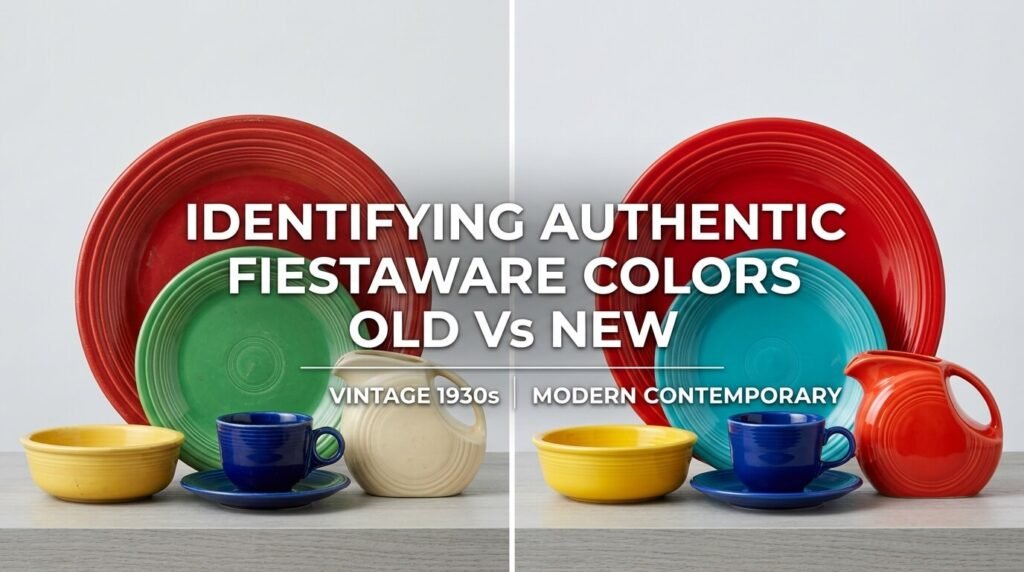
Three checks settle most identification questions before you’ve even turned the piece over twice: the base, the mark, and the color. Run them in this order, because each one narrows the possibilities faster than the last.
Step 1 — flip it over: base rings vs smooth recessed base
- Turn the piece upside down and look at the underside of the base.
- Check whether concentric rings wrap the entire base, edge to edge — that’s the vintage signature.
- A smooth, recessed base with a printed logo in the center means modern.
- Compare ring spacing to a known vintage photo if unsure. Vintage rings are tight and consistent, not a decorative afterthought.
Step 2 — read the mark: vintage ink stamp vs modern impressed logo
The mark works even when the base check is ambiguous. Vintage Fiesta carries a lowercase “fiesta” in script, either stamped in black ink under the glaze or pressed directly into the mold.
Modern Fiesta uses an uppercase “FIESTA,” almost always arranged in a circle with a three-letter date code underneath.
| Mark feature | Vintage (1936–1972) | Modern (1986–present) |
|---|---|---|
| Case | Lowercase script | Uppercase block letters |
| Layout | Linear, hand-stamped or impressed | Circular, machine-stamped |
| Date code | None | Three-letter production code |
| Lead disclosure | Absent | Often reads “Lead Free” |
How to read Fiestaware marks: a complete backstamp guide
Homer Laughlin used four distinct marks across the original 1936–1972 run, each pinning a piece to a narrower window than “vintage” alone. You’re checking wording and placement, not microscopic detail.
The four vintage marks (1937–1973) and what each tells you
| Mark | Wording | Application | What it tells you |
|---|---|---|---|
| Indented trademark | “fiesta” script, part of the mold | Molded in | Used across most of the original run |
| HLC USA stamp | “fiesta” script with H.L.C. USA | Hand-stamped under glaze | Common on mid-period pieces |
| Cross-and-arrow mark | Cross with arrow, “fiesta,” Made in U.S.A. | Stamped | Narrower window than other marks |
| Genuine Fiesta stamp | “GENUINE fiesta” with H.L.Co. USA | Hand-stamped | Often found on later original-run pieces |
Modern marks (1986–present): uppercase Fiesta and the date code
Every piece made after 1986 carries FIESTA in capital letters, arranged in a circle around a small logo.
Underneath sits a three-letter code identifying the exact month and year of production, something vintage Fiesta never had. Read that code, and you’re not holding anything from before 1986. Full stop.
When there is no mark: what unmarked pieces actually mean
An unmarked piece isn’t automatically fake. Homer Laughlin never marked small items, juice glasses, demitasse cups, salt and pepper shakers, even during the original run, and a handful of larger pieces slipped through unmarked by accident.
If the base shows full concentric rings and the color matches a documented vintage window, the missing mark shouldn’t disqualify it. Lean on shape and color instead.
Using color to date your piece: the vintage color timeline
Color works even on a piece you can’t flip over, even with no mark at all. The rule: if a color doesn’t appear anywhere in the 1936–1972 list, the piece is either modern or made by someone other than Homer Laughlin, no mark required to rule it out.
Original five colors (1936): red, cobalt blue, light green, yellow, ivory
| Color | Production window | Defining visual trait |
|---|---|---|
| Red (orange-red) | 1936–1943, 1959–1972 | Uranium-glazed pre-1944; non-uranium after 1959 |
| Cobalt Blue | 1936–1951 | Deep, saturated blue |
| Light Green | 1936–1951 | Soft, minty shade |
| Yellow | 1936–1969 | Warm, sunny tone |
| Ivory | 1936–1969 | Creamy off-white; uranium content pre-1951 |
Colors added and retired 1937–1972: the complete vintage window
| Color | Production window | Notes |
|---|---|---|
| Turquoise | 1937–1969 | Reintroduced in the modern line in 1988 |
| Rose | 1951–1959 | Part of the “50s colors” group |
| Chartreuse | 1951–1959 | Never reproduced in the modern line |
| Forest Green | 1951–1959 | Dark, olive-leaning green |
| Gray | 1951–1959 | Often called Pearl Gray |
| Medium Green | 1959–1969 | Rarest of all original colors |
See full Fiesta color history and production dates for the complete list across both eras.
The 1973–1986 gap: No authentic Fiesta was produced during these years
Homer Laughlin discontinued the original line in 1972, partly over the shift away from lead-glazed dinnerware, and the line sat dormant until 1986.
That’s 14 years with zero authentic production. Any piece claiming a date inside that window is misdated. For the full collector’s reference across both eras, see the complete Fiesta dinnerware collector’s guide.
Modern Fiesta colors (1986–present): what’s different and why it matters
The 1986 relaunch didn’t just bring old colors back; every glaze was reformulated lead-free, which changed gloss and saturation. Six core colors launched the new line: White, Black, Cobalt Blue, Rose, Apricot, and Yellow.
1986 relaunch colors vs vintage equivalents: the easy confusions
| Vintage color | Modern equivalent | Key difference |
|---|---|---|
| Cobalt Blue (1936–1951) | Cobalt Blue (1986–present) | Modern glaze is glossier and more uniform |
| Rose (1951–1959) | Rose (1986–present) | Same name, different formula and tone |
| Turquoise (1937–1969) | Turquoise (1988–present) | Visually close; check the mark to confirm era |
| — | Sapphire (1990s, limited run) | Often mistaken for vintage cobalt, sapphire is modern-only |
How to tell modern cobalt from vintage cobalt — and sapphire from both
Vintage cobalt has a muted depth with small surface imperfections from hand glazing. Modern cobalt is uniform and glossier across the whole surface.
Sapphire causes the most confusion. It’s a 1990s-only color that never existed before the relaunch, so any sapphire piece is modern, no matter how close it sits to vintage cobalt on a shelf.
The three colors that need special identification tools
Medium Green, Radioactive Red, and the colors that respond to UV light won’t give up their identity through a mark or base check alone. Mixing up which test applies to which color is the most common collector mistake.
Medium green (1959–1969): the rarest and most misidentified vintage color
Medium Green is the rarest of the eleven original colors and the most often misidentified. It’s a true medium green, not the bright spring green of 1936, not the dark olive of 1950s Forest Green.
Production ran exactly ten years, and Fiesta sales were already slowing by the time it launched, which kept volumes low.
- A complete Medium Green place setting routinely sells for $150 to $300 or more.
- A Medium Green disk pitcher alone can bring $500 to $800.
- The glaze often shows an “orange peel” texture — a known production trait, not a defect.
- If a piece is genuinely Medium Green, it’s vintage by definition. The color never came back.
Radioactive red (1936–1943): uranium glaze, Geiger counter, and the orange-cast difference
Original Fiesta red used uranium oxide in the glaze, and the U.S. government seized the country’s uranium supply for the Manhattan Project in 1943, halting production. Red returned in 1959 with a non-uranium colorant, slightly truer, less orange.
A Geiger counter registers the pre-1944 glaze above background level; the 1959–1972 red won’t. After a later school radiation scare, fifty scientists signed a joint letter calling Fiestaware among the most benign radioactive materials found in a home.
See the Fiesta dinnerware lead and cadmium safety guide for more on glaze safety.
The UV blacklight test: which colors fluoresce, and what that confirms
The blacklight and the Geiger counter test two different things. The blacklight reacts to uranium in the glaze chemistry; the Geiger counter reacts to uranium-oxide radioactivity. They’re not interchangeable, and plenty of guides blur the two together.
| Color | Blacklight result | Geiger counter result | What it confirms |
|---|---|---|---|
| Ivory (pre-1951) | Glows brightly | Background level | Pre-1951 production |
| Ivory (modern) | No fluorescence | Background level | Post-1986 piece |
| Cobalt Blue / Turquoise (some vintage) | Faint green glow, inconsistent | Background level | Suggestive only |
| Red (1936–1943) | No fluorescence | Above background | Uranium-era red |
| Red (1959–1972) | No fluorescence | Background level | Post-uranium red |
Fiesta vs Harlequin vs Riviera: the look-alike problem no one solves clearly
Fiesta, Harlequin, and Riviera came from the same factory in overlapping decades — exactly why people can’t tell them apart at a glance. Homer Laughlin made all three. Only one is Fiesta.
Why they’re confused: same manufacturer, same colors, same era
Harlequin sold exclusively through F.W. Woolworth from 1938 to 1964 at a lower price point, using many of the same glaze colors as Fiesta but different shapes.
Riviera was Homer Laughlin’s unmarked budget line from roughly 1938 to 1948. Neither carries the Fiesta name anywhere, which is why an unmarked colorful plate so often gets called Fiesta when it’s one of its siblings.
The definitive three-way identification table
| Attribute | Fiesta | Harlequin | Riviera |
|---|---|---|---|
| Base rings | Tight rings wrap the entire base | Rings only at the edge | Almost no rings |
| Handle shape | C-shaped, with rings | Triangular, V-shaped | No ring detail |
| Backstamp | Always marked | Never marked | Never marked |
| Retail origin | Department and specialty stores | Exclusively F.W. Woolworth | Discount and budget retailers |
| Typical value | $40–$1,500+ depending on color and form | 30–50% below the equivalent Fiesta | Generally the lowest of the three |
| Fastest tell | Full-base rings, C-handle | Edge rings, V-handle, no mark | Nearly flat base, no mark |
The ring pattern alone usually settles which of the three you’re holding, and Fiesta wins the value comparison in almost every matchup.
Physical tells: weight, crazing, and glaze texture
Vintage Fiesta is lighter than modern, not heavier — the most counterintuitive tell of all.
Weight: why vintage is lighter than modern (not heavier)
This trips people up because the assumption usually runs the other way. Vintage Fiesta is thinner-walled than the contemporary line, which uses a heavier ironstone-style body.
Set a modern plate next to a vintage one of the same size, and the difference is immediate — the modern piece is heavier.
Crazing, orange-peel texture, and pinhole imperfections as authenticity signals
- Crazing — fine hairline cracks in the glaze — shows up far more on vintage pieces from decades of temperature change, and doesn’t hurt value.
- Tiny bumps or pinpricks point to the less-precise manufacturing tolerances of the original era.
- The “orange peel” texture on Medium Green is a known trait of that color, not damage.
- Modern pieces rarely craze and lean toward smoother, more even glaze application.
What the rarest colors are worth: a quick collector valuation reference
Color rarity drives most of the price gap between a $40 plate and a $500 one. See the vintage Fiestaware price and value guide for full pricing details before you walk away from a find.
Value by color rarity tier
| Tier | Colors | Approx. value range | Notes |
|---|---|---|---|
| High | Medium Green, Radioactive Red (pre-1944) | $150–$1,500+ | Short windows, strong collector demand |
| Mid | Chartreuse, Forest Green, Gray | $60–$300 | 1950s colors, moderate scarcity |
| Common | Yellow, Turquoise, Ivory | $40–$150 | Longer runs, more supply |
The piece-type multiplier: why the same color matters differently by form
Color sets the baseline, but form multiplies it. A Medium Green saucer and a Medium Green disk pitcher share the same color and era, yet they don’t sell anywhere close to the same price.
- A Medium Green disk pitcher: $500–$800.
- A complete Medium Green five-piece place setting: routinely above $1,000 at auction.
- A common-color saucer in any vintage shade: often under $20.
- Discontinued shapes — the onion soup bowl, the footed compote — add a premium on top of color rarity, since they were never reproduced in the modern line.
Building a Fiesta collection means learning to spot it across every era, vintage, modern, and the lookalikes on the same thrift store shelf. See the best American-made dinnerware by era for where Fiesta fits against everything else made in those same factories and decades.
Frequently asked questions about identifying Fiestaware colors
Is the unmarked FiestaWare fake?
No. Homer Laughlin never marked small pieces like juice glasses and salt shakers, and some larger pieces slipped through unmarked. Check the base rings and color against the production timeline instead of relying on the mark alone.
What is the rarest Fiestaware color?
Medium Green, produced only from 1959 to 1969, is the rarest of the original eleven colors. A complete place setting sells for $150 to $300 or more, and the disk pitcher alone reaches $500 to $800.
Can I use a blacklight to identify all vintage Fiestaware?
No. The blacklight only works reliably on a handful of colors, mainly pre-1951 Ivory, which glows brightly from uranium in the glaze. Original Red won’t fluoresce at all — that one needs a Geiger counter.
Is radioactive red Fiestaware dangerous to own?
No. The uranium-oxide glaze used before 1944 emits low-level radiation, a panel of scientists once described as comparable to everyday household items. Most collectors choose to display these pieces rather than use them daily.
What does “Fiestaware” vs “Fiesta” (no ware) mean?
“Fiestaware” refers to the original 1936–1972 run. “Fiesta,” dropping the “ware,” is the name used for the modern line relaunched in 1986 and still in production. Collectors use the two terms to separate the eras.
Were any Fiestaware colors made between 1973 and 1986?
No. Homer Laughlin discontinued the line in 1972 and didn’t relaunch it until 1986, leaving a 14-year gap with zero authentic production. Any piece dated to this window is misidentified.
How do I tell vintage cobalt blue from modern cobalt blue?
Vintage cobalt has small surface imperfections and a muted depth from hand glazing, while modern cobalt is glossier and more uniform. If the surface looks flawless from every angle, check the base and mark before assuming vintage.
Is Harlequin worth as much as Fiestaware?
No. Harlequin generally sells for 30 to 50 percent less than the equivalent Fiesta in the same color, since it was a budget line sold exclusively through F.W. Woolworth. Edge-only base rings and triangular handles confirm Harlequin instead of Fiesta.
What is the “orange peel” texture on medium green?
It’s a slightly uneven, bumpy glaze surface that shows up almost exclusively on Medium Green pieces because of how that specific glaze fired. It’s a recognized trait of the color, not a flaw, and it can help confirm authenticity.
About the Author & Reviewer
Sarah Emirone, Author
Sarah researches and writes SafeKitchn’s dinnerware and kitchenware guides, with a focus on material safety, lead content, and manufacturer specifications. She cross-references product data sheets, safety certifications, and regulatory filings (including FDA and Prop 65 records) before publishing, and updates articles when new information becomes available.
James Daniels, Reviewer
James reviews SafeKitchn’s material safety content for scientific accuracy. He holds a B.Sc in inorganic chemistry and works as a materials researcher, with particular focus on the composition and safety behavior of glass, ceramic, and metal used in kitchenware.