

Yes, Corelle dinnerware is oven safe, but only up to 350°F (177°C) in a fully preheated conventional or convection oven, and only when you follow a specific set of handling rules that most guides mention briefly without explaining why they matter. The temperature limit is firm.
The handling rules are not optional. Break either one and you risk cracking or shattering a dish that has otherwise survived years of daily use without incident.
This guide covers everything a Corelle owner actually needs to know about oven use: the official temperature limit and what the science behind it means, the exact rules Corelle’s own use-and-care documentation specifies.
Which Corelle pieces are not oven safe, regardless of what the broader set says, what happens when things go wrong, and how Corelle compares to other options when you need to cook above 350°F.
Written by Sarah Emirone | Reviewed by James Daniels, B.Sc, Inorganic Chemist & Materials Researcher | Updated September 2026 | See How We Test | Filed under: Buying, Care & Product Guides
What the Official Corelle Oven Safety Guidance Actually Says
Corelle’s official use-and-care documentation, published on corelle.com and the Corelle Brands Asia Pacific use-and-care page, states the following rules for oven use. These are not approximations or community interpretations. They are the manufacturer’s own instructions:
- Maximum oven temperature: 350°F (177°C) in a preheated conventional or convection oven
- The oven must be fully preheated before the dish is placed inside — do not put Corelle into a cold or still-heating oven
- Add liquid to the bottom of the dish when cooking certain foods — particularly foods that release liquid during cooking
- For warming empty dinnerware (heating plates before serving), use a preheated conventional or convection oven only — not a microwave
- Corelle is not broiler safe under any conditions
- Corelle is not stovetop safe under any conditions
- Corelle mugs and stoneware accessories are not covered by the same oven safety rules as Vitrelle glass plates and bowls
Corelle’s official use-and-care documentation confirms that Corelle dinnerware can be used for warming, baking, and reheating food in a microwave oven or preheated conventional and convection ovens, and that the oven must be preheated before inserting the dish.
Every rule in this list exists for a specific reason rooted in how Vitrelle glass responds to heat. The next section explains those reasons — because understanding the “why” makes the rules easier to follow consistently and helps you recognize situations the rules don’t explicitly cover.
Why the 350°F Limit Exists: The Physics of Vitrelle Glass in the Oven
Corelle’s oven safety rules are not arbitrary. They follow directly from how Vitrelle glass is engineered and how that engineering interacts with heat.
How Vitrelle’s Three-Layer Structure Responds to Temperature
Vitrelle is a three-layer laminated glass: two outer glass layers in compression bonded to an inner core layer under tension.
This engineered stress distribution is what gives Corelle its unusual combination of lightweight construction and impact resistance. The compressed outer layers resist fracture from everyday impacts in ways that a single-layer glass of the same thickness could not.
The lamination process creates a stress pattern that makes each layer have a stress opposite to the adjacent layer. The skin layers on top and bottom are in compression, while the core is in tension. This engineered stress distribution makes the product impact-resistant.
During the tempering process, the core undergoes crystallization, transforming the material into what is, from a material science perspective, a glass-ceramic.


This same structure creates a specific vulnerability to uneven heat distribution. When a Vitrelle plate is placed in an oven environment where different parts of the plate heat at different rates, one area near a hot element, another area still cold, the three layers expand at slightly different rates.
The engineered stress pattern that protects the dish under impact becomes a liability under thermal stress: the existing compression and tension in the layers interact with the thermally induced stress, and the combined load can exceed what the material can sustain.
This is the mechanism behind the 350°F limit. Below this temperature, in a fully preheated oven where heat distribution is even, the thermal stress added to the dish remains within the material’s tolerance.
Above 350°F, or in conditions where heat distribution is uneven (an oven still climbing to temperature, a broiler element above the dish, a direct flame below it), the thermal stress can exceed the material’s tolerance and the dish fails.
What Thermal Shock Is and Why It Is the Real Enemy
Thermal shock is what happens when a material experiences a rapid and steep temperature change, not just high heat, but a sudden differential between areas of the same piece.
When a heat gradient causes various portions of an object to expand at different rates, this is known as thermal shock. This differential expansion can be thought of as either stress or strain. At some point, the stress will exceed the material’s strength, causing a crack to occur.
For Corelle users, thermal shock is more commonly the cause of breakage than exceeding the temperature limit, because it occurs in situations that feel entirely routine:
- Taking a Corelle dish straight from the refrigerator and placing it in a preheated oven
- Taking a hot Corelle dish from the oven and setting it on a cold or wet countertop
- Adding cold liquid to a hot Corelle dish still in or just removed from the oven
- Placing a Corelle dish in an oven that is still preheating — the dish heats unevenly as the oven temperature rises
If you transfer Corelle directly from the freezer to the oven, this extreme temperature change can create thermal shock, potentially causing the glassware to crack or break.
When rapid temperature changes occur, different parts of the dish expand or contract at different rates, creating stress that can lead to damage.
Frozen Corelle items should come to room temperature about 30 to 45 minutes before being placed in a preheated oven. Similarly, allow hot dishes to cool before refrigerating or freezing them.
Related: Can You Use a Plate in the Oven?
The Complete Rules for Safe Corelle Oven Use
The following rules combine Corelle’s official use-and-care guidance with the physical reasoning behind each instruction. Following all of them, not just the temperature limit, is what keeps Corelle safe in the oven over years of use.
What You Must Always Do
- Preheat the oven completely before inserting the dish. Wait until your oven signals it has reached the target temperature before placing the Corelle inside. A dish placed in a still-heating oven is exposed to uneven, rising heat, the exact thermal gradient condition that causes stress fractures. The heating elements get extremely hot to bring the internal temperature up quickly, creating intense, localized hot spots that far exceed 350°F. Placing a cool or room-temperature plate into this environment creates stress in the glass, leading to breakage.
- Let refrigerated dishes come to room temperature first. Remove any Corelle dish you intend to use in the oven from the refrigerator at least 30–45 minutes before use. For a dish taken from the freezer, allow a full hour or more. The goal is to eliminate the temperature differential between the dish and the oven before the dish enters the oven.
- Add liquid to the dish when cooking food that releases liquid. Corelle’s official documentation specifically instructs users to add liquid to the bottom of the dish when cooking certain foods. This serves two functions: it prevents the dish from experiencing the intense dry heat that an empty or near-empty dish concentrates, and it distributes heat more evenly across the dish surface.
- Place dishes on the center rack. The center rack position provides the most even heat distribution in a conventional oven and keeps the dish as far as possible from the top and bottom heating elements. Like all glass bakeware, Corelle dishes should be placed on a middle rack in the oven to prevent them from breaking. The middle rack provides the most even heat distribution and keeps your dishes away from the oven’s hottest zones.
- Use oven mitts every time. Corelle is a good heat conductor — a plate that has been in a 350°F oven for 20 minutes will be dangerously hot to handle. The lightweight feel of Corelle at room temperature creates a tactile underestimation risk that does not exist with heavier ceramic bakeware.
- Allow the dish to cool gradually after oven use. Place hot Corelle on a trivet, a folded kitchen towel, or a wooden surface — not directly on a cold stone countertop, a wet surface, or metal. The cool-down process is subject to the same thermal shock risk as the heat-up process.
What You Must Never Do
- Never exceed 350°F (177°C). The maximum oven temperature is 350°F (177°C). This is a firm limit. Pushing it higher, even to 375°F, puts your dinnerware at serious risk of breaking.
- Never use Corelle under a broiler. The broiler produces direct, intense radiant heat from above that far exceeds 350°F and creates extreme uneven heating of the dish surface. The broiler uses intense, direct, top-down heat that is much hotter than 350°F. Placing Corelle under a broiler is one of the fastest ways to make it shatter. The same rule applies to toaster ovens — never use the broil or toast setting with a Corelle plate inside.
- Never use Corelle on the stovetop. Neither gas nor electric burners are safe for Vitrelle glass. Stovetop heat is localized, direct, and far beyond the material’s thermal tolerance.
- Never place Corelle on the oven floor. The oven floor is the closest point to the bottom heating element and experiences the most intense, localized heat in the oven.
- Never heat an empty Corelle dish for an extended period. Without food to absorb and distribute heat, the dish concentrates thermal load on the glass itself. Warming an empty plate briefly in a preheated oven for serving is acceptable; extended empty heating is not.
- Never add cold liquid to a hot Corelle dish. Adding cold water, broth, or sauce to a dish just removed from or still in the oven creates an immediate thermal shock differential at the contact point.
- Never use a damaged dish in the oven. A Corelle dish with an existing chip or crack has compromised structural integrity. Under the additional thermal stress of oven use, a pre-existing damage point becomes a fracture initiation site. Discard any Corelle dishes with chips or cracks. The structural integrity has been compromised.
Which Corelle Pieces Are Not Oven Safe
Not everything sold as part of a Corelle set shares the oven safety rating of Vitrelle glass plates and bowls. This is one of the most practically important details that most buying guides treat as a footnote.
Corelle Mugs and Cups
The Corelle warranty doesn’t apply to their mugs or stoneware. Corelle mugs are made from stoneware or porcelain, not Vitrelle glass, and do not carry the same oven safety rating as the plates and bowls.
The oven safety rules for Vitrelle glass apply specifically to Vitrelle glass pieces. Mugs should not be assumed oven-safe based on the plate rating.
Stoneware Pieces in Mixed Sets
Some Corelle sets include stoneware serving pieces, larger platters, serving bowls, or baking dishes sold as part of an extended collection.
These pieces have their own oven safety ratings that may differ from the Vitrelle glass rating. Check the specific piece, not just the set description.
Accessories With Lower-Rated Attachments
The standard temperature ceiling for Corelle dinnerware is 350°F (177°C). Any attachments, such as feet or handles, have a lower safety threshold at 248°F (120°C).
Exceeding these limits can compromise the structural integrity of your dishes. If a Corelle piece has a separate foot ring, handle, or lid attachment made from a different material, that attachment’s rating — not the Vitrelle glass rating — is the limiting factor for the whole piece.
Pieces With Metallic Decoration
Corelle dishes with gold or silver metallic rim accents should not be microwaved, and their oven safety should be verified on a per-piece basis.
Metallic decoration does not automatically disqualify a piece from oven use, but it requires confirmation that the specific piece is rated for oven temperatures rather than assuming the standard Vitrelle glass rating applies.
Vintage Corelle — Exercise Additional Caution
For vintage Corelle collections, exercise additional caution. Older Corelle pieces were produced to the safety standards of their era, and Corelle’s use-and-care guidance has evolved.
If you are using pre-2005 Corelle in the oven, verify the piece’s original use-and-care instructions if available, and treat any piece with bright-pigment decoration with additional caution, given the documented lead-in-decoration concerns with pre-2005 decorated pieces.
For more on the lead safety issue, see our non-toxic dinnerware guide.
What Corelle Can Actually Do in the Oven: Practical Use Cases
The 350°F limit covers more cooking territory than many Corelle owners realize. Understanding what falls within it prevents unnecessary trips to separate bakeware.
What Works Well at 350°F or Below
The 350°F limit for Vitrelle dinnerware covers a surprising range of recipes. Frozen foods, most baked pastas, many casseroles, and oven frittatas fall at or under that mark. More specifically, the following common uses fall comfortably within Corelle’s oven rating:
- Reheating leftovers — most leftovers reheat effectively at 300–325°F; Corelle handles this without any concern
- Warming plates before serving — a preheated oven at 200–250°F warms plates for serving in 5–10 minutes
- Baked eggs and frittatas — most recipes call for 325°F
- Baked pasta dishes and casseroles — most standard casserole recipes sit at 325–350°F
- Heating frozen meals — most supermarket frozen meal instructions specify 350°F or below
- Warming bread — refreshing day-old bread at 300°F works well in a Corelle dish or plate
- Low-temperature baking — custards, bread puddings, and egg-based dishes typically bake at 300–325°F
What Requires a Different Baking Dish
Some cooking tasks require temperatures above 350°F and should not be attempted in Corelle:
- Roasting meat and vegetables — most roasting recipes call for 400°F–450°F
- Broiling — not safe in Corelle under any circumstances
- Pizza baking — typically 425°F–500°F
- High-temperature baking (artisan bread, pastry) — typically 375°F–450°F
- Any recipe calling for oven temperatures above 350°F — reach for dedicated oven-safe bakeware: cast iron, enameled cast iron, borosilicate glass (Pyrex), or oven-rated stoneware
How Corelle’s Oven Safety Compares to Other Dinnerware Options
Understanding where Corelle sits in the broader dinnerware oven safety landscape helps buyers who are considering it alongside other materials, or who need to supplement Corelle with separate bakeware for higher-temperature cooking.
Oven Safety Comparison by Material
| Material | Max Oven Temperature | Broiler Safe | Stovetop Safe | Notes |
|---|---|---|---|---|
| Corelle Vitrelle Glass | 350°F (177°C) | No | No | Preheated oven only; no thermal shock |
| Vitrified Porcelain | 500°F+ (varies by brand) | Most: no | No | Higher thermal tolerance than Vitrelle |
| Stoneware (high-fired) | 450°F–500°F (varies) | Some brands: yes | No | Better high-heat performance than Corelle |
| Borosilicate Glass (Pyrex) | 450°F (232°C) | No | No | Higher limit than Corelle; still no broiler |
| Enameled Cast Iron | 500°F+ | Yes | Yes | Best high-heat versatility; much heavier |
| Cast Iron (uncoated) | No practical upper limit | Yes | Yes | No decoration concerns; requires seasoning |
| Melamine | Not oven safe | No | No | Never oven safe under any circumstances |
| Bone China | 350°F (varies) | No | No | Similar limits to Corelle; handle carefully |
For buyers who need dinnerware that handles high-temperature roasting, broiling, or stovetop-to-oven cooking, Corelle is the wrong tool — not because it is low quality, but because Vitrelle glass is engineered for a different set of priorities (impact resistance, lightweight, non-porous hygiene) rather than thermal versatility.
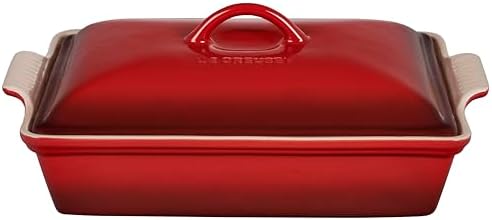
- Premium stoneware ensures excellent heat distribution for uniform browning and even cooking with no hot spots
- Superior heat retention keeps food warm or cold for serving
- Colorful glaze is nonporous, non-reactive, scratch-resistant, and resists stains and flavor absorption
Le Creuset stoneware, rated to 500°F and broiler-safe, covers the full range of oven applications. Enameled cast iron covers everything, including stovetop use. These are fundamentally different products serving a different cooking need.
For buyers who primarily need to reheat food and warm plates, which represents the majority of oven use in the average household, Corelle’s 350°F limit is rarely a practical constraint.
If you are ever uncertain whether a specific Corelle piece is oven safe, check the bottom of the piece for oven-safe markings and verify against Corelle’s use-and-care guide at corelle.com. When in doubt, use the piece in the microwave for reheating and reserve a dedicated baking dish for oven cooking above 300°F.
Frequently Asked Questions
Is all Corelle dinnerware oven safe?
Corelle Vitrelle glass plates and bowls are oven safe up to 350°F (177°C) in a preheated conventional or convection oven. Corelle mugs and stoneware accessories are not covered by this rating and should not be assumed oven safe.
Mixed-material pieces with handles or feet made from materials other than Vitrelle glass have a lower limit of 248°F (120°C) for those attachments.
Can I put Corelle in the oven to warm plates before dinner?
Yes. Warming empty plates for serving is an explicitly approved use in Corelle’s official documentation. Use a preheated conventional or convection oven — not a microwave — and keep the temperature at or below 350°F.
Brief warming at lower temperatures (200–250°F for 5–10 minutes) is the standard approach.
Can I take Corelle from the fridge directly to the oven?
No. Moving a cold dish from the refrigerator directly into a preheated oven creates the thermal shock conditions that cause cracking and shattering. Remove the dish from the refrigerator at least 30–45 minutes before oven use and allow it to come to room temperature first.
Can I use Corelle in a toaster oven?
No. Toaster ovens use heating elements positioned very close to the food surface, creating uneven, intense, localized heat that far exceeds 350°F near the elements.
The combination of high localized temperature and uneven heat distribution makes toaster ovens unsafe for Corelle regardless of the temperature setting.
What happens if I exceed 350°F with Corelle in the oven?
The dish may not fail immediately, but exceeding the rated temperature weakens the thermal stress tolerance of the Vitrelle glass structure. The dish may crack cleanly in one location, or it may shatter.
In either case, when Vitrelle glass fails under thermal stress, it fragments into sharp pieces, a more dangerous failure mode than how standard ceramic typically breaks.
Any Corelle dish that has been used above 350°F should be retired from use, even if no visible damage occurred, as the thermal overexposure may have compromised the structural integrity without producing a visible crack.
Is Corelle safe in a convection oven?
Yes. Corelle is explicitly rated for both conventional and convection ovens up to 350°F (177°C). The convection fan circulates air and promotes more even heat distribution, which is actually a slightly better oven environment for glass dinnerware than conventional oven hot spots.
The same preheating, temperature limit, and thermal shock rules apply.
Can I cook raw food in Corelle in the oven, or only reheat?
You can cook raw food in Corelle, provided the recipe temperature does not exceed 350°F, and you follow the liquid rule — add liquid to the bottom of the dish when cooking foods that release liquid during cooking.
Egg dishes, casseroles, baked pastas, and custards all cook successfully in Corelle. Dishes requiring higher temperatures, such as roasted meats, vegetables at high heat, or baked goods requiring 375°F or above, require a different baking vessel.
Does using Corelle in the oven void the warranty?
No. Oven use is an explicitly approved use case in Corelle’s official documentation and warranty. The three-year limited warranty against breaking and chipping covers normal use, which includes oven use within the specified temperature limits.
Using Corelle outside those limits above 350°F, under a broiler, or on a stovetop would constitute misuse and would not be covered.
About the Author & Reviewer
Sarah Emirone, Author
Sarah researches and writes SafeKitchn’s dinnerware and kitchenware guides, with a focus on material safety, lead content, and manufacturer specifications. She cross-references product data sheets, safety certifications, and regulatory filings (including FDA and Prop 65 records) before publishing, and updates articles when new information becomes available.
James Daniels, Reviewer
James reviews SafeKitchn’s material safety content for scientific accuracy. He holds a B.Sc in inorganic chemistry and works as a materials researcher, with particular focus on the composition and safety behavior of glass, ceramic, and metal used in kitchenware.